

ARTICLES
Written By Rich For You.

Your Last Three Hires Made You Poorer. Here's How to Check.
People are hard to find and expensive to keep. That combination punishes anyone who hires on gut. I've written plenty about the leadership side of hiring. Today is about the arithmetic, because the arithmetic is where most owners are flying blind.
Mark runs a $4M electrical company. Last spring he sat across from me, frustrated. "I've added three people in eighteen months, and I'm working harder than ever. Where's the money?"
I asked him one question. "Of those three hires, which ones paid for themselves?"
Silence. Then: "I think most of them?"
"I think" is not a number.
We pulled the numbers that afternoon with his accountant. Revenue was up 11%. Fully loaded payroll was up 23%. Gross profit per labor dollar had slid from $2.10 to $1.74. Mark hadn't built a bigger company. He'd built a more expensive one.
Every owner I talk to says the same thing: I can't find good people. They're not making it up. In NFIB's 2026 jobs report, between 84% and 87% of owners who were hiring said they got few or no qualified applicants. And in May, labor costs hit the highest reading in the survey's history as owners' single most important problem.
People are hard to find and expensive to keep. That combination punishes anyone who hires on gut.
I've written plenty about the leadership side of hiring. Today is about the arithmetic, because most owners want to feel confident their decisions are effective and need clear metrics to do so.
Headcount is a vanity metric. "We're 40 people now" sounds great at a cocktail party. It means nothing on a P&L. Forty people producing $4M is a completely different business than forty people producing $9M. Headcount tells you how big your payroll is. It tells you nothing about whether that payroll is working.
Two numbers actually matter.
Revenue per employee. Total revenue divided by full-time-equivalent headcount. This is the blunt instrument. If it's flat or falling while you keep adding people, you're buying growth instead of earning it.
Gross profit per labor dollar. Gross profit divided by total fully loaded labor cost: wages, payroll taxes, benefits, bonuses, all of it. This ratio helps you evaluate whether each dollar spent on staff generates sufficient profit and guides smarter hiring decisions.
This is the sharp instrument. It tells you how many dollars of gross profit every dollar you spend on people brings back. Benchmarks vary by industry, so set realistic targets based on your industry standards, and track your trend over time to see whether your staffing is effective.
Every hire is a ‘plus’ or a ‘minus’.
There's no neutral. A ‘plus’ hire pushes gross profit per labor dollar up after a reasonable ramp. A ‘minus’ hire drags it down and keeps it there. Use clear criteria, like performance metrics and ramp-up time, to categorize each hire and make informed staffing adjustments.
Yes, some hires are deliberate investments. A new sales leader might need nine months before the numbers show it. Make that call on purpose, with a target and a deadline, so you feel in control of your growth.
Mark's fix wasn't firing anybody. Two of his six hires were clearly pluses. Two were still ramping, so we put dates on them. Two were in roles that should never have existed (minus-hires). We redeployed one, and let the other role close through attrition. Within two quarters, his ratio was back above $2.
Your action item for today:
Grab your last 12 months of financials. Calculate gross profit per labor dollar for the quarter before each of your last three hires, then for your most recent quarter. Put it on one page. Next to each hire, write one word: plus, minus, or ramping. If ramping, write the date it has to show up by.
If you can't pull that together in an hour, that's your real answer. Knowing whether your people are paying off gives you clarity and confidence, instead of hiring in the dark.
The talent shortage is real. But when good people are this scarce and this expensive, you can't afford to hire on hope.
Stop counting heads. Count what the heads produce.

The Inspiration Myth: Why Your Team Isn't Performing
Stop waiting for magic. Here is the no-BS blueprint to engineer influence and drive relentless execution.
Stop waiting for magic. Here is the no-BS blueprint to engineer influence and drive relentless execution.

Look, let’s stop pretending inspiration is some mystical, elusive superpower. It’s not. If you want your team to execute at a high level, break through their Performance Ceiling, and actually win, you have to engineer influence.
Here are seven ways to unlock actual influence and get your people moving:
Be Authentic (Toss The Boss Mask)
People smell a fake from a mile away. To build trust, be unapologetically real. When leaders are genuine and transparent, their teams feel more confident in their authenticity and trustworthiness.
Action: Audit yourself. Know your actual values and motivations, and stop putting on a corporate mask. Share your real experiences; the wins and the failures.
Empathy is Leverage (Bump Up Your EQ)
Empathy isn't soft; it's practical. When leaders understand their team's friction points and emotions, they build connection and influence. Showing genuine care encourages openness and trust.
Action: Shut up and actively listen by asking open-ended questions, paraphrasing to confirm understanding, and observing non-verbal cues. Read the room, understand what’s driving them, and prove you care through your actions, not just your words.
Paint a Crystal-Clear Vision
Vague goals inspire nobody. A compelling, vivid picture of the future motivates leaders and builds confidence. A clear vision creates purpose and inspires teams to align and act decisively.
Action: Articulate exactly what winning looks like by sharing specific milestones, using vivid language, and illustrating how each team member's role contributes to that ultimate goal. Make sure every single person on your team knows exactly how their daily grind contributes to that ultimate goal.
Out-Execute Your Own Advice (Walk the Talk)
Your actions have to match your mouth. You cannot inspire anyone if you aren't doing the work. People are inspired by leaders who eat dirt, overcome obstacles, and keep moving forward with sheer determination. Roll up your sleeves.
Action: Align your daily behavior with your stated values. When things go sideways, tackle the adversity head-on. Show resilience and openly share the lessons you pull from the wreckage.
Stop Taking Good Work for Granted
High performance needs oxygen, and that oxygen is appreciation. When you acknowledge the grind, you build their self-belief. Give them the confidence to stretch their boundaries.
Action: Call out the small wins. Give constructive feedback, offer real support, and build a culture where people actually respect each other's hustle.
Embrace the Growth Grind
If you are stagnant, your team will be stagnant. You have to embody a growth mindset. If you aren't constantly learning and breaking your own ceilings, why should they?
Action: Actively seek out the feedback that hurts. View your failures as data points. Share your personal growth journey to give your team permission to do the same.
Eat the Stress (Be Positive)
Your attitude dictates the room's energy. If you drag your personal garbage or stress into a meeting, you poison the well. You are the leader: eat the stress and project a motivating, solution-oriented viewpoint.
Action: Find the upside in the chaos. Bring the energy, smile, and set a tone that forces everyone else to level up.
It’s Tuesday. Try one action this week.

Your Brain Believes The Rerun.
"Your brain doesn't check facts. It checks frequency. So repeat the story where you're dangerous."

Your brain is not a truth detector. It is a repetition detector.
It does not audit the story you tell it. It does not fact-check. It takes whatever line you run most often and files it under "settled."
That is why the guy who says "I'm terrible with numbers" at every dinner party is still terrible with numbers at 52. Nobody ever told him he was. He told himself, out loud, a few thousand times, and his brain did what brains do. It believed the rerun.
Here is the part that should make you sit up. You are already doing this. Right now.
You have a story running on loop about what you are, what you are not, and what you are "just not built for." You did not sit down and choose it. You inherited it from a bad quarter, a brutal boss, a deal that fell apart in 2011. And you have been rehearsing it ever since like it is scripture.
I watch this every week with owners running seven- and eight-figure companies. Smart operators. Real results. And they will tell me, straight-faced, "I'm not a sales guy."
Meanwhile, they built the entire book of business themselves. The evidence sits in their own P&L, and they cannot see it because the story is louder than the data.
So change the story. Not with affirmations. Affirmations fail because your brain knows when you are lying to it. Change it with receipts.
Write down five things you have actually pulled off. Not vibes. Facts. The client you saved. The hire you got right. The year you should not have survived and did. Then say the sentence those five facts prove. "I figure things out." "I close hard deals." "I build teams that stay." Now repeat that one. Say it before the pitch. Say it in the car. Say it when the wheels come off.
You are not inventing a new identity. You are promoting the true one and canceling the show that has been hogging the schedule.
Repetition will happen either way. That is not optional. Your brain will run something on a loop today whether you pick it or not.
The only question on the table is who writes the script.
“Your brain will believe any story that you repeat. Make sure it's a story about how capable you are.”

Your Team Meetings Stink. That's Not a Reason to Kill Them.
Most small business owners killed their team meetings because they were awful. Here are five rules that make a 15-minute meeting worth attending.

A client of mine runs a specialty contracting firm - eight million in revenue, 38 people, solid margins, great reputation. When we started working together, he told me, proudly, that he had eliminated every standing meeting in the company two years earlier. His words: "My people hated them. I hated them. So I pulled the plug."
I asked him what those meetings used to look like.
Ninety minutes. Monday mornings. One sales guy who ate twenty of them. Somebody always brought up the parking lot. Nobody ever left with a decision. His team had a nickname for it. They called it the Monday hostage situation.
He was right to kill that meeting. It was garbage.
But look at what he got in the eighteen months after: duplicated work between ops and estimating, three jobs that slipped because nobody identified a material delay, and two strong people who walked because they had no clue where the company was headed.
He didn't have a meeting problem. He had a meeting design problem. And he solved it by deleting the only structured moment his team had to align.
So we rebuilt it. Here are the rules:
1. Hold them regularly. Daily if you run a fast operational business, weekly if you don't. Same day, same time, same place, no exceptions. Irregular meetings feel like emergencies. Regular meetings feel like a heartbeat. Cancel one and you have taught your team the whole thing is optional.
2. Fifteen minutes. Hard stop. Not "about fifteen." Fifteen. Stand up if you have to. When people know it ends on the clock, they show up prepared, they get to the point, and they stop using the room to think out loud. Constraint creates clarity.
3. Consistent structure every single time. Past, present, future.
Past: what did we do, what were the numbers, what got missed.
Present: what has to happen today or this week, and who owns it.
Future: what's coming, the big client visit, the new hire, the move you're making next quarter. Three buckets. Every time. Your team stops guessing and starts preparing.
4. Recognize top performance out loud. Sixty seconds. Name the person, name the specific thing they did, say why it mattered. Public recognition costs you nothing and buys you enormous discretionary effort. It also quietly sets the standard for everyone else in the room. Do it every meeting, and mean it.
5. Shut down the drift. This is where most owners fold. You've got a talker, a prolonger, and somebody who wants to relitigate last month. Handle it live: "Good point, that's a two-person conversation; take it offline." Then move. If it happens twice with the same person, you have that conversation privately. If you won't enforce this, don't bother with rules one through four. Your discipline is the product.
My client now runs a twelve-minute daily huddle. Not because I told him to keep it. Because his team asked to keep it when he floated the idea of dropping it.
Your action this week: Put a fifteen-minute meeting on the calendar at the same time for the next five business days. Write three headers on an index card: past, present, future. Run it. End on time even if you're mid-sentence, especially if you're mid-sentence. On Friday, ask your team one question: What do you want to change about this?
Then change it, and run it again next week.

The Two Hours That Actually Move Your Company
"Work on the business" has become a phrase owners use to feel like a CEO instead of acting like one. It's the business version of saying you'll eat better. No definition. No output. No accountability.

Dave runs a $3M specialty contracting firm. He told me he works ON the business every Friday morning. So I asked him to send me what he produced last Friday. Nothing came.
Because nothing existed. He'd spent three hours answering emails in a quieter room with the door shut. That's not working on the business. That's hiding with better lighting.
Here's the part nobody says out loud. "Work on the business" has become a phrase owners use to feel like a CEO instead of acting like one. It's the business version of saying you’ll eat better. No definition. No output. No accountability.
And that's exactly why it never happens. It's not a discipline problem. It's a definition problem. Vague work loses every single time to work with a deadline attached. Your ops manager has a deadline. Your biggest client has a deadline. Your "strategic thinking time" has nothing. So it dies. Every week. For years.
So define it. Working on the business means one thing: two hours that produce something meaningful and tangible that didn’t exist before you sat down. An asset. A decision. A metric. Walk out with a sense of accomplishment, and you did it.
Here are the two hours:
Scoreboard (20 minutes).
Numbers only. Revenue, pipeline, margin, capacity. No stories, no excuses, no inbox. Just what actually happened.
Constraint (30 minutes).
One question: what is the single thing holding your company back right now? Not five things. One. Write it in a sentence a twelve-year-old understands. This clarity will give you confidence in your focus.
Build (40 minutes).
Forty minutes making the first version of the thing that attacks that constraint. You aren't building a polished final product. You are building the scaffolding. The bullet points for the new job description. The baseline parameters for the new pricing model. Build it ugly. Build it now.
Decide (30 minutes).
One decision. One owner. One date. In writing, sent to your team before you leave the room.
Four blocks. Two hours. Something real on the table every single week.
Dave started this in January. By April, he'd transformed his company. He didn't do it by trying to boil the ocean. He spent his 40-minute Build blocks writing down exactly where his estimating process was bleeding cash. He used his Decide blocks to fire his worst client and officially promote a foreman he'd been "thinking about" for two years. Same guy. Same hours. Different container.
Take Action:
Block Thursday, 7 to 9 AM, recurring, on the calendar before you close this page.
Why Thursday? Because Monday is for putting out fires, and Friday is for hiding. Thursday is when you execute. Name the meeting "Constraint." Not strategy. Not planning. Constraint. Then show up Thursday and produce one thing.

Stop Coddling Your Team: How to Kill the 3-Conversation Rule Today
I see business owners and their people pull this garbage all the time. You think you're being a "supportive leader" by softening the blow. You're not. You're just being weak, and it's killing your momentum.

Listen up. If you are running a business and find yourself having the same conversation with an employee three times before they actually change their behavior, the problem isn't them.
It's you.
I see business owners and their people pull this garbage all the time. You think you're being a "supportive leader" by softening the blow. You're not. You're just being weak, and it's killing your momentum.
Here is the infamous “HR-approved” 3-Conversation Rule (or trap as I call it), and why it is pure trash:
First Chat (The Hint): You sugarcoat the feedback with a compliment sandwich. You leave the room thinking you set them straight; they leave the room thinking they just got a glowing review.
Second Chat (The Nudge): Two weeks later, nothing has changed. You get irritated but still leave a backdoor open for their excuses. You "strongly suggest" a pivot.
Third Chat (The Explosion): You finally snap. You lay down the absolute law, remove all ambiguity, and - miraculously - the behavior changes the next day.
Why are you wasting weeks of productivity because you are afraid to look someone in the eye and tell them the truth? Recognize when a performance issue demands a direct conversation to prevent further delays and loss of momentum.
They Might Freak Out
Prepare to manage emotional reactions during your direct conversation; leaders often worry about conflict escalation, and managing emotions effectively keeps the discussion focused and productive.
Stop managing feelings and start managing performance. Here is how you can confidently turn those three exhausting meetings into one clear, effective conversation:
Cut the fluff: Drop the small talk. State the specific problem immediately to demonstrate professionalism and respect for everyone's time.
Reassure them that direct, honest conversations can strengthen trust when done correctly; leaders often fear damaging relationships, but clear, consistent talk builds credibility over time.
Demand a replay: Do not ask, "Do you understand?" They will nod. Say, "Tell me exactly what you are going to do differently the minute you walk out of this office."
The One Powerful Action Step
Write it on a sticky note. Before your next corrective meeting, write the exact, non-negotiable outcome you demand on a Post-it note so you feel more prepared and decisive. The note's brevity keeps you concise and doesn’t let you procrastinate (it takes seconds to write).
Stick it on your desk right in front of you. If you end the meeting without explicitly stating exactly what is on that piece of paper - and outlining the consequences of failing to deliver it - you failed as a leader.
What is the one tough conversation you have been avoiding this week that you need to collapse into a single meeting today?

Stop Buying Ads. Buy Your Competitor's Retirement.
There is a massive demographic shift happening right now in local business. Boomers own millions of profitable, stable companies. They are 67 years old, they are tired, and they want out.

Dave burned $140K last year on an agency promising to double his revenue.
He owns a commercial landscaping company doing $4 million a year. The agency overhauled his website and ran endless tests on landing pages.
His revenue moved exactly three percent.
Dave is exhausted. He is staring at a dashboard of useless clicks while his profit margins erode.
Your obsession with lead generation is keeping your business small. You think scaling requires building a better funnel. It does not.
The fastest path from $4 million to $8 million is buying the guy down the street.
There is a massive demographic shift happening right now in local business. Boomers own millions of profitable, stable companies. They are 67 years old, they are tired, and they want out.
Here is the brutal reality of your market right now:
Most retiring owners have no successor and zero exit plan.
They already employ the trained staff you spend months trying to recruit.
They possess a rusted-on book of business that trusts them implicitly.
They will gladly finance the deal themselves to secure their retirement income.
While you fight for scraps on Google Ads, your real growth engine is sitting on a golf course waiting for an offer.
Stop buying software and start buying market share. Execute these two zero-cost actions this week:
Pull a list of every competitor in a 50-mile radius who has been in business for over 25 years.
Call the owner directly, skip the pitch, and ask if they are tired of the daily grind and want to discuss their exit strategy over black coffee.
"While you are busy trying to build a better mousetrap, your smartest competitor just bought the cheese factory."
— Catalyst Leadership, Rich Gee

6 Key Actions To Neutralize Performance Problems.
Working with employees to resolve performance problems is one of your key leadership responsibilities.

Two years ago, a client of mine - let’s call him Marcus, the founder of a 20-person logistics firm - was bleeding talent. His best drivers were quitting, and his margins were shrinking. The root cause wasn't the market; it was David, his lead dispatcher. David was consistently sloppy, missing delivery windows by margins just small enough to debate.
Instead of addressing it, Marcus engaged in a deadly mix of hope and avoidance. He didn't want to be the "bad guy." By the time Marcus finally sat down to address the performance problem, the damage was done. The team was exhausted from covering David's tracks, and trust in Marcus’s leadership was fractured.
In a small business, you do not have the luxury of hiding an underperformer inside a massive corporate structure. Working with employees to resolve performance gaps is not just a leadership responsibility; it is an existential requirement. How well you execute this depends entirely on your preparation.
Here are the six critical actions you must take before you step into a performance intervention:
1. Document the Gap
You cannot manage what you cannot measure. You must identify both the desired and actual performance in undeniable, behavioral terms. Do not use emotional language or vague character assessments.
Weak: "You are being lazy and uncommunicative."
Fact-Based: "You missed the Monday and Wednesday 9:00 AM huddles, and your weekly reports have been submitted two days late for the last three weeks."
Weak: "Your sales numbers are disappointing."
Fact-Based: "Your target is 40 outbound calls per day; you are averaging 18."
2. Calculate the Blast Radius
Determine the exact negative impact of the problem. In a small business, nobody works in a silo. How is this behavior affecting the rest of the team? Is your top performer working weekends to cover the slack? Is the client experience degrading?
Write down the specific, measurable ways this employee's shortfall is damaging the business. You will need this to pierce through their defensiveness and show them the broader consequences of their actions.
3. Define the End Game
Identify the realistic consequences the employee will face if the performance is not immediately corrected. Write them down. Never bluff. If the consequence is a formal written warning, say so.
If the consequence is termination, you must be fully prepared to execute it. Empty threats destroy your credibility faster than anything else.
4. Establish the Precedent
In a large corporation, you look at "past practices" to see what HR did five years ago. In a small business, you are actively building the culture with every decision. Ask yourself:
How have I handled this with others?
If I let this slide, what standard am I setting for the rest of my team? Consistency is your best defense against claims of unfair treatment, but more importantly, it dictates the caliber of your company's culture.
5. Choose Your Intervention Strategy
Determine what type of discussion is actually required. Do not conflate these three distinct lanes:
Coaching: The employee has a skill gap but the right attitude. They need training, resources, or shadowing.
Course-Correction: The employee knows how to do the job but is choosing not to execute. This is a behavioral issue requiring a firm realignment of expectations.
Formal Discipline: The employee has repeatedly failed to meet documented standards, and you are beginning the formal offboarding process (PIP).
6. Fortify Your Position
Before initiating formal discipline, ensure your house is in order. In the modern business environment, a botched termination can result in frivolous lawsuits or unemployment claims that hike your insurance rates.
Review your employee handbook, ensure your documentation (from Step 1) is airtight, and if necessary, run your plan past an employment attorney (this is SO important). Measure twice, cut once.
Without question, the most critical component of solving a performance problem is your preparation. Walking into these meetings blind or driven by emotion is a rookie mistake. Preparation shapes the dialogue, strips away the emotion, and ultimately dictates whether you retain a reformed employee or successfully excise a toxic one.

AI Made Everybody Competent. These Three Things Still Separate You.

Your proposal looks great. So does your competitor's.
Your follow-up email is well written. So is theirs. Your website copy is clean, your deck is sharp, your onboarding docs are thorough. So are theirs.
That's what happened in the last two years. Competence got commoditized. The floor came up for everybody, and the stuff that used to make you look professional now just makes you look like everyone else.
So what's left?
The same three things I've been telling clients for fifteen years. I wrote this list a long time ago. I almost didn't republish it. Then I realized it's the only list that got MORE valuable, not less.
Here they are.
1. Give Them Something They Didn't Pay For
Not service. Service is table stakes. Service is what they already bought.
I'm talking about the moment where a client steps back and goes "wait, they did WHAT?" The unexpected thing. The thing that wasn't in the scope, wasn't in the invoice, and wasn't in the contract.
Look at who's winning right now. Nordstrom went private in 2025 and everyone assumed they'd coast. Instead revenue climbed 7% to $15.9 billion while Saks and Neiman Marcus were falling apart around them. They didn't win on inventory software. They won because a human being remembered you.
JetBlue's Mint cabin just took the top spot in J.D. Power's 2026 satisfaction ranking for first and business class. Second year running. Their JFK lounge got voted best airport lounge in the country. This is an airline. In an industry where nobody expects anything. They bought goodwill nobody else in the category was even bidding on.
Trader Joe's has been doing it for decades with a crew that actually talks to you and a product wall you can't get anywhere else.
None of these are technology plays. Every one of them is a decision somebody made about what the experience should feel like.
Do this today: Pick your last three clients. Find one thing you can do for each of them that costs you under an hour and wasn't on the invoice. Do it before Friday. Don't announce it. Just do it and watch what comes back.
2. Get In The Room. On Purpose.
Here's where most people get this wrong, including the version of me that wrote the first draft of this article.
The old advice was "get out and meet people." That's not advice, that's a fortune cookie. Random coffee is not a pipeline. Networking events full of people selling to each other are not a pipeline.
The real version is narrower and harder: thirty minutes a day, every weekday, spent on people who can actually move your business. Clients. Past clients. Referral sources. The three or four connectors in your market who know everybody worth knowing.
Thirty minutes. Five days a week. That's two and a half hours. You waste more than that on your phone before lunch.
And the reason this matters more now than it did in 2015 is simple. Anybody can generate outreach at infinite scale. Which means everybody is. Which means the inbox is dead and the only channel that still works is the one that requires a body in a chair.
Lunch. Coffee. A drive to their office with two sandwiches. That still converts, because almost nobody is willing to do it anymore.
Do this today: Open your calendar. Block thirty minutes tomorrow morning. Name the block. Then write down five names, and reach out to all five in that half hour. Not "someone." Five names, on paper, before you close this tab.
3. Ask. Then Shut Up.
This is the one that separates the professionals from everybody else, and it's the one nobody practices.
When I sit down with someone, I ask the boring stuff first. How's business. How's the family. Where'd you end up this summer. Basic, human, low stakes.
Then I use the only question that matters.
"Really. Tell me more."
That's it. That's the whole technique. Four words that turn a polite exchange into an actual conversation. People will tell you what's keeping them up at night if you give them ten seconds of silence and prove you're not waiting for your turn to talk.
And then you listen. Not for your opening. Not for the seam where you can slide your pitch in. You listen because their problem is genuinely more interesting than your pitch, and because the person who understands the problem best usually gets hired.
Here's the part that should worry you: everybody talks now. Everybody publishes. Everybody posts. Attention is the scarcest thing in the market, and giving it away for free is the cheapest competitive advantage available to you.
Do this today: Next conversation you have, any conversation, ask one real question and then say "really, tell me more." Then count to five before you speak again. Five full seconds. You'll be shocked what fills the gap.
The Part Nobody Wants To Hear
None of this is new. You've read versions of all three before. You probably nodded along.
And you're probably not doing any of them consistently.
That's not a knowledge problem. That's the whole game. The three companies I named up there aren't smarter than you. They just decided these things were non-negotiable and then did them ten thousand times in a row while everyone else was optimizing something on a screen.
The tools got better. The playing field got flatter. The people who go the extra mile, get in the room, and actually listen are about to get very, very hard to compete with.
Be one of them.
Pick one of the three. Do it this week. Then tell me what happened.

Turn Your People Into Idea Machines.
Your team stopped bringing you ideas. You trained them to. Somebody spoke up once. It went nowhere, or it landed on their desk as extra work. They did the math. They stopped.

Most owners think creativity is a hiring problem. It's a permission problem.
You don't recruit idea people - you stop punishing the ones already on your payroll. Somewhere along the line, pitching an idea started costing your team something.
It got ignored, or worse, it got them a second job stacked on top of the one they already had. That trade never gets put in writing. Everybody learns it anyway.
The Problem Isn't Talent. It's Your Collection System.
I coached the owner of a 22-person HVAC company outside Hartford. His dispatcher had proposed a routing change eighteen months earlier. She got no reply - not a no, just nothing. She never spoke up again, and he read that silence as her not caring.
I had him sit down with nine employees, one at a time, and ask each one the same question: "What's something you suggested that went nowhere?" He got seven answers in five days. Two were live inside a month. One cut his fuel spend by roughly $1,900 a quarter. The ideas were already in the building. He'd just built a system that swallowed them.
Four Fixes:
1. Go dig up what's buried. Before you ask for anything new, account for what you already killed. You will hear about ideas from two years ago. That's not your team being petty - that's them telling you exactly why they went quiet.
2. Stop ambushing people. The open brainstorm rewards the loudest voice in the room and hands your quiet people nothing. Send one specific question 48 hours ahead and require a written answer before anyone walks in. A client of mine runs a 40-person insurance agency and had a "no agenda, just talk" Friday meeting. I made him send one question every Wednesday: "Where did we lose a client this month and why?" Answers due Thursday at noon. His account manager wrote four sentences that exposed a renewal gap costing him eleven accounts a year. She'd known for two years. Nobody had ever asked.
3. Close every loop. Yes, no, or not yet - but answer. Track ideas the way you track leads: status, owner, date, decision. A client with three dental practices was getting one suggestion per month from 31 employees. We built a one-page log, and she reviews it Friday at 4:00, reading the decisions aloud on the team call - including the nos. Fourteen ideas came in six weeks. She killed nine publicly and explained why. The flow never slowed. People will take a no. They won't take being ignored.
4. Give them a box, not a blank page. "Any ideas?" is the laziest question an owner can ask. A manufacturing client asked his floor team for cost-saving ideas and got crickets for two months. I rewrote it: "Find me $5,000 in waste on the second shift by October 15." Six submissions in eleven days, from guys who'd never sent him an email. The winner was a pallet-staging change from a forklift operator with nineteen years there.
Do This Week:
Ask three people what idea they buried. Listen. Don't defend.
Pick one question for your next meeting and send it out 48 hours in advance. Written answers required.
Build a one-page idea log — idea, who raised it, decision, date. Review it Friday, out loud.
Rewrite your next ask with a dollar figure, a deadline, and one customer.
Your team already has the ideas. You've been collecting them wrong.

Why Your Pricing is Destroying Your Brand
You are pricing like a commodity, and as a result, the market treats you like one.

Your obsession with competitive pricing is exactly what is keeping you trapped in the single-digit millions. You think you are losing deals because your price is too high. Let me correct you: you are losing deals because your price is a red flag. You are pricing like a commodity, and as a result, the market treats you like one.
The hard truth you are currently ignoring is that your larger customers are begging to pay you more, but your cheap pricing is explicitly telling them your solution isn't robust enough to handle their scale. You aren't being out-competed; you are being out-positioned. You are fighting in a race to the bottom, and if you win, you lose.
“Signals of Value”
In the book Competitive Advantage by Michael Porter (and recently popularized by Alex Hormozi in his podcast), Porter crystallizes a concept that most business owners fundamentally misunderstand: "Signals of Value."
Customers do not buy products. They do not buy features, lines of code, or consulting hours. They buy outcomes, and they use price as the primary proxy to determine if you can actually deliver that outcome.
When you anchor your price to your internal costs, or worse, to your lowest-tier competitor, you instantly strip your offering of its credibility. Human psychology is hardwired to associate premium pricing with superior capability. Luxury brands exploit this. Elite SaaS companies weaponize it. You are completely ignoring it.
By discounting your way to a closed-won deal, you signal desperation. You signal a lack of conviction in your own product. This stalls your growth in two catastrophic ways. First, you compress your margins, strangling the cash flow required to scale operations and hire elite talent.
Second, you attract the absolute worst tier of clientele: the high-friction, low-retention buyers who will churn the second someone else offers them a cheaper deal. Your pricing strategy isn't just a financial model; it is a psychological trigger. Right now, your price tag is triggering doubt.
Time To Execute
If you want to break past your current revenue ceiling, you must transition from a cost conversation to a value conversation immediately. Here is your mandate. Execute this rigid, three-step framework today.
Step 1: Audit and Isolate the Commodity
Look at your current pitch deck and pricing page. Highlight every single line item that your competitor also offers. That is your commodity list, and it is trash. You can no longer compete on these metrics.
Strip the conversation of deliverables, hours, and features. Rewrite your pricing model entirely around the financial or operational impact you deliver to the client. You are no longer selling software or services; you are selling the definitive solution to their most expensive problem.
Step 2: Engineer the Premium Anchor
Take your current highest price tier and triple it. Do not hesitate. Build an offering that justifies this new price point by bundling unparalleled access, speed, or done-for-you implementation.
Introduce this tier to every single prospect going forward. You will not sell this to everyone, and that is exactly the point. This tier serves as your ultimate signal of value. It anchors the prospect's expectations so high that your standard, newly elevated pricing suddenly feels like an undeniable strategic investment rather than a bloated expense.
Step 3: Restructure the Sales Narrative
Fire the salespeople who apologize for your pricing. Train your revenue team to ruthlessly defend value rather than justify cost.
When a prospect inevitably pushes back on the price, the response is never a discount. The response is: "Our pricing reflects the absolute certainty of the outcome. If you are looking for the cheapest vendor, we are not a fit. If you are looking for the vendor who will solve this problem permanently, this is what it costs." Own the price. Demand respect.
Final Thoughts
Pricing is the ultimate test of a business owner’s conviction. If you flinch when you state your price, you do not believe in the value of your own company. The market will always pay a premium for certainty, prestige, and results. Stop letting fear dictate your margins. Raise your prices, elevate your positioning, and force the market to respect the signals of value you project. Execute.

The Multi-Triangulation of Compensation
The idea that "hard work equals more money" is the biggest fairy tale in the corporate world. If you think putting in 60-hour weeks, grinding through weekends, and sweating over your keyboard automatically entitles you to a larger slice of the pie, you are playing a game that doesn't exist. Hard work is the baseline. It keeps you from getting fired. It does not dictate your compensation.

The idea that "hard work equals more money" is one of the biggest fairy tales in the corporate world.
If you think putting in 60-hour weeks, grinding through weekends, and sweating over your
keyboard automatically entitles you to a larger slice of the pie, you are playing a game that
doesn't exist. Hard work is the baseline. It keeps you from getting fired. It does not dictate your
compensation.
Your salary is not a merit badge for effort. It is the output of a complex, often invisible algorithm your manager runs behind closed doors. I call it the multi-triangulation of compensation.
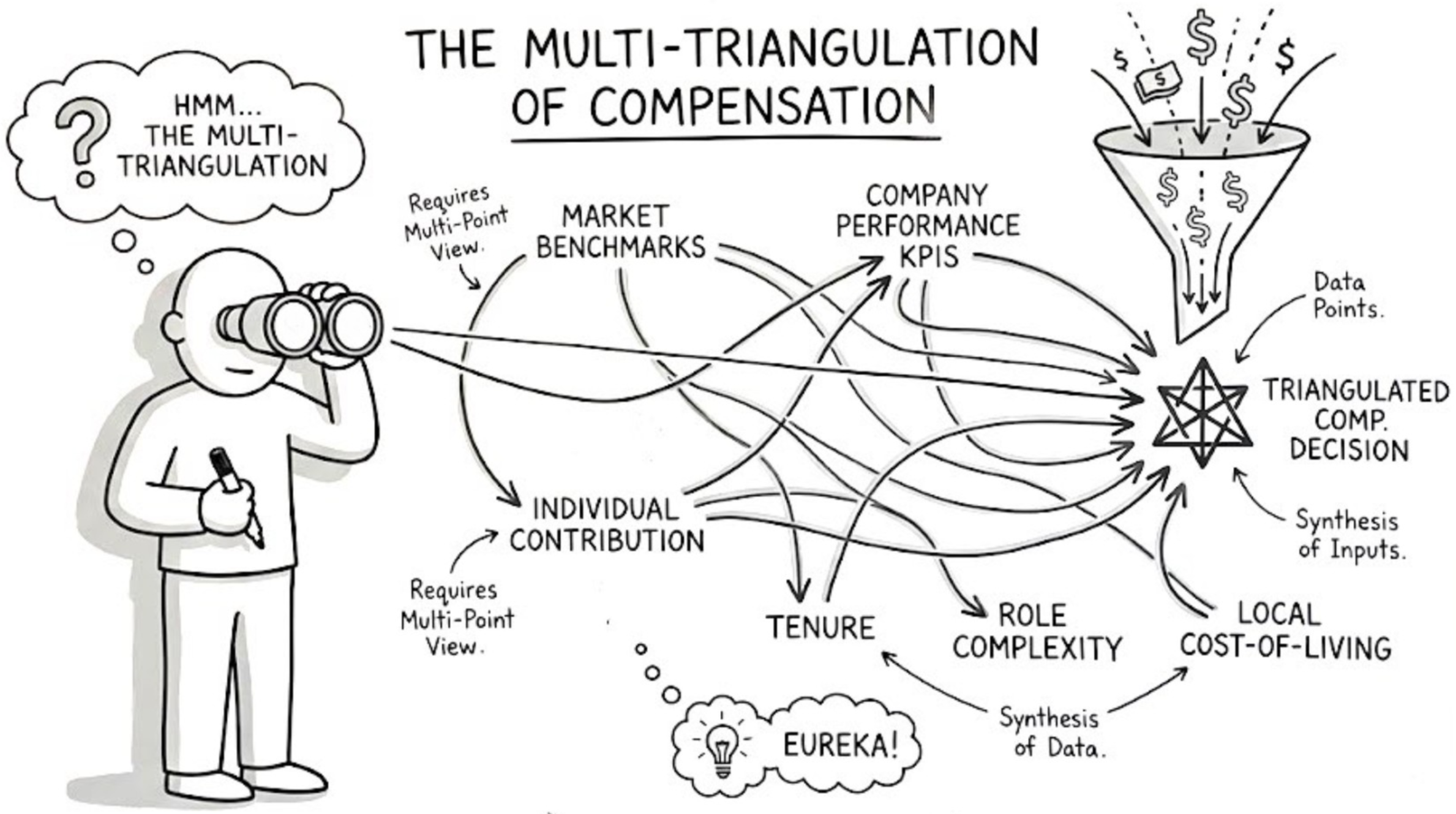
When your boss is sitting in a room looking at a spreadsheet of merit increases, they are
balancing leverage, perception, and corporate bureaucracy. Here is what they are actually
taking into consideration:
The Friction of Replacement: How much operational pain will they suffer if you walk out
the door tomorrow? If they can replace you with someone 20% cheaper in two weeks, your
leverage is zero.
The Likability Factor: Let's be ruthless—managers advocate for people they like and
appreciate. If you are a high performer but a massive pain to manage, your boss will
subconsciously cap your pay to avoid rewarding your behavior.
Actual Bottom-Line Impact: Did your work make the company money, save the company
money, or mitigate a massive risk? "I worked really hard on this deck" means nothing. "This
deck closed a $500k account" means everything.
The Health of the Business: You could be the best player on the team, but if the
department's budget is bleeding out, or the company missed its quarterly targets, the well is
dry.
The Manager's Political Capital: To get you a significant bump, your manager has to go to
their boss and spend political capital. Do they have the relationship, the track record, and
the spine to fight for you?
HR's Stranglehold: Human Resources operates on salary bands, equity caps, and internal
parity constraints. Your manager might want to give you a 15% raise, but HR will block it to
prevent "market misalignment."
The Domino Effect (Peer Parity): Your boss knows that if they give you a massive bump, it
leaks. They are calculating: If I give this to you, do I have to give it to the other three people at
your level?
Future Runway: Are you capping out in your current role, or are they grooming you for
leadership? Compensation is often a retention tool for future value, not a reward for past
performance.
If you are only focusing on the output of your daily tasks, you are blind to 80% of the board. So, what do you do about it? You stop complaining about fairness, and you start playing the actual game.
Your Action Plan
1. Speak the Language of Money
Stop tracking your hours and start tracking your impact. When you sit down for a compensation discussion, do not talk about how hard you worked. Bring a documented list of how your specific actions drove revenue, cut costs, or streamlined operations. Draw a straight line from your desk to the company's bank account.
2. Arm Your Boss for the Fight
Your manager has to justify your raise to HR and their boss. Do not make them do the homework. Build the business case for them. Give them the data, the market research, and the performance metrics so that when HR pushes back, your boss has the exact ammunition needed to win the argument.
3. Deliberately Increase Your Replacement Cost
Become the bottleneck for something critical. Own a client relationship, master a proprietary
system, or become the only person who knows how to navigate a specific regulatory headache.
When your manager runs the calculus of you leaving, the thought needs to give them a
migraine.
4. Audit Your Relationship Capital
Look in the mirror. Are you high-maintenance? Do you complain constantly? Do you create
fires your boss has to put out? If you are a drag on your manager's energy, they will not fight
for you. Be the person who solves problems before they reach their desk. Make their life easier,
and they will want to keep you around.
5. Read the Macro Environment
Timing is everything. If the company just announced layoffs or missed earnings, do not ask for a raise. You will look completely out of touch with the business reality. Wait for a win—either yours, your department's, or the company's—and ask when the iron is hot.
If you want to get paid, stop acting like a worker bee waiting for a gold star and start acting like a business of one. But in the end, go and ask for more money if you deserve it. Today.

The $100,000 Reply You Never Sent.
Overwhelm is the socially acceptable name for a much uglier truth. You are not too busy to send a two-second reply. Nobody is. You are avoiding.
Last month, I ran a discovery call with a business owner who was, in his own words, running on empty.
Better part of 10 years running his own consulting practice. A team he'd built one hire at a time. Chronic staff/client turnover - every time he delegated authority, his team either screwed up or the client left. He hadn't taken a real week off in years. He routinely answered client calls from his vacation, on the weekend, at three in the morning - you get the gist.
He said yes to coaching. He meant it. I could see the relief on his face.
I sent him his welcome packet and invoice, and we scheduled a 2-hour kickoff session. He quickly accepted.
Then he mysteriously declined our kickoff invite the day before and stopped responding. I reached out and gave him three options in a follow-up email with a graceful exit built into option three: "Just tell me you've changed your mind. No hard feelings."
Nothing. Dead Air. Silence from a man running a business in trouble with staff and clients who depended on him.
I could tell you I was annoyed. That would be honest. But it isn't the point of this article - because if you're reading this, here's what you need to hear:
His silence wasn't rude. It was a diagnosis.
The exact same diagnosis he would have paid me for over twelve months of coaching. He got it for free. He just didn't recognize it.
Ghosting Isn't Overwhelm
Business owners at $1M–$10M love the word overwhelm. It's the cover story we tell ourselves for the emails we don't answer, the decisions we don't make, the calls we duck, and the confrontations we defer.
"I've been slammed."
"I meant to get back to you."
"It's been crazy."
Overwhelm is the socially acceptable name for a much uglier truth.
You are not too busy to send a two-second reply. Nobody is. You are avoiding.
Overwhelm makes you fail at hard tasks. It makes you drop the ball on complex asks. Overwhelm doesn't stop you from typing a single digit into a text field. The moment the ask becomes smaller than the response, you are no longer overwhelmed. You are choosing. And the choice is: "I don't want to feel what responding would make me feel."
That's not overwhelm. That's avoidance with better PR.
The Silence Is the Diagnosis
Every owner I've ever coached who ran a chaotic business ran a chaotic personal operating system underneath it. And the tell wasn't in the P&L or the org chart. It was in the ghosts.
The vendor invoice they ignored for nine weeks.
The employee they should have fired six months ago.
Moving their accountant’s critical email to a folder and forgetting to follow up on time.
If you're the person on the receiving end of that pattern, it feels like rudeness. It's not. It's a signature.
The person is showing you exactly how they process any input with a decision cost attached: They Don't. They put it in the pile. They wait-hope-wish it goes away. And when it doesn't, they resent the person still asking.
Which brings me to the mirror.
If You're Ghosting People, They Already Know
Read this next part twice.
Every time you decide not to respond to someone - the vendor, the employee, the client - you are not making one small logistical choice. You are broadcasting your operating system to the person on the other end.
You are telling them: "When something has a decision cost, I go dark. Do not depend on me to close a loop. Do not trust me with anything that requires a yes or a no."
Your team knows this about you.
Your vendors know this about you.
Your family knows this about you.
Your prospects know it three minutes into a phone call.
The people around you have already mapped your ghosting pattern, and they've adapted to it - usually by working around you instead of through you.
That is how you became the bottleneck of your own business.
You didn't build a company to become its biggest obstacle. But you didn't build it that way either. You built it exactly this way. Every ghost is a brick in your Performance Ceiling. Every unanswered email is another row of masonry between where you are and where you should be. And you've been laying them yourself, one by one, for years.
What It's Actually Costing You
The owner I opened this article with - the one who went silent on me - was about to pay me to fix the exact behavior he just demonstrated. He would have been shocked to hear that his ghosting me was the thing coaching was going to address. But it was. Because the ghost is never one-off. It's the operating system.
He'll ghost his next senior hire the same way.
He'll ghost his next partner conversation the same way.
He'll ghost the acquisition offer that finally comes across his desk the same way.
And each of those ghosts will cost him tens of thousands, or hundreds of thousands, or the whole business.
He doesn't see the meter running because ghosting is silent - that's the entire point of it. There's no invoice for the deal you didn't close, the manager you didn't retain, the coach you didn't hire, the marriage you didn't save. No line item. No paper trail. Just a slow, quiet drift downward that you eventually mistake for a bad economy or bad luck.
But the meter is running. It's always running.
The Two-Second Rule
I'll give you the discipline in one sentence: if the response is shorter than the excuse, you have no excuse.
"Not this time." Two seconds.
"Yes . . . next Tuesday works." Two seconds.
"No, I've decided against it." Two seconds.
"Not now . . . ask me in Q3." Three seconds.
That's it. There is no email, text, or message from a serious human being in your professional life that legitimately requires more than that. Not one. Every longer message is either a real conversation you owe them, or a decision you're avoiding. There is no third category.
If you can't send the two-second reply, the problem isn't your calendar. The problem is that you don't want to say the thing that a two-second reply would say. Which means the actual work isn't clearing your inbox — it's figuring out what you're afraid of saying and why.
That's the work.
That's coaching.
That's leadership.
The Door I Left Open
I closed the file on that business owner last week. He may surface again in twelve or eighteen months - more broken, more ready. If he does, we'll talk. The door stays open. But I won't chase him, and I won't follow up.
Because coaching a ghost isn't coaching. It's babysitting.
And if you recognized yourself anywhere in this article - if there is a person on your list right now you owe a two-second reply to and haven't sent - you already know what the next move is.
Send it. Right now. Before you finish reading this sentence.
That's the whole game - Rich

The Tom Hanks Standard: Stop Negotiating the Minimum Requirements of the Job
If you are a manager negotiating with your team, you do not have a team. You have dependents. Here is how the Tom Hanks standard translates directly to business performance - and how to enforce it.

Tom Hanks is universally branded as the nicest guy in Hollywood. But do not confuse professional grace with a tolerance for amateur hour.
He didn't learn his work ethic on a pampered movie set. He credits the great stage director Dan Sullivan with teaching him the ruthless reality of the work (link). During an actors’ roundtable, Hanks recalled Sullivan's baseline expectations, stripping the job down to its brutal, mechanical core and laying out the absolute minimum for what it takes to be a professional:
"And you’ve got to show up. You've got to be here on time.
You've got to know the text, and you've got to have an idea cuz I can't do this all myself."
Hanks isn’t describing excellence here. He is describing the operating minimums. Yet, in corporate boardrooms and executive suites everywhere, leaders are exhausted, burnt out, and doing the work of five people because they are treating these basic tenets of employment as stretch goals.
If you are a manager negotiating with your team for these five components, you do not have a team. You have dependents. Here is how the Tom Hanks standard translates directly to business performance - and how to enforce it.
1. "You've got to show up." (Presence)
This is not a metric of physical attendance. Swiping a badge or logging into a Zoom call does not mean someone has shown up; it just means they aren't absent.
Showing up means bringing actual, focused mental bandwidth to the room. In too many organizations, passive observers are allowed to exist as dead weight, hiding in the back of meetings they have no business being in. If an employee is at the table, they need to be in the game. If they have nothing to contribute to the outcome, they should decline the invite. You are paying for impact, not an audience.
2. "You've got to be here on time." (Discipline)
Being late is not a quirk; it is a theft of collective momentum. When a team member strolls in five minutes late, they are signaling that their time is infinitely more valuable than the time of everyone else sitting at the table.
It is the most basic metric of operational reliability. If a manager or an associate cannot manage their own calendar, they have surrendered the right to be trusted with managing a project, a P&L, or a client relationship. Schedules are absolute. Tolerate chronic lateness, and you are actively endorsing a culture of disrespect.
3. "You've got to know the text." (Preparation)
There is no excuse for zero-catch-up meetings. The text is the data, the financial brief, the historical context, and the project objective.
Do the homework. A leader should never have to burn the first twenty minutes of an expensive meeting reading facts to people who were already sent the deck. When your team arrives without knowing the material, they are outsourcing their preparation to you. If they haven't read the script, they have no business being on the stage.
4. "You’ve got to have an idea..." (Initiative)
This is the hard, definitive line separating an order-taker from a professional. Anyone can spot a problem—that requires zero skill. Fixing it requires skin in the game.
Your team should never walk into your office with a problem unless they are carrying at least one viable solution in the other hand. Having an idea proves they are thinking critically about the business, rather than just processing tasks. If they rely on you for all the answers, you are not managing them; you are doing their job for them. They are paid to think. Make them do it.
5. "...cuz I can't do this all myself." (Accountability)
This is the raw reality of scaling any operation. A leader’s job is to direct the play, cast the right people, and ensure the vision is executed. You cannot act out every part.
If you are doing the heavy lifting on both ideation and execution, your team is failing you. But more importantly, you are failing your business by allowing it to continue. If your team is showing up late, unprepared, and empty-handed, it is because you have proven to them that this behavior is survivable.
Set the standard. Tell them what the baseline is. And the next time someone walks in unprepared, look them in the eye, tell them they aren't ready for the conversation, and walk away. Defend the standard, or stop complaining about the results.

The Client Who's Quietly Leaving
They're not complaining. They're not calling. That's the warning sign.

A coaching client of mine runs a seven-figure boutique agency.
Last week, he sat in my office and bragged about his most profitable account.
"They're completely hands-off," he said. "No pushback on the last two invoices. No emergency emails. We're on autopilot."
I told him he was about to lose the contract.
He laughed. Three days later, they canceled.
The Danger of Silence
They're not complaining. They're not calling. That's the warning sign.
Most business owners treat silence as a victory. You think no news is good news, and that a quiet client is a happy client.
That is a weak, dangerous mindset.
A quiet client is a client who has already mentally checked out. When they stop fighting you on strategy, asking for revisions, or demanding your time, they haven't achieved nirvana.
They have simply given up on you and started looking for someone else to solve their problem.
Here is the reality of client retention:
Friction is engagement. A client who complains still cares about the outcome of your work.
Apathy is the exit door. Silence means they no longer believe you are capable of fixing the issue.
Autopilot is a myth. If you aren't actively proving your value every single month, you are just an expense line waiting to be cut.
The Execution
Stop waiting for the cancellation email. Execute these two directives before you leave your desk today.
1. The "Red Flag" Audit Pull up your active client roster immediately. Highlight anyone who hasn't asked a question, requested a meeting, or pushed back on a deliverable in the last 30 days. Treat these accounts as active emergencies.
2. The Disruption Call Pick up the phone and call the biggest "quiet" client on that list. Do not ask, "How are things going?" Ask, "What is the one thing we are failing to deliver for you right now?" Force the friction.
"The most important thing in communication is hearing what isn't said." — Peter Drucker

The 90-Day Reset That Will Save Your Business.
One quarter is enough time to completely change the trajectory of your business - if you know what to touch first.

A second-generation service contractor sat across from me last year. He was completely burned out.
He had seen flat revenue for three quarters and was grinding 70-hour weeks just to keep the lights on, missing dinners with his family.
He handed me a massive, spiral-bound "5-Year Strategic Vision" he had paid a consulting firm five figures to build.
I looked at him and said, "Steve, we don't need a five-year vision right now. We need to get you breathing again."
When your daily operations are choking you, a five-year plan is just a distraction from the real work. We instituted a 90-day reset.
Here is exactly how we broke it down to completely change his state and his business:
Days 1–30: Stopping the Bleed
We did not add a single new initiative. We practiced pure Addition by Subtraction. We audited his client list and fired the bottom 15% - the legacy accounts that demanded the most attention but yielded the lowest margins. Immediately, his team stopped putting out fires and started doing the work that actually paid the bills.
Days 31–60: Smashing the Founder Bottleneck
He was the bottleneck for every decision. If a truck needed a $50 part, he had to approve it. We mapped out his daily friction points and transferred that authority to his lead techs. We gave them budgets and let them make the calls. He was terrified for a week, and then he felt a massive weight lift off his chest. Give your people the chance to step up, and they will.
Days 61–90: Building Momentum
With his time freed up and the toxic clients gone, we focused on agility. He started answering the phone with energy again. We targeted two high-margin commercial accounts he previously didn't have the bandwidth to chase, and he closed them both using pure moxie and follow-through.
Within one quarter, he took back 20 hours of his week, and his profitability jumped 14%.
Most owners are paralyzed by the sheer volume of things they think they need to fix. They try to overhaul the entire machine at once, get completely overwhelmed, and stay stuck.
Here is the truth: One quarter is enough time to completely change the trajectory of your business—if you know what to touch first.
You are hitting The Performance Ceiling not because you lack work ethic, but because you lack focus.
Addition by Subtraction is your superpower. You grow by cutting the dead weight and the energy vampires.
Focus creates momentum. Isolate one core operational bottleneck. Crush it.
Massive action beats perfect planning. Test it, break it, adjust it in real-time.
Do This Today:
Fire your worst client. Identify the one account that drains your team's energy, destroys your joy, and eats your margins. Protect your culture. Let them go by Friday.
Empower your team. Pick one operational decision you currently bottleneck because you want to control it. Give that authority to your team permanently.
"The path to success is to take massive, determined action." - Tony Robbins

Your First Office Manager Isn't an Expense. They Are Your Escape Hatch.
The fear of letting go of control is keeping you small. An experienced, highly competent office manager or executive assistant is not a secretary. They are the operational glue that allows you to step out of the weeds. They are the multiplier that takes you from a stressed-out operator to a true business owner.

You hit $1.5 million in revenue. Your crews are out in the field, your schedule is booked solid, and you are... sitting at your kitchen table at 7:00 PM fighting with QuickBooks and returning voicemails.
You know you need help - but you are terrified of making your first non-revenue-generating hire. You look at a $65,000 to $80,000 salary for an experienced office manager and see pure overhead eating into your margins. You tell yourself, "I can just handle the paperwork on the weekends."
Here is the math you are actively ignoring: Your time as the owner is worth at least $300 to $500 an hour when you are closing deals, building partnerships, or expanding your service footprint.
Every time you spend two hours chasing down a late invoice, routing a truck, or playing phone tag with a prospect, you are paying someone $500 an hour to do a $30-an-hour job. That someone is you.
It is financial sabotage masquerading as being frugal.
The fear of letting go of control is keeping you small. An experienced, highly competent office manager or executive assistant is not a secretary. They are the operational glue that allows you to step out of the weeds. They are the multiplier that takes you from a stressed-out operator to a true business owner.
Bringing in a professional to run your back office is the single most profitable move a service business can make. It buys back your time to actually grow the company.
Stop stepping over dollars to pick up dimes. Here is how you execute this hire immediately.
The "Buyback" Strategy
Starting right now, you are going to replace yourself in the office.
1. Hire for Competence, Not Cheapness
Do not hire your cousin, and do not hire the cheapest entry-level candidate on a job board (too many of my clients do this and fail).
You are not looking for someone you have to micromanage. You are looking for a seasoned professional who will look at your chaotic systems, reorganize them, and tell you where you need to be. Pay them what they are worth. Your decision will pay for itself in new business within 90 days.
2. Hand Over the Keys
Once they are through the door, give them the CRM, the schedule, the intake phone line, and the billing. Your job is to train them on the standard, not look over their shoulder every ten minutes.
3. The 30-Day Test
If you are still checking the general inbox or answering the main phone line 30 days after they start, you have failed the transition. Get out of their way. Use those 20 reclaimed hours a week to generate revenue, negotiate better vendor rates, or build out your next service tier.
Your business will never scale exponentially until you fire yourself from the admin desk.

Signs You Are Underpricing Your Services: The 20-Minute Fix.
Most business owners are undercharging by 15 to 20 percent right now. You are leaving pure, unadulterated profit on the table because you are terrified a client might walk.

I sat down with a client last week - Dave’s accounting firm was pulling in $3 million, but his margins were bleeding out on the office floor. He was exhausted, grinding 70-hour weeks, and complaining about "the economy."
I told him to open his P&L and pull his last twenty invoices. Within ten minutes, the room went dead silent. Dave wasn't losing to the economy. He was losing to his own fear. He hadn't raised prices on his core legacy clients in four years.
Here is the brutal reality: Most business owners are undercharging by 15 to 20 percent right now. You are leaving pure, unadulterated profit on the table because you are terrified a client might walk. But if you look at your own books - the rising cost of goods, the labor hikes, the inflation you have quietly absorbed just to "keep the peace" - the data screams the truth.
By swallowing those costs, you aren't being a loyal partner. You are literally funding your clients' businesses with your own money. It crushes your cash flow, completely kills your ability to hit that 20–25% annual growth target, and guarantees burnout.
You don't need a massive strategy overhaul to fix this. You need a 20-minute audit and a spine.
The Legacy Client X-Ray
Pull the files for your ten oldest clients. Compare exactly what they pay today versus what a brand-new client pays for the exact same deliverable. If the gap is more than 10%, you have a massive leak. You are penalizing yourself for their tenure.
The Margin Stress Test
Look at your direct costs from twenty-four months ago versus today. Have you passed those exact percentage increases along? If your costs went up 18% and your prices only went up 5%, you are actively deciding to take a pay cut. Calculate the spread, pick up the phone, and correct the baseline immediately.
"Underpricing isn't a customer loyalty program: it's a coward tax you pay to avoid a ten-minute conversation. Stop apologizing for your value and start invoicing for it."

You Aren't Stuck. You're Paralyzed. Here is the Cure.
You think you’ve tried everything. You think the market is dead, your team is tapped out, and your business has flatlined. You are officially stuck, and you don’t know where to turn.
Look up. The sky is right there. You just have to climb out.

You think you’ve tried everything. You think the market is dead, your team is tapped out, and your business has flatlined. You are officially stuck, and you don’t know where to turn.
Let me tell you about a client I had recently - David runs an $4M B2B services firm. For two years, his revenue hasn’t moved a single inch. When he came to me, he was exhausted. He was pulling 70-hour weeks, micromanaging his sales team, rewriting marketing copy, and drowning in the daily grind. He sat in my office and said, "I’ve pulled every lever. Nothing works. The industry is just soft right now."
I looked right at him and told him the truth: "The industry isn't soft, David. You are."
David was suffering from a classic psychological condition called Learned Helplessness.
Coined by psychologist Martin Seligman, learned helplessness happens when you endure repeated failures or roadblocks and eventually conclude that you have zero control over the outcome. You stop trying to find new solutions because your brain has been conditioned to believe that nothing will work. You become blind to the opportunities right in front of your face.
I see this constantly. Business leaders dig themselves into a 20-foot hole of busywork, obsolete strategies, and self-pity. They are standing at the bottom, staring at the dirt, complaining that it’s dark.
Look up. The sky is right there. You just have to climb out.
If you are stuck in a stagnant business and feeling paralyzed, hoping for a miracle won't save you. You need to reset your mental hard drive, reclaim your moxie, and start executing.
Here is your 3-step action plan to break the paralysis and get back to growing.
Step 1: Drop the Shovel (Pattern Interrupt)
You cannot solve a problem using the exact same routine that created it. If you are stuck, your current daily actions are actively contributing to your stagnation.
Take Action: Stop digging. Cut the busywork that makes you feel productive but yields zero ROI. Eliminate the "Management Tax" you are imposing on your team by micromanaging things that don't matter.
Take 24 hours entirely away from the business. Go for a drive, sit in a room with a whiteboard, or go to the gym. You need a brutal, physical pattern interrupt to snap your brain out of the loop of learned helplessness.
Step 2: Audit the Horizon (Cognitive Reframing)
When you are down in the hole, all you see is dirt - the lost deals, the annoying emails, the minor operational fires. You are leading with emotion and exhaustion, not data and strategy.
Take Action: Climb out of the hole and look at the facts. Strip away your emotional attachment to the strategies that are failing. Ask yourself the hard questions: What would a ruthless competitor do to put me out of business right now? Where is the actual leverage in my market?
Force yourself to write down five radical, positive options you have completely ignored because they felt too risky, too expensive, or too uncomfortable. You haven't tried everything; you’ve only tried everything you are comfortable with.
Step 3: Deploy the Micro-Pivot (Agile Execution)
The antidote to stagnation is not a massive, perfect, 100-point strategic overhaul. The antidote to stagnation is momentum. Overthinking creates paralysis; action creates clarity.
Take Action: Pick one of the uncomfortable options from Step 2 and execute a micro-pivot immediately. Make the phone call you’ve been dreading. Kill the underperforming product line today. Hire the expert. Send the aggressive proposal.
You need to prove to your own brain that you are back in the driver's seat. Business agility isn't about being reckless; it's about making decisive, rapid moves to test the market and generate momentum.
You are the architect of your own stagnation, which is the best news in the world.
Why? Because it means YOU are also the only one who can engineer the breakout. Stop staring at the dirt, look up at the sky, and start climbing.

Your Company Can’t Scale Until You Stop Being the Hero
Catalyst Leadership is about igniting transformation and ensuring every person in the room is part of a shared mission. As a leader, you don’t need to play every note. Your role is to bring together multiple experts and create a shared sense of purpose and belonging.

When Leonard Bernstein first took the conductor’s podium at the New York Philharmonic in the late 1950s, he faced an orchestra of accomplished, occasionally arrogant prima donnas. They knew their instruments better than he did.
But Bernstein didn't try to out-play them. Instead, he combined undeniable musical insight with clear, unwavering direction. He bridged authority with empathy, turning a group of individual virtuosos into a cohesive, world-class force.
How often do we assume leadership means diving in headfirst, micromanaging tasks, or being the loudest voice in the room? In my twenty years of coaching business owners, I see it constantly. Leaders try to do everything, making the high-level strategic calls while grinding through the daily grunt work.
That is the “solo player” approach. You might be the absolute best at a specific operational role, but by hogging the instrument, you cap your organization's potential and stifle your team.
To truly embrace the conductor mindset, you need to step off the stage and onto the podium, much like Bernstein did, to lead with purpose.
The Conductor’s Mindset
Leadership is about igniting transformation and ensuring every person in the room is part of a shared mission. As a leader, you don’t need to play every note. Your role is to bring together multiple experts and create a shared sense of purpose and belonging.
Here is how that manifests in your daily operations:
Unwavering Vision: Everyone in your organization must know the overarching piece you’re trying to achieve. There are no hidden agendas; you wave the baton for all to see.
Strategic Empowerment: Your team members have unique gifts. Do not overshadow them. Shape how their individual contributions fit into the grand design, helping them feel valued and capable.
Ruthless Focus: A conductor can’t let the orchestra drift mid-performance. Master the interplay of sales, operations, marketing, and finance, and keep the tempo. Don’t allow random side projects or internal politics to derail your core mission.
From Player to Conductor
To make this shift immediately, implement Team Sprints.
Once a quarter, gather your team for a one- or two-week sprint focused on a side challenge (one that has been on the back burner for a while), with you defining the objective and setting the tempo, then stepping back to let the team lead.
Let them interpret the challenge in their own creative way. Conclude with a celebratory rundown of results that showcases what your team achieved, fostering pride and a sense of accomplishment.
Final Thoughts
To remain a do-it-all hero is to remain a mere player. If you want to orchestrate a movement that outlasts you, you have to lead.
As Beethoven said, “To play a wrong note is insignificant; to play without passion is inexcusable.” Leave the self-limiting soloist mindset behind, lead with unstoppable conviction, and orchestrate the show your industry never saw coming.