Cannibalize Yourself, or Someone Else Will

In 2005, Apple’s iPod was a cultural phenomenon. It accounted for a massive portion of the company's revenue and was practically printing cash. Most executives would have milked that product line for another decade, fighting off copycats while margins slowly bled out.
Steve Jobs didn’t. He recognized that the iPod was nearing the top of its growth curve. Phones were getting smarter, and eventually, a phone would play music. If anyone was going to render the iPod obsolete, Jobs decided it would be him.
The critical phase, and the point where Jobs excelled, is understanding that the investment for the next S-curve must be heavily funded during the surge of the current one.
That is the point of maximum capital, influence, and capability. He didn't wait. He diverted significant resources, people, and money from his most profitable division to fund a secret project: the iPhone.
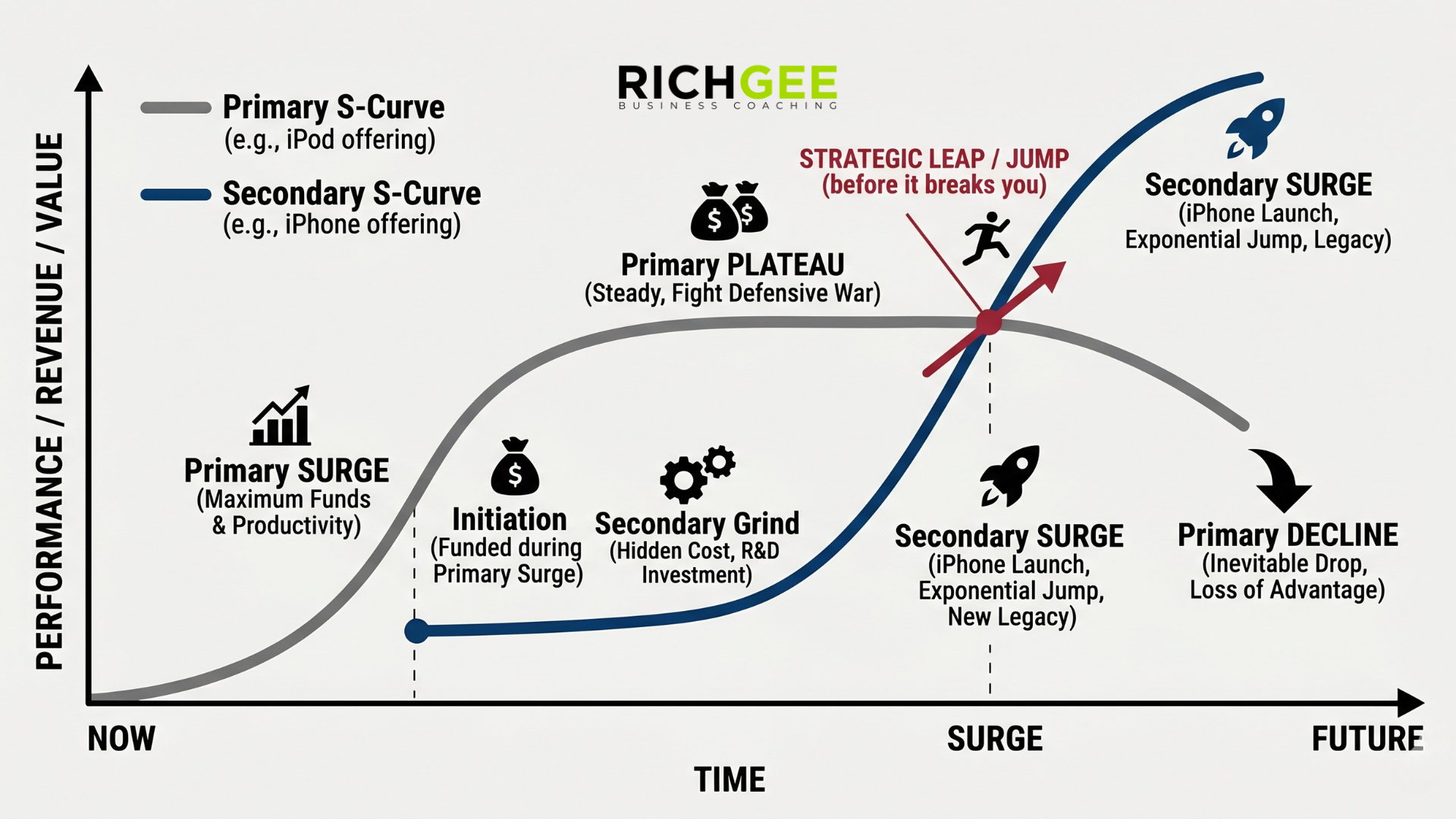
During the iPod's Plateau, growth was steady, but massive resources were being invested in iPhone R&D with no return, a critical period of intense labor with no immediate payoff. When the predictable, inevitable decline of the iPod finally materialized, Jobs was ready.
The iPhone, having completed its "Grind" and "Initialization" phase, was launched, starting a completely new, parallel, and even larger upward trajectory just as the first one began its fall. That is the difference between building a legacy and filing for bankruptcy.
The Brutal Reality of the Curve
Everything in the world has a bell curve. This is not a metaphor; it is the fundamental mathematical expression of lifecycle. Every business model, every skill, every dominant product, and every career trajectory rises, peaks, and eventually declines. Your success is temporary, and the skills that get you to the top of one curve are not the skills that will build the next one.
What we are describing is the intersection of two distinct growth trajectories, often called the Strategic Pivot or Sigmoid S-Curve methodology. Here is how it actually plays out, overlaid on the bell curve model you intuit:
1. The Primary Curve (iPod):
The Surge: A high-growth phase. Your primary offering has hit product-market fit, or your career has found a powerful niche. Revenue and reputation are high. This is where most people get comfortable, enjoying the high return on their previous investments.
The Plateau: Growth slows. The market is saturated. The standard of excellence is now the standard baseline. The product still makes money, but the rate of increase flattens. This is the moment when you must be operating defensively.
The Decline: The inevitable drop. The market shifts, new competitors emerge, or your skill becomes obsolete. If you are only on this single curve, your entire system collapses.
2. The Secondary, Pivotal Curve (iPhone):
The power lies in when you start the second S-curve. Jobs understood that you cannot wait.
Initiation (Funded during the Surge): The correct time to fund your next venture is while you are still scaling up on your first. You use the maximum capital and productivity of the Surge phase to bankroll the next initialization.
The Secondary Grind (The Hidden Cost during the Plateau): While the first curve enters its Plateau (where Apple was milking iPod profits but investing heavily), the second curve is in a deep "Grind" phase. This is the period of intense investment—money, people, and intellectual energy—with zero initial return. You are building the future with the resources of the present, accepting a high, hidden cost. This is why few people do it; it is difficult to invest in your own obsolescence while you are "winning."
The Strategic Launch: The moment the first curve (the primary product) shows the first signs of decline, you must launch the second curve (the next offering). Your goal is to have finished the costly, low-return "Grind" phase of the second product before the primary income source fails. The iPhone launched precisely as iPod sales began to flatten, ensuring a seamless, exponential jump into a new lifecycle without a period of stagnation or failure.
Most professionals make a fatal error right at Step 2 of the primary curve: they confuse momentum with immortality.
The only time to dig your next well is while you are still drinking deeply from your current one.
Your Action Items
Stop appreciating your current position and start auditing it. To become the ruthlessly adaptive mentor of your own success, you must execute these two directives:
1. Map your Coordinates Without Ego: Look at your primary source of revenue or career value. Are you in the Surge, the Plateau, or the beginning of a Decline? Be brutally honest. Do not use past results to justify present comfort. If your capability, client base, or revenue isn't experiencing rapid upward velocity right now, you are on the Plateau. Acknowledge it. Your clock is ticking.
2. Enforce the "20% Self-Cannibalization" Rule: If you are currently in the Surge, take 20% of your profits, time, and human capital and forcibly allocate it to a high-stakes, high-reward secondary skill, product, or market that you believe has the potential to make your primary work obsolete. Do not wait for a sign, and do not find excuses. You are building the boat while you are still standing on dry land. If you wait until you are drowning to pivot, you are acting out of desperation—and desperation is not a strategy.
Conclusion: The Question is Not "If," but "When"
The math doesn't lie, and the curve has no ego. Every dominant skill, every profitable business model, and every successful product/business has an expiration date. Your current peak is not a permanent state; it is a point on a predictable timeline. The single greatest threat to your future relevance is the comfort you feel in your present success.
While you are celebrating your current position, the market is shifting, your skills are becoming baseline, and a competitor is at the bottom of a new curve, grinding to replace you. Desperation is not a strategy, and waiting for the decline to act is an admission of failure.
The only time to dig your next well is while you are still drinking deeply from your current one.
Where are you right now on the S-curve? What new offering/product can you begin to launch? What is your competition doing to outflank you?
Don't get caught behind the S-curve; initiate a new pivot today.
P.S. Take 60 seconds to answer a few questions to find out your Ceiling Score. Stop guessing what behaviors are costing you, find out the exact number, and learn how to finally break through.