

ARTICLES
Written By Rich For You.
What's Holding You Back? You Are.
The more insidious of life's obstacles are your internal obstacles.
People, institutions, rules, regulations, and hierarchies all play major roles in our life. They get in our way, they make us stumble, we get frustrated, and we give up.
I start all workshops and coaching relationships with the discussion of Limiting Beliefs. Why? In life, we run into so many external obstacles. People, institutions, rules, regulations, and hierarchies all play major roles in our life. They get in our way, they make us stumble, we get frustrated, and we give up. They win.
The more insidious of life's obstacles are your internal obstacles. I've broken them down into manageable chunks to allow you to understand them and to hopefully assess and ameliorate each one. When I think of limiting beliefs in my life, I call them life's 'Little Stinkers'. Here they are:
What We've Learned
These are the 'hard-wired' internal obstacles that are drilled into us from an early age. 'Don't do this' and 'you can't do that' play a major part in our learning process. We might have parents, siblings, teachers, and other adults in our life telling us what is right and wrong. Not that it's a bad thing — it's important to do — but sometimes they say certain things that are seared in our personality.
Examples: "They're out of your league" "No one can get an A in that class" "You're not artistic" "You can't sing"
What We've Experienced
These are the myriad of personal experiences when we've tried to step out of our bubble and try new things. And they don't go well. We try something new once or take a big step out of our comfort zone and fail. We revert back to a safe spot and constantly repeat to ourselves that we shouldn't go there — it's a waste of time.
Examples: "We shouldn't go there" "We can't do it" "It's not in our DNA" "I'd be happier staying the same"
What We Think/Fear
This is the third level of limiting beliefs. Take what we've learned and what we've experienced, mix them together, and you end up here. These are all the limiting beliefs we have in our head and we project them all into the future. We mentally scare and hold ourselves back from learning new things, experiencing new practices, and meeting new people.
Examples: "If I do it, I will fail" "This will be a futile exercise" "They won't like me" "They will laugh at me" "I will lose a lot of money"
What We Dodge
This is the lazy limiting belief. We get stuck or complacent in our limiting belief world and feel this is all I need to do. We take the other three limiting beliefs and let our procrastination, laziness, and distractions kick in to hold us back.
Examples: "This has worked all my life" "It's good enough" "My job is fine" (I hate the word fine) "I don't have the time"
Conclusion
If you let these limiting beliefs win, you will NEVER get the opportunity to change your life, your situation, your work, your abilities, your friendships, and possibly increase your happiness. I find if you just stay static in your life and career, you won't be happy for long. So start looking in the mirror and start eliminating those internal obstacles!
The 5 Behaviors Of Successful People.
When I start with clients who are in-transition, we meet at my office in Stamford and I cover the Five Behaviors Of Successful People. I do this to help them focus, get out of a mental 'rut', and move forward with enthusiasm, passion, and determination.
In retrospect, I actually cover these five areas with all of my clients, but I do it differently — I'm a bit more subtle:
TRACK & PLAN You need to know where you've been, where you are, and where you're going at ALL TIMES. This means tracking your time (schedule) minute by minute and accounting for all of your time and energy. You should be sticking to a plan, taking discrete steps each day, and taking it to its natural conclusion.
FAIL: If you're just winging your calendar or making large swaths of time blocks, you're not tracking effectively. If you don't have a plan (try setting up 90-day plans — they're manageable), you will fail.
BE BOLD One of the original taglines for my coaching practice was "Be Bold In Life". I still love it because it embodies the swashbuckler spirit that we all need to be successful in business. You need to take chances, uncover opportunities, and most of all, you need to be BOLD in your thinking.
FAIL: Just keep saying "I can't do that!". Or constantly ask for permission to do things instead of just doing them. Or not doing them because you know they're going to fail.
THINK & ACT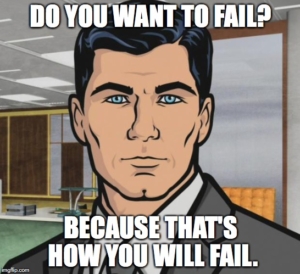 This is the cornerstone of my coaching philosophy — figure out what needs to be done and DO IT. Don't second guess yourself and get caught up in analysis-paralysis. Look at your options, make a decision, and take action. Worst case, if your wrong, step back, reassess, and take action.
FAIL: Procrastinate, contemplate forever and try to come up with every permutation. Push for perfection.
CHALLENGE Life is a series of challenges you must overcome to keep moving and stay happy. Work, relationships, kids, etc. are all made up of small and large challenges that we must deal with. Here's the secret — embrace each challenge with enthusiasm and vigor or you will go through life with a glass half-empty existence.
FAIL: Moan, complain, and run away from your problems. The faster you come up with a plan and deal with your challenge, the faster you will get on with your life.
OPEN UP You can spend your life closed down and not interacting with anyone or you can open your heart to the world and make a lot of new friends. Try to make a new friend every day — an acquaintance, a connection — take an avid interest in your fellow man. Most of all — SMILE!!!
FAIL: Stay home, watch TV, cocoon, close your office door, keep your head down and let your voicemail/email take over all of your connections. Oh yes — forget to smile.
The Perfect Message On Time Management (from a Google Manager).
I was wondering around the web the other day and ran into this article/email on Medium (one of my favorite sites). I ran into a profound message from a Google manager who wrote a simple email to his staff on Time Management. (By Jeremiah Dillon, Head of Product Marketing, Google Apps for Work)
It was so well received, he was asked to broadcast it to a larger audience, and history was made.
Here it is in it's entirety (even with some inside Google jokes). Enjoy!
To: Friend
Subject: If you don’t have time to read this…read it twice.
Stop. Breathe. Now, think about how you’re managing your time. Speaking for myself, I have some room for improvement.
It’s been said there are two paradigms to scheduling — the manager and the maker.
The manager’s day is cut into 30 minute intervals, and they change what they’re are doing every half hour. Sorta like Tetris — shifting blocks around and filling spaces.
The maker’s day is different. They need to make, to create, to build. But, before that, they need to think. The most effective way for them to use time is in half-day or full-day blocks. Even a single 30 minute meeting in the middle of “Make Time” can be disruptive.
We all need to be makers.
Ok. Great idea. I’ll do that… you know… later… I’m late for a meeting.
No. It doesn’t work that way. The only way to make this successful is to be purposeful. Establish an implementation intention. You need to define precisely when and where you’ll reserve Make Time for your projects. Let me tell you a story about a study on this effect:
- The control group was asked to exercise once in the next week. 29% of them exercised.
- Experiment group 1 was given the same ask, along with detailed information about why exercise is important to health (i.e. “you’ll die if you don’t”.) 39% of them exercised.
- Experiment group 2 was asked to commit to exercising at a specific place, on a specific day at a specific time of their choosing. 91% of them exercised.
Commit to protecting Make Time on your calendar including the time and place where you’ll be making, and ideally detail on what you’ll be making. That way, you know, it’ll actually happen.
So, I can just do this like… last thing on Friday, right… after all of my meetings are over?
Actually, no. Many of our meetings could be shorter or include fewer people, and some don’t need to happen at all. Take back those hours for your Make Time instead. But, don’t put it off till the end of the day on Friday — the time you choose really matters. Your energy levels run the course of a wave throughout the week, so try to plan accordingly:
Aim to do the following:
- Monday: Energy ramps out of the weekend — schedule low demand tasks like setting goals, organizing and planning.
- Tuesday, Wednesday: Peak of energy — tackle the most difficult problems, write, brainstorm, schedule your Make Time.
- Thursday: Energy begins to ebb — schedule meetings, especially when consensus is needed.
- Friday: Lowest energy level — do open-ended work, long-term planning and relationship building.
Always bias your Make Time towards the morning, before you hit a cycle of afternoon decision fatigue. Hold the late afternoon for more mechanical tasks.
My new challenge to you: create and protect your Make Time and before you “steal someone’s chair,” consider whether it’ll be disruptive to their Make Time.
P.S. I have Make Time on my calendar. Please don’t schedule over it, and I promise to do my best not to schedule over yours.
Don't Think Too Much. Just Act.
"If you wait to do everything until you're sure it's right, you'll probably never do much of anything." - Win Borden "A ship is safe in a harbor, but that's not what ships are for." - William Shedd
I wanted to hit you early this morning with a few of my favorite and powerful quotes.
I've been doing a LOT of public speaking lately. Conferences, keynotes, expos, organizations, and corporate gigs have been littering my calendar lately. It's been a BLAST. And I've learned a lot about the people I present to.
They're scared. Not the monster in the closet with the knife scared, but a slow, rhythmic, fear that invades their life. Their thinking.
And their actions.
The markets are unsure right now. Business is unsure right now. People are unsure right now.
But this is one of the best times to strike out and do something DIFFERENT. Take a chance. Try something new. BE BOLD IN LIFE.
I promise you — there are a LOT of people out there right now making a lot of money based on their ideas, their connections, and their HUSTLE.
You can be one of them too.
So today's charge for you is to look at what you do everyday and do it differently. Make a change. Reach out to someone who you thought was untouchable. Start something new. Improve and expand what you do.
It will not only motivate and inspire you — it will energize and get everyone around you to notice your tsunami.
Make it happen.
Stop Being Scared On The Job.
Are you complacent, gun-shy, or just plain scared?
I coached the head of sales of a Fortune 500 company yesterday and we had an interesting conversation.
She had a recurring issue with some of the executive board members she reports to — they are frequently challenging her management of the sales force because sales have dipped slightly over the past six months.
Sales performance is a highly subjective area in business because if it is dropping off, many factors can come into play such as pricing, marketing, product management, distribution, the marketplace . . . I can go on forever. During these meetings though, it all seemed to fall right on her shoulders. Why?
Initially, she was a bit complacent. She saw the numbers falling slightly, but didn't really see any reason to change strategy. Then when they really started to turn downward, she became gun-shy. And then right before the next board meeting, she was scared.
I call it falling down the rabbit hole. Complacent to gun-shy to scared — it's a disturbing vortex many managers go through (especially in today's marketplace). We feel the market will have it's ups and downs and then something bad happens — and we are afraid to do anything because we are gun-shy — we don't want to make things worse.
Ultimately, we move to being scared because we don't know where to turn. Here's how we solved her problem:
- THINK - Develop a series of strategies to solve the issue. Predict outcomes and impacts for each of the strategies.
- TAKE ACTION - Choose the best one.
- COMMUNICATE - Massively communicate your decision to your peers and superiors with your logic before they begin to complain.
The board wasn't concerned about her strategy or performance — they were concerned about her lack of communication, perceived interest, and action. Once you show people you are ON IT, they usually back off. In addition, if you show them your thinking around the problem, they see you've taken the time to work the issue. Only certain 'evil' people will take this as a chance to sabotage you. In addition, she also engaged all the other areas impacted for their input — which pretty well ameliorated any sabotage from the 'evil' people.
So don't fall down the rabbit hole — Think, Take Action, and Communicate.
POST YOUR QUESTIONS OR COMMENTS BELOW
P.S. Are you getting complacent at work? Let’s talk. I’ve worked with thousands of executives and have helped them manage difficult situations — call or email me to schedule a complimentary session.