

ARTICLES
Written By Rich For You.
What Do I Need To Do To Move UP?
To your questions — broadly — one needs experience, knowledge, gravitas, tools, communication skills, connections and exposure to become a CMO. Let me cover each one and I'll include your questions:
Experience
You need a requisite amount of experience to become a CMO. It's not 'how many years', it's more about how many areas do you feel comfortable in the marketing arena? I come from a marketing background — you need creative, technical, statistical, client, financial and communication experience to make CMO. You need to know all the areas you will manage — so many newly minted CMO's who hit the top rung usually are lacking in many of these areas and it shows in their performance. I'm not saying you need to be an expert in all areas — although you should have leveraged each one during your career.
Knowledge
It's what you know. Where has the industry been and where is it going? What is your competition doing? Where has your company failed and succeeded? What CAN you do to move forward? Knowledge is power and when you're at the pinnacle of your organization, you need to have a adequate grounding in the past, present, and future of your industry. People will be looking up to you and it's imperative that you have a good base to lead them forward. Or, surround yourself with people who do.
Gravitas (Leadership)
Leadership happens instantly. You can't train for it — I can tell a novice a mile away by how they comport themselves in certain situations and with people. Guess what — your people can too. You need to clearly develop good leadership behaviors with positive engagement, enthusiasm, energy, and motivation. Unfortunately, gravitas comes with time — if you compare me with my 35 year old me, you will instantly see how cool, calm, and collected I am during critical situations.
Management Tools & Techniques
It's what you know. Most people aren't open to better ways of doing things. "I've done it this way for years" is the death knell of any job or business because something better or someone faster comes along. As with knowledge, you need to re-assess your toolbox of tool and techniques and see if they're still effective and motivating. Bottom line, as a CMO, you need to leverage many motivational, time-management, and process-driven skills to stay at the top and succeed.
Communication Skills
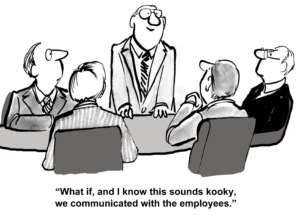
If you've been a doer (worker-bee) during your career, you need to ramp up your interpersonal communication skills. I've worked with and seen many C-Level people who are incredible at getting things done, but suck at getting people to help them. When you approach the big positions, it's less doing and more communicating. In fact, it hinges on evangelizing. You need to inspire the people around you and help you achieve your vision for the future. If you aren't communicating effectively, you will lose the troops who will make that happen.
Also, you should be speaking ALL THE TIME. Sample topic: Where will your type of marketing/industry be in 5/10 years?
Connections & Exposure
You should connect with key people in (and outside) of your organization. Connections are the currency of influence and success when you want to become a CMO. Marketing needs the assistance of every other department in your organization, so it's imperative that you develop critical connections to ensure a smooth flow of information, assistance, and resources. The more 'friends' you acquire, the more currency you have to spend when you need to lean on them for a favor.
Get out of your bubble. So many people tend to stay and communicate with the same 10 people regularly. You need to build your connections and get out and meet better tennis players who play better tennis.
I can go SO much deeper with each area - but I wanted to give you a brief intro on what you need to do to move up.
Ethical Leadership — You Need A Mastermind Group.
In Napoleon Hill's bestselling book, Think & Grow Rich, he introduces a practice called The Master Mind Group. As an executive who wants to succeed, you should regularly assemble a grouping of professionals who will help you learn, understand and grow.
In Napoleon Hill's bestselling book, Think & Grow Rich, he introduces a practice called The Master Mind Group. As an executive who wants to succeed, you should regularly assemble a grouping of professionals who will help you learn, understand and grow.
They could be an attorney, an accountant, a financial planner, a marketing/pr consultant, etc. At the end of the day, you need a grouping of smart individuals who know their areas cold and can help you with any problem, situation, or opportunity that might arise. You meet with them on a quarterly basis, off-site, usually for a full day (you also pay them for their time).
Let's look at this idea through a lens to pursue a highly ethical leadership style: Can you use this Master Mind Group practice to help you maintain (or regain) your high ethical standards? Yes, you can.
Look at the makeup of the group. You need highly reputable professionals that abide by ethical standards in their respective vocations. Now we all know that there are some miscreants who buck the system ethically (we are not talking about them) — we want the best, the brightest, AND the most ethical.
Choose an attorney, accountant, or financial planner of the highest ethical standards . . . Why? Because they will steer you straight ALL THE TIME. Adopt a 'Definite Purpose' as an objective to be attained by the alliance, choosing individual members whose education, experience and influence are such as to make them of the greatest value in achieving that purpose.
There isn't any use in forming a Master Mind Alliance just to have someone to chat with. Your Master Mind will fail if you don't have a strong motive behind it, and it's up to you to plant that motive in the minds of the group members. Your allies for this group should be chosen for their ability to help you get to where you are going. Do not choose people simply because you know them and like them.
You want the hard truth — you want these members to steer you straight and give you valuable advice.
When you have established rapport, you will find that ideas will flow into the minds of each of the members and likewise into your own mind. When the Master Mind is in effect, it produces ideas that would not come to your mind alone. I have had that experience many times when sitting in on the many groups of which I am a member on a consulting basis.
But in the end, you want these professionals to keep you on the straight and narrow and to help you when you are pulled into shady territory by investors, the board, your peers, etc. You need a voice of reason to help you navigate these treacherous waters.
Fire The CEO! That Will Never Happen.
Instead of firing the people who make your products, it's high time we focus in on the actual people making the bad decisions.
Read this today: "IBM Corp. this summer will lay off hundreds of workers in the Hudson Valley region as part of a $1 billion company restructuring that could cut as many as 8,000 jobs worldwide." (link) The truth: Bad management decisions by the top impact the hard workers under them.
It happens time and time again - when the same cast of characters - The Board, Chairman, CEO, President, CFO, CMO, CIO, COO, CSO, (and many others) make decisions which are either good for Wall Street (to get that pennies per share price up) or good for them (so they can hold onto their jobs for another year).
It's the typical corporate country two-step - instead of innovation and growth - they focus on swaying to the gyrations of factory/office closings and staff reductions. Make a bad decision? Time to start firing up the guillotine! Instead of realizing that THEY (management) have made serious miscalculations of the market/their customers/their competition, they continue on in their role (with HUGE bonuses) while they slowly eviscerate the organization from the inside out.
Think of what IBM used to be (i.e., the Watsons) where they took bold ideas, acted upon them, and led the industry. They picked up on the PC, Laptops, Operating Systems, Enterprise Solutions, etc. What happened?
Why isn't IBM in mobile computing? They used to be a leader. Answer: Short sighted vision and watching-their-butt management. What can benefit management in the short term (just to get another year or two of outrageous bonuses) or playing the market so they can leave and land at their next gig (and do the exact same thing over again). I would love some news organization to start up a Bad CEO database so we can see where they turn up next — we can track them like Lo-Jack for executives.
And before I begin receiving rebuttals . . . I know . . . there are companies who are doing it the right way, IBM and other companies are reacting to industry changes, etc. I just find it's sad to see a leader in American technology lay off 8,000 workers. That's a LOT of good people. Also, I don't hate CEO's — I just hate BAD CEO's. And we all know who they are.
Failure: How You Deceive Yourself Everyday.
Wonder why you don't get certain things accomplished? Why you hit the same obstacles every time?
Wonder why you don't get certain things accomplished? Why you hit the same obstacles every time? It comes down to a simple phrase one of my clients so eloquently related to me the other day:
"I know the little games I play with myself."
You see, we all play games in our head. I know of no one who has a personality which is so buttoned up that they perform at optimum efficiency. We think we know some people like that — but the real truth is — they play games too.
The secret is knowing what the games are and why we do it. It's the what and the why that will deliver the insight you need to move past these games.
What games am I speaking of?
Do you dodge people at work? Do you procrastinate on important things? Do you show up late to appointments and meetings? Do you let important and timely decisions lay fallow until the 'right' moment? Again — we ALL do it. So let's pick an easy one:
"I am always late on paying my bills."
WHAT: "I don't open bills until the last minute." That's the reason or the game we play.
WHY: We are afraid of having reality hit us square in the face. We know we spent a lot this month — now the bill is here and is waiting to be paid. But it might not be as bad as you think. But you'll never know until you open it.
And when you do — it immediately forces you to make a decision — where am I going to get the money to pay this? Or if I don't have the money — I have to get it. I either have to work harder or borrow from savings. AND — here's the best part — it forces us to alter our behavior to ensure it doesn't happen again.
And that's the hard part. But I want you to now place yourself in the spot of someone who opens their bills immediately, schedules or pays them immediately, and moves on. How does that sound? How does that feel? Pretty good.
So why aren't you doing it?
Powerpoint: Do You Make These 5 Simple Slide Mistakes?
I can't tell you how many BAD powerpoint presentations I've sat through. One of my major pet peeves focuses on your slide background. It's bad.
I can't tell you how many BAD presentations I've sat through. Let's just say — a lot. My major pet peeve centers around what your presentation slide background looks like. Now before you start your protestations (i.e., executives from organizations) — I totally understand you might have to stick with an approved slide background. I truly feel sorry for you. I was an executive for 20 years and for all internal (and many external) presentations, I broke the rules. No one ever took me to task — ever.
But here are my thoughts (in no special order):
1. "I have to have my logo on each slide!"
No you don't. Maybe your company requires you to have it there, but if you really looked into it, you probably don't need to.
Most of the time, you will need to begin (and end) the presentation with your logo, but for all intents and purposes, the inner slides will only need the information you're presenting. Now if you need to send/distribute the presentation, that's another story — see #5.
Slide real estate is at a premium and the inclusion of a repetitive logo on each slide (and the accompanying buffer around it) is a WASTE OF SPACE. Remember — the object of each slide is to be open, simple, and uncluttered so the audience can focus on the message. Repetitive logos, slide numbers, dates, and titles are not required.
2. "I have to have my company's colors on each slide!"
No you don't. Think of FedEx - purple and orange - imagine a background of purple and orange. OMG. Your job is to present a message to your audience — not hit them over the head with each slide. We've already dispatched the logo, let's work on the background colors.
When you work with a number of colors, shapes, or repetitive images, you are muddying the message. It's as if the audience is wearing 3D glasses and the movie isn't 3D. When you have a number of colors, shapes, lines, or gradations, it just makes it harder to see the font on the screen. Especially if the gradation moves from light to dark — try placing a phrase in black on a background that has a gradation from white to black. You won't see some of the letters — making it hard to read — equals lost message. It also looks juvenile.
3. "The audience can't see the words on my slide when I project on a screen!"
This happens ALL the time. Why? All projectors, screens, and room lighting are different — so you need to compensate for these changes. What I do is always work with a white background — you can never lose with white. It brightens up the screen, takes advantage of any projector bulb's shortcomings, and keeps people's focus on the screen. In addition, colors look brighter.
You can also use a black (or dark) background. But I find it tends to darken the whole room and adds a somber edge to the experience. Steve Jobs used a slightly-graded background for his presentations — but he had perfect stage lighting. Try it — you might like it. One caution — if you like to use images, sometimes their background is white — so you'll have to do some Photoshop magic to make the background around them transparent. That's why I stick with white.
4. "I have to stick to the 'Powerpoint-approved' template!"
No you don't. Honestly, they suck. They stick with boring fonts, the leading (space between each line of text) is not the best, and their choice of bullets . . . terrible. The only way for you to personalize the presentation (to your subject) is to start fresh and choose your own layout. Once you lock it in — stick with it — it will then be easy for you to replicate again and again and again.
In addition, you don't want your presentation looking generic or like another person's presentation. Candidly, when I see a canned 'Powerpoint-approved' background presentation, I think two things:
- This person has no idea what they're doing. They're whole presentation is suspect.
- This person really doesn't care about the look and feel of their presentation. They've rushed it.
5. "Projecting and printing are two totally different deliverables!"
So they can look different. In fact, they can look like two totally separate deliverables. Why?
- One is for projecting on a screen in front of an audience with commentary from you. The audience is focusing on you and using the slideshow as an accompaniment to bolster your message.
- The other is for silently reading at one's desk. Two different deliverables. You do need a logo or copyright on each page because the presentation might be pulled apart and distributed to other people. Also, it's frequently printed on white paper, so the use of complex and colorful backgrounds (and fonts) might interfere with the final printed product. In addition, if you have to email it, eliminating most (if not all) images will dramatically affect the size of the emailed file.
I run into these five mistakes at least once a week and it's a train wreck when it happens. In fact, I see a presenter (who is an accomplished academic and speaker) who sabotages their own presentation by making all five of these mistakes.
Lots of Enemies? Make Friends With The Press.
Part Five of a series on Ethical Leadership — many more to come. Have I lost my mind? Honestly — the idea of making the press your friend is obscene!
 Part Five of a series on Ethical Leadership — many more to come.
Have I lost my mind? Honestly — the idea of making the press your friend is obscene!
Part Five of a series on Ethical Leadership — many more to come.
Have I lost my mind? Honestly — the idea of making the press your friend is obscene!
Hear me out — there is a logic to my madness.
When my team coaches businesses on the inner workings of their business, we ask them to develop a Mastermind group. A group that includes a tax accountant and an attorney. Why? In addition to the visionary participants (marketing/sales), as a business owner you need trusted individuals who will tell you the truth — and don't have an agenda — because they stick to the FACTS.
Now I will lay all my cards on the table — certain parts of the press are unreliable, sneaky, and downright corrupt (like all areas of business). But there are certain areas of the press who are ethical, forthright, and just. Reporters who stick to the facts and tell it like it is — whether it is good or bad news. Finally, reporters who are in it to report the NEWS and not just get the juicy story.
Those are the people that you sidle-up to and make friends. Why?
Because they are ethical. And they will keep you on the straight and narrow. It is always refreshing to surround yourself with people that will not only massage your ego, but trusted advisers who will tell you the truth AND let you know when you venture into unethical territory.
Now let's be honest — you don't have to tell them everything. But if you get a trusted editor or publisher that you meet for lunch on a regular basis, you can be assured that they will tell you what's on their mind.
And that my friends, is worth its weight in GOLD.
CMO to CEO: Insights & Advice From CEOs Who Have Made The Transition.
Little is written about the options available to CMOs to progress beyond their role as marketers and become key players at the executive committee level. At the Rich Gee Group, we frequently run into many C-Level executives who want to progress to the top rung and help them develop a strategy on what they should be doing to make themselves credible contenders for the CEO berth.
 Little is written about the options available to CMOs to progress beyond their role as marketers and become key players at the executive committee level.
At the Rich Gee Group, we frequently run into many C-Level executives who want to progress to the top rung and help them develop a strategy on what they should be doing to make themselves credible contenders for the CEO berth.
Little is written about the options available to CMOs to progress beyond their role as marketers and become key players at the executive committee level.
At the Rich Gee Group, we frequently run into many C-Level executives who want to progress to the top rung and help them develop a strategy on what they should be doing to make themselves credible contenders for the CEO berth.
Spencer Stuart has a great report (click here for the PDF) that outlines each of the 10 ways to prepare for a role as a CEO:
- Take on a general management role in an emerging market
- Broaden your skill set at every opportunity
- Gain experience in at least one non-marketing role
- Get involved in as many mission-critical, non-marketing projects as you can
- Demonstrate your credibility and track record as a commercial leader
- Develop close working relationships with other functions
- Work with the CFO to value the company’s brand assets
- Hone your communication skills
- Learn to make the tough decisions
- Find a mentor who is already a CEO or in a general management position
It's a great read. Enjoy! - Rich
Ethics - The Only Way To Be A True Leader.
eth-ics (noun) - that branch of philosophy dealing with values relating to human conduct, with respect to the rightness and wrongness of certain actions and to the goodness and badness of the motives and ends of such actions. Right and Wrong. Good and Bad. And the most important part - the motive and ends of such actions. There are many executives out in the marketplace today that know what they are doing is wrong . . . and bad.
 eth-ics (noun) - that branch of philosophy dealing with values relating to human conduct, with respect to the rightness and wrongness of certain actions and to the goodness and badness of the motives and ends of such actions.
Right and Wrong. Good and Bad. And the most important part - the motive and ends of such actions.
eth-ics (noun) - that branch of philosophy dealing with values relating to human conduct, with respect to the rightness and wrongness of certain actions and to the goodness and badness of the motives and ends of such actions.
Right and Wrong. Good and Bad. And the most important part - the motive and ends of such actions.
There are many executives out in the marketplace today that know what they are doing is wrong . . . and bad. But they still do it because the motives and ends of such actions will deliver one or both of these results:
- The company will do better.
- They will make more money, be more successful, and ensure a continuous launching pad to bigger and better positions.
Now here's the REAL question - Can they still achieve these same goals listed above if they do the right thing . . . good things?
Now we can get into the semantical argument that what I see as good might be bad for another (or vice-versa). Or that based on our differing opinions of ethics, what you might see as 'bad' might be 'good' viewed by another. But let's cut out the BS - as an executive, you absolutely know when you are doing something that is slightly (or gravely) unethical (until you do it so frequently that it becomes 'good' in your eyes).
I took ethics in college (I state that I am not an expert) and know that there are two arguments (or more) for every ethical issue. But I've also lived in the corporate world for 20+ years and coached top level executives for 10 years. I believe that in business, there is rarely gray, there is only black and white. Why? In business, everything is measured, everyone is conservative, and risk is constantly minimized. Most of the time (not all mind you), you can faithfully predict how your actions will affect your bottom line, customers, employees, shareholders, etc. Not on a granular scale - but more on a ballpark one.
But when it comes to bad and wrong, I know it when I see it.
Bad and Wrong decisions go against the company's natural grain of behavior. You've probably felt this if you have worked in corporate - you are marching down the street with a strategy, everyone is singing the same tune. Suddenly, management makes a 180° turn and states that we will be doing the exact opposite of what they were pontificating 6-12 months before.
Now I understand that markets change. Customer wants and needs change. But 180 degrees? We were going North, but now we are going South? That clearly communicates to me that the people at the top don't know what they are doing, are open to the fickleness of certain corporate soothsayers, or dramatically underestimate the market to the point that they were COMPLETELY wrong. Candidly, these people should be FIRED. But these are not Bad and Wrong decisions in an Ethical context.
I honestly think that when executives make bad and wrong decisions do so for three reasons (the motive and ends):
- They're lazy. Going the 'bad' or 'wrong' direction is easier, less risky, more profitable in the short term, etc.
- It's a personality thing. They feel that making contrarian decisions keep them above the rabble, they are smarter than the rest, and they are fooling the masses.
- They believe that there is a LOT more money and power to be made by going bad.
Bernard Madoff was a #2 & #3. Not only did he realize that there was a LOT more money to be made by deceiving his investors and the market, it probably was a personality thing. Bottom line - most unethical executives have abnormal self-esteem (very low or very high) so they compensate by doing unethical things.
Many executives who testify in front of Congress (honestly - they've probably done something wrong!) usually have all three personality traits. Go back and view the testimonies of the investment firms, insurance companies, tobacco companies to get a good feel for #1, #2 and #3.
OK - That's enough for one day. My next post will discuss the treatment.