

ARTICLES
Written By Rich For You.
How to Be an Unpredictable Manager Who Energizes the Team.
In today's dynamic and constantly evolving business landscape, there's an increasing need for managers who can shake things up. A dash of unpredictability can invigorate your team, inspire innovative ideas, and drive enhanced productivity.
Over 20 years ago, I had a manager whose presence was an instant energy booster. The moment he walked into the office, his dynamic body language, purposeful stride, and vibrant voice lifted the atmosphere. "Good Morning, Rich!" he would exclaim, his voice resonating with genuine enthusiasm and a broad smile. He was sincerely thrilled to be there and see each of us.
His knack for surprising us kept us on our toes. Sometimes, he'd spontaneously invite us to sit in on a meeting with upper management, giving us a glimpse into high-level decision-making. Other times, we'd find a recently read book on our desks, carefully chosen to inspire or challenge us. Occasionally, he'd even surprise us with tickets to the US Open, announcing that the van would leave in just 15 minutes. His unpredictability was infectious and highly motivating, shaping a workplace environment where every day felt like a new adventure.
Traditional management theory often centers around stability, predictability, and standardization. While these elements have their place, they aren't the be-all and end-all of effective leadership. In fact, in today's dynamic and constantly evolving business landscape, there's an increasing need for managers who can shake things up. A dash of unpredictability can invigorate your team, inspire innovative ideas, and drive enhanced productivity.
The Power of Unpredictability
Unpredictability, when channeled appropriately, can become a powerful tool. Imagine your favorite movie or novel. What makes it memorable is the unexpected twists that keep you engaged and invested. That same level of intrigue can apply to management. You can be the leader who keeps people on their toes, eager to see what comes next. An unpredictable manager infuses the workplace with energy, and this energy translates into higher engagement, motivation, and, ultimately, performance.
Injecting Enthusiasm
Let's start with enthusiasm, a contagious trait that can elevate the atmosphere of an entire office. Surprise your team with moments of joy. This could be as simple as bringing in doughnuts on a Monday morning or as meaningful as a handwritten note praising a team member for a job well done. Make it a habit to celebrate small victories. This can make even the most mundane tasks feel like part of a grander mission.
Cultivating Motivation
Keeping your team motivated is crucial for long-term success. Why not surprise your team with an unexpected reward for hitting a milestone? This doesn't always have to be monetary. It could be an extra day off, a team-building exercise, or even an afternoon off for everyone to recharge. The key is to keep them guessing. The thrill of the unexpected can act as an added layer of motivation.
Fostering Learning
A routine work environment often doesn't lend itself to growth or learning. Break the cycle by introducing unexpected learning opportunities. Bring in guest speakers without prior notice or designate a "learning day" where everyone takes a break from their usual tasks to focus on personal development. You could also encourage spontaneous skill-sharing sessions among team members. This not only promotes learning but also builds stronger team bonds.
Ensuring Two-Way Communication
Unpredictability should not extend to communication; that can lead to confusion. However, you can be unpredictable in the ways you encourage open dialogue. Don't just stick to annual performance reviews; have impromptu one-on-one meetings where you discuss more than work. Encourage your team members to voice their thoughts and ideas in unexpected settings, perhaps in the middle of a project meeting or during a team lunch. This promotes a culture of openness and inclusion.
Mastering Effective Delegation
The art of delegation is vital for a manager. Being unpredictable in this area means knowing how to delegate not just tasks but responsibilities. One week, you could empower a junior team member to lead a meeting or take charge of a small project. The following week, it might be someone else. This does two things: it prepares your team for diverse roles and keeps them engaged, as they won't know what exciting opportunity might come their way next.
Final Thoughts
Unpredictability in management is not about being inconsistent or chaotic; it's about injecting freshness into an otherwise monotonous routine. It's the managerial equivalent of adding spices to a dish—you enhance flavors and create a more engaging experience. Done right, your unpredictability can turn you into the kind of leader that drives results and makes the workplace a more fulfilling and exciting place to be. So go ahead, shake things up a little, and watch your team flourish.
Navigating Office Politics: Building a Successful Career Through Savvy Behaviors.
Office politics, the art of influencing others to achieve goals within the workplace, is a subject that often evokes strong reactions. For many, it's synonymous with negativity, manipulation, and mistrust. However, another side to this coin is that "good political behavior" can propel your career forward. In contrast, "bad political behavior" can be detrimental. Let’s explore why most people dislike office politics and uncover the strategies that can lead to career growth.
Office politics, the art of influencing others to achieve goals within the workplace, is a subject that often evokes strong reactions. For many, it's synonymous with negativity, manipulation, and mistrust.
However, another side to this coin is one where "good political behavior" can propel your career forward. In contrast, "bad political behavior" can be detrimental.
Let’s explore why most people dislike office politics and uncover the strategies that can lead to career growth:
The Dislike of Office Politics
Office politics tends to get a bad rap because it often involves behaviors that can be seen as counterproductive or harmful to the work environment. Here are some reasons why many individuals harbor a dislike for office politics:
Perceived Unfairness: Employees can feel disheartened and disillusioned when promotions or rewards seem to be based on personal relationships rather than merit.
Conflict and Stress: Office politics can lead to conflicts and heightened stress levels as individuals compete for recognition or resources.
Lack of Transparency: Decisions made behind closed doors can lead to a lack of transparency, leaving employees in the dark.
Erosion of Trust: Manipulative tactics and backstabbing behaviors erode trust among coworkers, making it difficult to collaborate effectively.
Good Political Behavior
Contrary to the negative perception of office politics, some behaviors can be deemed positive or "good political behavior." These are strategies that help individuals advance their careers while maintaining integrity and professionalism:
Effective Networking: Building genuine relationships with colleagues and superiors can provide valuable insights and opportunities. Good political behavior involves networking with sincerity and reciprocity.
Conflict Resolution: Addressing conflicts and differences constructively is a key element of good political behavior. It shows your ability to handle challenges professionally.
Influence through Ideas: Instead of resorting to manipulation, influencing others through the power of your ideas and expertise is a hallmark of good political behavior.
Transparency and Honesty: Being open and honest in your communication fosters trust and credibility among your peers. This is essential for navigating office politics positively.
Bad Political Behavior
On the flip side, "bad political behavior" comprises actions that can hinder your career growth and damage your professional reputation. Avoid these detrimental behaviors:
Manipulation: Manipulating others through deceitful means, such as spreading false information, can lead to short-term gains but long-term consequences.
Sabotage: Undermining colleagues or coworkers to eliminate competition is a dangerous game that often leads to isolation and resentment.
Office Gossip: Engaging in harmful gossip can damage relationships and trust within the workplace.
Self-Promotion at the Expense of Others: Putting your interests above those of your team or organization can alienate you from colleagues and superiors.
How to Navigate Office Politics Successfully
Now that we've covered the reasons behind the dislike for office politics and the distinction between good and bad political behavior, here are four action steps to help you navigate office politics successfully:
Develop Emotional Intelligence: Understand your emotions and those of others. This will enable you to navigate office politics with empathy and better understand your coworkers' perspectives. (resource)
Build Authentic Relationships: Cultivate genuine relationships with colleagues based on trust and mutual respect. Effective networking is about creating a supportive network rather than self-serving connections. (resource)
Focus on Solutions, Not Problems: When conflicts arise, shift your focus from the problem to finding solutions. This demonstrates your ability to be a problem solver and a team player. (resource)
Lead by Example: Set a positive example by practicing good political behavior. Your colleagues will take notice and may follow suit, contributing to a healthier workplace culture. (resource)
Office politics may have a negative reputation, but it's inevitable in any workplace. By understanding the distinction between good and bad political behavior and adopting the right strategies, you can use office politics as a tool to advance your career, build relationships, and contribute positively to your organization's success.
Remember, office politics isn't inherently evil; the behaviors and intentions behind it determine its impact on your career and the workplace.
Remembering Joan Blumenfeld: A Pillar of Eldercare and A Ray of Sunshine.

In the intricacies of life and business, we occasionally cross paths with individuals who leave an indelible mark on our lives. They're not just colleagues or acquaintances; they're people who bring joy, wisdom, and purpose into our everyday interactions. One such luminary was Joan Blumenfeld.
Joan was more than just a colleague to many of us in the Darien Dynamos BNI group; she was a beacon of positivity, a person who could light up a room with her knowledge, enthusiasm, and heartfelt concern. As I stumbled upon one of her business cards recently, waves of memories and emotions reminded me of her undeniable impact. It felt necessary, if not imperative, to pen down a tribute in her memory.
Joan helmed a managed care practice focused on the elderly. In a world often preoccupied with the concerns of the young and middle-aged, Joan dedicated her life to ensuring that our seniors received the love, care, and dignity they deserved. Her practice wasn't just about eldercare but also about guiding and consulting the children of these elders, helping them navigate the often turbulent and emotionally charged waters of caregiving. Her work was more than a profession; it was a vocation, a call to ensure that the twilight years of our seniors were as golden as they deserved to be.
It was evident in our BNI group meetings that Joan's knowledge was vast. But what truly set her apart was her ability to present this knowledge with an enthusiasm that was infectious. Every week, she'd share insights, updates, and advice that was invaluable and delivered with a freshness that made even the most complex subjects seem approachable. Her presentations were never just about information; they were a masterclass in how to blend expertise with empathy.
While her professional accomplishments were noteworthy, what truly made Joan special was her spirit. She brought to our group an aura of camaraderie that made our weekly meetings something to look forward to. Joan was always present, engaged, and caring, whether it was a quick chat about the weekend, a shared laugh, or a deep discussion about life and business.
I remember the days when challenges seemed insurmountable, and the weight of entrepreneurship felt heavy. On such days, Joan's presence was like a bright spot, a reminder that any challenge could be overcome with the right attitude and approach. Her belief in the power of positivity, her unwavering support, and can-do spirit inspired many of us to push through our limitations.
It's a painful reality that Joan left us in 2017. The void she left is palpable, not just in our BNI group but in the hearts of everyone she touched. Her legacy, however, remains alive. She ensured that countless seniors lived their later years with grace and dignity through her work. She showed us the power of positivity, knowledge, and genuine human connection through her interactions.
As I organize my office and come across little memories of Joan, I'm reminded of the fragility of life and the importance of making every interaction count. Joan did just that. She lived a life filled with purpose, joy, and love. And in doing so, she left an indelible mark on all our hearts.
Joan Blumenfeld, you are missed. But more importantly, you are remembered, cherished, and celebrated.
AI for Execs: Navigating the Future of Business.
"AI doesn't replace leadership; it redefines it. In the age of intelligent machines, the savvy executive adapts, learns, and thrives."
"AI doesn't replace leadership; it redefines it.
In the age of intelligent machines,
the savvy executive adapts, learns, and thrives."
Artificial Intelligence (AI) has become a game-changing force in today's rapidly evolving digital landscape, transforming industries and businesses globally. As executives navigate the complex waters of modern-day leadership, understanding AI isn't just beneficial—it's essential. But why is AI so important, and how can executives effectively harness its potential? Let's dive in.
Understanding AI's Impact
At its core, AI mimics human intelligence processes using algorithms, data, and machine learning. It has the potential to automate tedious tasks, offer insights from vast amounts of data, and even communicate with customers in real time. Its applications range from customer service chatbots and predictive analytics to more advanced functions like autonomous driving.
For executives, AI isn't just about technology; it's about transformation. It's reshaping business models, customer interactions, and the very nature of decision-making. A report by McKinsey Global Institute estimates that AI could add $13 trillion to the global economy by 2030. This potential for growth underscores the importance of integrating AI into business strategies.
Actionable Insights for Executives:
Educate Yourself & Your Team: Before diving into AI integration, ensure you and your team understand the basics. This means something other than becoming an AI expert but grasping its capabilities, benefits, and potential pitfalls. Consider arranging workshops or seminars for top leadership to gain foundational knowledge.
Evaluate Business Needs: AI offers myriad possibilities, but not every AI solution suits every business. Analyze which areas of your operations could benefit the most from AI integration. Is it customer service? Supply chain management? Product recommendations? By pinpointing specific areas, you can tailor your AI strategy effectively.
Collaborate with Experts: It's always a good idea to bring in experts when dealing with unfamiliar terrain. AI specialists can provide insights into what technologies to adopt, how to integrate them, and how to avoid potential pitfalls. They can also help you understand the cost-benefit ratio of various AI applications tailored to your business needs.
Prioritize Data Management: AI thrives on data. The quality and volume of data you feed into an AI system determine the effectiveness of the outcomes. As an executive, ensuring your business has a robust data management strategy is paramount. This includes gathering relevant data, ensuring its accuracy, and maintaining security and privacy.
Promote an Ethical AI Culture: With great power comes great responsibility. As AI gains more influence in decision-making, addressing ethical considerations is essential. This includes understanding and mitigating biases in AI models and ensuring transparency in AI-driven processes. Establishing an ethical AI framework not only safeguards your business's reputation but also fosters trust among stakeholders.
In Conclusion
Embracing AI is no longer optional for forward-thinking executives. When approached with curiosity, preparedness, and ethical considerations, it's a journey that can catapult businesses to unprecedented heights.
By following the action items above, executives can chart a course that not only leverages the immense power of AI but also ensures that their businesses remain competitive, innovative, and ethically grounded in the age of intelligent machines.
Remember, in the words of John McCarthy, the father of AI, "Artificial Intelligence is not about making machines intelligent; it's about making intelligence artificial." As executives, it's your prerogative to determine how this artificial intelligence can best serve and elevate your business.
Resources:
Prediction Machines: The Simple Economics of Artificial Intelligence by Ajay Agrawal, Josh Gans, and Avi Goldfarb - This book provides a clear and concise overview of the economics of AI, and how executives can use AI to create value for their businesses. It covers topics such as the different types of AI, the costs and benefits of AI adoption, and how to develop and implement an AI strategy.
Artificial Intelligence for Managers: Leverage the Power of AI to Transform Organizations & Reshape Your Career by Thomas H. Davenport and Nitin Kalé - This book is a practical guide to using AI to transform organizations. It covers topics such as how to identify AI opportunities, how to build an AI-ready culture, and how to measure the success of AI initiatives. The book also includes case studies from companies that have successfully implemented AI.
The AI Product Manager's Handbook: Develop a Product that Takes Advantage of Machine Learning to Solve AI Problems by Tom Provost and Josh Wills - This book is a guide for product managers who want to develop AI-powered products. It covers topics such as how to identify AI product opportunities, how to develop a data strategy, and how to build and deploy AI models. The book also includes case studies from companies that have successfully developed and launched AI products.
All three of these books are well-written and informative, and they provide valuable insights for executives who want to learn more about AI and how to use it to transform their businesses.
Why Design Matters in Your Career and Business.
But why should you, as a business owner, executive, or professional, care about design? Let’s dive in.
Ever stopped to admire a sleek Apple product or been captivated by the intuitive icons on early Macintosh computers? Perhaps you've gazed at an intricate data visualization and understood complex information at a single glance.
These are the masterstrokes of design luminaries like Jony Ive, Susan Kare, and Edward Tufte. Their influence extends beyond mere aesthetics; they've revolutionized how we communicate, work, and do business.
But why should you, as a business owner, executive, or professional, care about design? Let’s dive in.
The Legends of Design and Their Philosophies
Edward Tufte: A master of data visualization, Tufte's principle is straightforward yet profound: Present information with clarity and integrity. For Tufte, clutter isn’t an attribute of information but a failure of design.
Jony Ive: As the design genius behind many iconic Apple products, Ive believes in the harmony of form and function. His designs don’t scream for attention; they elegantly command it.
Susan Kare: A pioneer in digital graphic design, Kare crafted the early Macintosh’s recognizable icons and fonts. Her belief? Good design, even in its simplest forms, can spark joy and clarity in daily interactions.
How Design Influences Daily Business Activities
Presentations: A well-designed presentation can be the difference between sealing a deal and losing potential business. Clutter-free slides, guided by Tufte's principles, ensure your message is front and center. Adopting the aesthetic and functional harmony preached by Ive can lead to a presentation that's impactful yet minimalistic.
Business Cards: In a world of digital connections, a tangible business card remains a powerful tool. A card inspired by Kare's design philosophy might include an icon or logo that's both playful and professional, leaving a lasting impression.
Reports: Think of the countless reports that cross desks every day. Those that stand out are clear, concise, and well-organized—echoing Tufte's belief in the purity of information. Reports should not only present facts but tell a story.
Day-to-Day Correspondence: Emails, memos, and letters are more than mere words. The layout, typography, and even the choice of images can convey a sense of professionalism and care. Taking a cue from Ive, the design in correspondence should feel intuitive, making communication seamless.
Why Every Professional Should Embrace Design
Design isn’t the exclusive domain of artists or graphic designers. It plays a crucial role in how effectively we communicate our ideas, values, and brand. As Jony Ive mentioned, “Design is a way of looking at the world.” When we adopt this perspective, we not only enhance our products and services but also enrich our interactions and relationships.
Actionable Steps to Embed Design in Your Life
Design Audit: Periodically review your brand materials, from logos to correspondence templates. Ensure consistency and a reflection of your brand values.
Stay Updated: Design, like any field, evolves. Subscribe to design blogs or magazines to stay informed about the latest trends.
Invest in Professional Design Tools: Equip yourself or your team with quality design tools. It’s an investment in your brand's image and efficiency.
Seek Expertise: If design isn’t your strength, collaborate with professionals. A graphic designer or a branding expert can bring a fresh perspective.
Educate & Train: Organize workshops or training sessions for your team on the basics of design thinking. Embedding a design mindset can lead to improved internal and external communication. Edward Tufte is running one right now.
Feedback Loop: Regularly solicit feedback on your designs. Whether it’s a new logo, report template, or an email signature, understand its impact on your audience.
In a nutshell, design is the silent ambassador of your brand, your work, and you as a professional. Whether it's the elegance of an Apple product, the clarity of data visualization, or the charm of a pixel icon, the power of design is undeniable.
When harnessed correctly, it can elevate your career and business to unprecedented heights. Remember, good design is obvious; great design is transparent. Embrace it, and let it be your edge in the business world.
Imposter Syndrome: How It Shapes Careers and How to Break Free.
Imposter Syndrome doesn't discriminate.
Imposter Syndrome doesn't discriminate.
Imposter Syndrome. You've probably heard of it, perhaps even identified with it. It's the nagging belief that, despite all evidence to the contrary, you're a fraud, and it's only a matter of time before everyone finds out.
In my previous article, I touched on its surface implications and some basic strategies to overcome them. Today, we'll dive deeper into the core of this phenomenon and offer further action items to combat it.
Unpacking Imposter Syndrome
Imposter Syndrome doesn't discriminate. It plagues both newbies and seasoned professionals. Some of the world's most accomplished people, from Maya Angelou to Albert Einstein, have expressed feelings of self-doubt and inadequacy at some point in their careers.
But where does it stem from?
Cultural and Societal Expectations: Often, societal pressures regarding success, achievement, and roles can create a fertile ground for imposter feelings. When we deviate from these 'norms' or find ourselves in unfamiliar territory, it's easy to feel out of place.
Personal Perfectionism: For many, there's an ingrained belief that they must achieve perfection in everything they do. Any deviation from this self-imposed standard can trigger feelings of fraudulence.
Fear of Failure: Ironically, this fear might stem from previous successes. The more you achieve, the more you have to lose, leading to a perpetual cycle of self-doubt.
Deeper Consequences of Imposter Syndrome
While feelings of inadequacy and self-doubt might seem harmful enough, the ripple effects of Imposter Syndrome can be even more detrimental:
Stagnation in Career: Those suffering often shy away from taking on new challenges or roles, fearing exposure.
Physical and Mental Health Toll: Constant stress and anxiety can lead to a range of health issues, including insomnia, depression, and burnout.
Reduced Creativity: A mind consumed by self-doubt can rarely think outside the box. Innovation and creativity suffer.
Action Items: A Deep Dive
Reframe Failures: Instead of viewing failures or mistakes as evidence of your 'impostor' status, see them as natural parts of growth. Every setback offers a lesson. Start by journaling your feelings when you experience a setback, and then write what you learned from it.
Seek Mentorship: Find someone who has walked your path. Often, they'll have experienced the same feelings and can offer both reassurance and guidance. Consider joining professional groups related to your field where mentorship opportunities are abundant.
Break the Silence: Talk about it. You'll be surprised how many of your colleagues feel the same way. Sharing your feelings can often dilute them, and hearing others echo your sentiments can be reassuring.
Set Realistic Expectations: While ambition is commendable, setting unattainable standards for yourself can perpetuate feelings of inadequacy. Break down tasks into manageable steps and celebrate small victories.
Seek Professional Help: If feelings of fraudulence start to overwhelm you, consider seeking therapy or counseling. Sometimes, a professional perspective can provide the tools and strategies you need to overcome this syndrome.
Practice Self-Compassion: Instead of being your harshest critic, try being your biggest supporter. Remind yourself of past achievements and strengths regularly. Meditation and mindfulness can also help center your thoughts and feelings.
In Conclusion
Imposter Syndrome is a formidable adversary. It lurks in the shadows, whispering persistent doubts and magnifying every mistake. However, with self-awareness, actionable strategies, and a supportive network, you can combat these feelings and embrace your true potential.
Remember, every professional, no matter how accomplished, has faced moments of doubt. It's not the presence of these feelings but how you address them that will define your career trajectory. So, the next time the imposter whispers in your ear, face it head-on with the confidence and strategies you've armed yourself with. Your career—and your well-being—depend on it.
The Power of Unwavering Commitment in Achieving Success.
Genuine commitment means deciding and eliminating all other options, creating a single-minded focus that can catapult you toward your goal.
Success is more than just a product of skill, timing, or luck; it's often a result of something deeper and more intentional: commitment. But commitment doesn’t mean simply making a decision. It goes beyond that. Genuine commitment means deciding and eliminating all other options, creating a single-minded focus that can catapult you toward your goal. Let’s explore why and how unwavering commitment makes you successful.
Why Commitment Matters
Creates Focus - When you commit to something, you’re not just deciding on a course of action. You're funneling all your energy, time, and resources toward achieving a particular goal. This level of focus makes your efforts more effective, helping you make better use of your time and energy.
Builds Resilience - When you're committed, setbacks don’t deter you. Because you’ve already eliminated all other options, failure isn’t possible in your mind. This perspective turns obstacles into mere delays and setbacks into learning experiences.
Drives Consistency - People who achieve their goals are only sometimes the most talented or resourceful. They’re often the most consistent. Commitment helps you stay the course, ensuring that you're constantly taking actions that move you closer to your objective.
Instills Confidence - When you eliminate all other options, invest in yourself. You’re telling yourself that you’re capable and deserving of your goal. This level of self-belief can be self-fulfilling, making you more likely to achieve what you've set out to do. Here are five critical action steps to foster commitment:
1. Define Your Goal Clearly
You can't commit to something vague or ambiguous. Whether it’s a career aspiration, a fitness target, or a personal milestone, make sure your goal is specific, measurable, attainable, relevant, and time-bound (SMART).
Instead of saying, "I want to be successful in my business," a more specific goal would be, "I want to increase my revenue by 20% in the next 12 months." That means you need to increase your revenue by ~1.5% each month — that’s doable.
2. Eliminate Alternative Scenarios
Once you’ve set a goal, eliminate or sideline any options that could distract you. If you aim to grow your business, don’t waste time considering backup plans or side projects that will divert your focus. Make it a point to concentrate all your efforts on achieving this objective.
Don’t dilute your efforts by pursuing unrelated opportunities if you’re committed to growing your business. Stick to your core competencies and expand from there. Don’t get distracted by shiny objects, other people, and your own hamster wheel.
3. Commit Publicly
Sharing your commitment with others can instill a sense of accountability. When others know what you’re working towards, you’re more likely to follow through. This can be as simple as telling a friend or as formal as announcing it on social media.
Let your mentor or trusted colleagues know if you’re aiming for a promotion. Their support and occasional check-ins can keep you on track. Don’t be afraid — if you feel you are a high-performer, you should be paid like one.
4. Develop a Routine
Consistency comes from routine. Establish a daily or weekly schedule that accommodates activities directly related to your goal. Stick to this routine and make it a non-negotiable part of your life.
If you’re an aspiring writer, spend two hours daily solely writing. Make this a non-negotiable commitment, just like a meeting with a client. Be committed to your goal, and don’t goof off.
5. Continuously Assess and Adapt
Your initial plan won’t always be perfect. Be prepared to tweak, but ensure they align with your end goal. Periodic reviews can help you see if you’re on track and allow you to make data-backed decisions.
If your business isn’t growing as fast as you’d like, assess your strategies and adapt them without changing your end goal of business expansion. Too many business owners refuse to change and start to see their businesses slowly come apart.
Conclusion: Create A Razor-Sharp Focus
Commitment is a powerful tool for achieving success, but it goes beyond merely deciding on a course of action. When you make a decision and then consciously eliminate all other options, you create a razor-sharp focus that increases your odds of success. So, define your goals, eliminate distractions, commit publicly, develop a routine, and be ready to adapt. Your path to success might be challenging, but it becomes more apparent with unwavering commitment.
Why 'Busy' Doesn't Mean 'Productive': The Secret to Peak Performance.
The truth is - genuine peak productivity isn't about getting everything done.
Peak productivity — it's the holy grail for executives, entrepreneurs, and high-performers across various fields. When we think of peak productivity, what often comes to mind is a superhuman ability to complete endless to-do lists, answer every email, and never miss a deadline. But is that really what it means to be at the pinnacle of productivity?
The truth is . . genuine peak productivity isn't about getting everything done. It's about getting what truly matters done and having the wisdom to stop there. In this high-speed, always-connected world, being productive has often been equated with busyness. However, being busy isn't the same as being effective. Here, we'll dive into what it really means to reach peak productivity and provide actionable steps to help you focus on what genuinely matters.
What is Peak Productivity?
Peak productivity is a state of flow where you're not just doing things right, but you're doing the right things. It is a balanced state of optimized performance and well-being, where your actions align with your goals, values, and highest priorities. You're not overwhelmed with meaningless tasks, but rather, you're invested in duties that contribute to your larger objectives and visions.
1. Identify Your Highest Priorities
Take some time to identify what really matters to you. Write down your top 3-5 priorities and focus on them. These will serve as your compass, helping you navigate the sea of responsibilities that often come your way. (learn more)
2. Use The Eisenhower Matrix
Organize tasks into four categories: urgent and important, important but not urgent, urgent but not important, and neither. Aim to spend most of your time in the 'important but not urgent' box. This strategy keeps you proactive rather than reactive. (learn more)
3. Time Blocking
Block out time for your most important tasks. Treat these time blocks as non-negotiable appointments with yourself. This ensures that you allocate focused time for what really matters. (learn more)
4. Master the Art of Saying "No"
Peak productivity requires the ability to say no to tasks and commitments that don't align with your highest priorities. Cultivate this skill to ensure you're not diluting your effectiveness by taking on too much. (learn more)
5. Evaluate and Reflect
At the end of each week, assess how well you've stuck to focusing on what's important. Make adjustments as necessary. This continuous feedback loop will help you fine-tune your approach to productivity.
6. Unplug to Recharge
Reaching peak productivity also means knowing when to step back and recharge. Work in bursts of intense focus and then take short breaks to rejuvenate. This strategy ensures that you're always performing at your best when you are working. (learn more)
Case Study: Steve, the Overwhelmed Executive
Steve was an executive at a tech startup. He prided himself on being the first to arrive and the last to leave the office. His to-do list was endless, and he wore his busyness as a badge of honor. Despite his hard work, he felt stressed and unfulfilled.
Steve decided to pivot his approach by focusing on peak productivity. He started by identifying his top three priorities: leading his team effectively, scaling the business, and maintaining a work-life balance.
He began using the Eisenhower Matrix to sort his tasks, discovering that he had been spending an inordinate amount of time on urgent but unimportant tasks. By focusing more on the 'important but not urgent' box, Steve could lead more proactively.
Time-blocking helped him carve out uninterrupted time for strategic planning, team meetings, and personal development. He mastered the art of saying "no" to non-essential commitments and took time to evaluate his week regularly.
Within a few months, Steve found himself less stressed and more fulfilled. His team noticed the positive changes and became more engaged, the business saw accelerated growth, and Steve was finally able to enjoy a well-balanced life.
Peak productivity doesn't mean doing more; it means doing more of what matters. By taking steps to align your actions with your highest priorities, you set yourself up for meaningful achievement, not just a longer to-do list. So, shift your focus from doing everything to doing what's important—and have the courage to stop there.
The Double-Edged Sword of Success: Navigating Scrutiny and Public Opinion as a High-Performer.
Success is not a one-way street to unbounded freedom; it comes with increasing scrutiny from peers, stakeholders, and the public.
Over my 15+ years of coaching, I've observed an under-discussed yet impactful reality: as one ascends the professional hierarchy, vulnerability to public scrutiny and opinion grows proportionally. High performers, executives, and business owners are often revered as strong, resilient, and invincible. However, beneath this façade lies a not-so-secret vulnerability—a palpable apprehension of what others think.
Success is not a one-way street to unbounded freedom; it comes with increasing scrutiny from peers, stakeholders, and the public. When a junior employee makes a mistake, it's a learning opportunity; when a CEO or a prominent executive errs, it's front-page news. Public opinion, in this digital age, can make or break careers. There's no straightforward way to escape this scrutiny, but strategic methods exist to manage and mitigate its impact.
Cultivate Emotional Intelligence
Self-awareness and emotional intelligence are vital for understanding how external perceptions impact you. It's easy to get caught up in the whirlwind of public opinion. Still, those who know how to manage their emotions will weather the storm more effectively.
Action: Engage in mindfulness activities like meditation and deep-breathing exercises. These can help you focus on your inner state, separate your identity from external opinions, and give you the mental clarity to respond rather than react.
Establish Boundaries
One of the most significant steps to reduce the impact of external opinions is to set firm boundaries, both digitally and in real life. This means learning to say 'no' when needed and limiting your consumption of news and social media that can skew your self-perception.
Action: Allocate specific times for social media and reading news rather than continually checking throughout the day. This gives you more significant control over your narrative.
Have a Core Support System
The role of a strong support system—whether it's family, friends, or trusted colleagues—can't be overstated. They offer an alternative narrative to public opinion, reminding you of your worth and capabilities.
Action: Make it a point to have regular check-ins with your support system. Use these times for venting, reality checks, and constructive feedback.
Practice Vulnerability
Leaders are often conditioned to show strength and hide weaknesses. While this might serve you in some areas, it can also isolate you, making the scrutiny feel even more overwhelming.
Action: Allow yourself to be vulnerable with your close circle. Share your concerns and fears because a problem shared is often a problem halved.
Develop a Strong Personal Brand
A strong personal brand can act as a buffer against negative public opinion. Ensure you continuously nurture a brand that aligns with your core values and strengths.
Action: Consistently communicate your value proposition through platforms where you can control the narrative, like a personal blog or LinkedIn.
Case Study: Sarah, The Scrutinized CEO
Sarah had always been a high-performing individual. She worked her way up to become the CEO of a mid-sized tech company. As her responsibilities grew, so did the scrutiny. Every decision she made was dissected in industry publications, and the Twitterati were not always kind.
Sarah's fear of public opinion started to affect her decision-making abilities. She became overly cautious, avoiding bold moves that could steer the company into new opportunities. Realizing the impact, Sarah sought out a high-performance coach.
Implementing Emotional Intelligence: Sarah started with mindfulness training. She incorporated daily meditation into her routine, which helped her separate her emotional state from external opinions.
Establishing Boundaries: Sarah removed news apps from her phone and designated 30 minutes each morning for catching up on news and social media.
Core Support System: Sarah contacted her family and friends more often. She also started a bi-weekly check-in with a circle of mentors who provided invaluable perspectives.
Practicing Vulnerability: Sarah practiced being vulnerable with her inner circle, sharing her fears and insecurities. This eased her emotional burden and allowed her to receive constructive feedback.
Personal Branding: Sarah began actively contributing to a blog and engaging on LinkedIn, focusing on the positive impacts of her company and the lessons she learned as a leader.
Within six months, Sarah's approach to leadership transformed. She regained her confidence and made a series of decisions that led her company into one of its most profitable quarters. While she couldn't control public opinion entirely, Sarah learned how to manage its impact, armed with emotional intelligence, boundaries, and a support system that buoyed her through the highs and lows of executive life.
How Top Performers Can Become Inspiring Leaders.
Shifting from individual contributor to leader can be tricky and requires more than domain expertise.
In the business world, being a top performer often paves the way to new opportunities, usually the transition to management. However, shifting from individual contributor to leader can be tricky and requires more than domain expertise.
It's about managing people, aligning goals, and creating a culture that fosters growth. If you're a top performer considering the leap into management, start by doing some self-evaluation and follow these six steps to make a successful transition:
Understand the Difference Between Managing and Performing
Recognize the New Role:
Managing is about more than individual success; it's about team success. Understanding the distinct differences between these roles is crucial. Managers must shift from personal achievement to coaching, guiding, and supporting others.
Learn New Skills:
The skills that make you a star performer may differ from those required in management. Consider enrolling in management training or finding a mentor to help you navigate the new terrain.
Self-Evaluate and Identify Areas for Growth
Assess Your Strengths and Weaknesses:
Take an honest look at your skills and areas that might need development. Are you good at communication, decision-making, or problem-solving? Recognizing these will guide your growth as a manager.
Seek Feedback:
Feel free to ask peers, mentors, or supervisors for feedback. They can offer insights into areas where you can improve and help you transition smoothly.
Develop Emotional Intelligence (EQ)
Cultivate Empathy:
Understanding your team's emotions, motivations, and needs is essential as a manager. Develop empathy by listening actively and being present for your team.
Build Relationships:
Emphasize building solid and meaningful relationships with your team members. Foster trust and openness, ensuring everyone feels valued and heard.
Set Clear Goals and Expectations
Define Success:
As a manager, it's your responsibility to set clear and achievable goals for your team. Collaborate with them to establish these goals, ensuring they align with the organization's vision.
Monitor Progress:
Regular check-ins and progress tracking are crucial to ensure the team is on the right path. Be ready to offer guidance and support as needed.
Foster a Positive Team Culture
Create an Inclusive Environment:
Ensure that all team members feel welcome and included. Encourage diversity of thought and be aware of unconscious biases affecting decision-making.
Encourage Collaboration:
Promote a culture where team members collaborate, share ideas, and contribute to common goals. Facilitate collaboration by providing the necessary resources and support.
Embrace Continuous Learning and Adaptation
Stay Updated:
The business landscape is ever-changing, and staying updated with industry trends and best practices is vital. Invest in continuous learning for both yourself and your team.
Be Flexible:
Adaptation is critical in management. Be open to change and encourage your team to do the same. Be a role model for resilience and innovation.
Case Study:
From Sales Prodigy to Inspiring Manager:
The Journey of Emily Thompson
Background: Emily Thompson was a star sales representative at TechWave Inc., a leading software company. With an outstanding track record, she consistently surpassed targets, earning accolades and awards. Her success caught the eye of the executive team, and she was soon offered a managerial position to lead a new sales team.
Challenges: Transitioning from an individual performer to a manager was challenging. Emily initially struggled to shift her focus from personal achievements to guiding her team. Her drive for success created pressure, and her team began to feel the strain.
Solution:
Self-Evaluation: Emily recognized that her approach needed to change. She took time to assess her strengths and weaknesses and sought mentor feedback.
Management Training: Enrolling in a management development program, Emily learned essential leadership skills such as empathy, goal-setting, and collaboration.
Building Relationships: Emily made a conscious effort to connect with her team, understanding their goals, fears, and aspirations. Weekly one-on-one meetings were implemented to foster trust.
Clear Goal-Setting: Collaborating with her team, Emily set clear, achievable targets and provided the support needed to reach them.
Fostering a Positive Culture: Emily cultivated an environment encouraging open communication and collaboration. She became an advocate for her team, emphasizing growth over rigid targets.
Outcome: Emily's transformation from a star performer to an inspiring manager led to a thriving sales team at TechWave Inc. They achieved their targets, and the team also reported higher satisfaction and engagement levels. Emily's willingness to adapt, learn, and grow was crucial to her success as a manager.
Key Takeaways: Emily's journey illustrates that the transition to management requires more than just technical skills. Understanding the new role, continuous learning, empathy, and focusing on team success is vital in transforming from a star performer to a star manager. Her story is a testament to the fact that with the right approach, top performers can become even more influential as leaders, lighting the way for others to succeed.
Fixing Dysfunctional Leadership: How To Target & Transform Bad Managers.
This article explores four strategies to reinforce leadership growth by considering the unique context of the company's culture and organizational structure, ensuring that development efforts are effective and resonant with all members of the organization.
Bad bosses impact the potential of your people.
When Sarah, a promising team leader at SmartTechCorp, began spending more time with her superiors, her team started to notice a shift in her priorities. Meetings with her team became less frequent, and candid conversations dwindled. It became apparent that she was more concerned with impressing the leaders above her than fostering an open and collaborative environment within her team. As she continued dismissing her mistakes and weaknesses, she unconsciously established an unspoken rule: vulnerability was not welcome.
Her behavior was emblematic of a broader problem. When a leader places all focus on superiors and neglects their own team, they send a clear message about their priorities. Similarly, by refusing to admit mistakes or weaknesses, leaders foster an environment where vulnerability becomes taboo. Such behaviors can lead to a toxic culture that stifles growth and innovation. Sarah's story is not unique; it reflects a dilemma faced by many leaders and organizations.
How can leaders avoid this pitfall and create an environment encouraging growth, collaboration, and understanding? This article explores four strategies to reinforce leadership growth by considering the unique context of the company's culture and organizational structure, ensuring that development efforts are effective and resonant with all members of the organization.
Leadership is a complex entity, shaped by more than just individual drive and capabilities. When a leader places all focus on superiors and neglects their own team, they send a clear message about their priorities. Similarly, by refusing to admit mistakes or weaknesses, leaders foster an environment where vulnerability becomes taboo. Such behaviors can lead to a toxic culture that stifles growth and innovation.
Unfortunately, the typical leadership development program often overlooks the essential role of company culture, norms, and organizational context. This negligence tends to oversimplify the multifaceted nature of leadership, potentially undermining the effectiveness of the development efforts. So, how can organizations align leadership development with the unique characteristics of their company's culture? Here's a guide to four strategies that can reinforce leader growth while taking the full picture into account.

1. Identify
Assess the Current Culture:
By using tools like surveys and 360° assessments, organizations can gauge the prevailing values, beliefs, and behaviors within the company. What does the team feel about collaboration, innovation, and accountability? Knowing these insights can provide a foundation for aligning leadership development with cultural realities.
Identify Potential Misalignments:
There may be instances where the existing culture does not align with the intended leadership traits. Recognizing these discrepancies early can lead to targeted interventions to align leadership development with organizational norms.
2. Incorporate
Integrate Cultural Values:
Design leadership development programs to reflect the unique cultural values and norms of the organization. Tailoring programs to resonate with the existing company ethos ensures a more organic integration of leadership growth within the organizational framework.
Offer Realistic Scenarios:
Leadership training that mirrors real-life organizational challenges and dilemmas can provide leaders with practical insights into how they can apply their skills within their specific work environment. Such realistic scenario-based learning helps cement the connection between theory and practice.
3. Promote
Encourage Vulnerability and Learning from Mistakes:
Leaders who admit to mistakes and show their human side foster a more trusting and supportive team environment. Leadership development must encourage such openness and demonstrate that vulnerability is not a weakness but a strength.
Create Feedback Loops:
Frequent and honest feedback is critical for leader growth. Establishing systems for open communication between leaders and their teams can create a culture of continuous improvement and responsiveness. It's important to align this feedback with the organization's culture to ensure that it's meaningful and constructive.
4. Monitor
Regularly Evaluate the Impact:
Assessing the effectiveness of the leadership development program must be an ongoing process. Regular evaluations help in identifying areas for improvement and ensure alignment with the organizational culture and goals.
Adapt to Evolving Needs:
As companies grow and evolve, so do their cultures and leadership requirements. Leadership development programs must be flexible and adaptive, ready to shift with these changing dynamics. Continuous monitoring and adjustments will keep the development efforts relevant and effective.
Leadership development cannot be a one-size-fits-all approach. Recognizing the unique culture and organizational context of a company is essential to create development programs that resonate and make a real impact. By identifying the existing culture, incorporating cultural insights into development programs, promoting a culture of openness and accountability, and continually monitoring and adjusting the approach, companies can nurture leaders who not only excel in their roles but also foster a positive and growth-oriented organizational environment.
The strategies mentioned above move beyond conventional leadership development methods. They offer a holistic view that acknowledges the vital role of company culture, reinforcing leader growth while considering the entire organizational picture. It's a reminder that leadership is not a solitary journey but one that requires a synergistic effort with the team, organization, and culture within which a leader operates.
Speak Out and Stand Out: How to Complain and Climb the Corporate Ladder.
It's all about how to complain the right way - if done thoughtfully and strategically, raising an issue can resolve the problem and elevate your standing in the organization.
We've all been there — a daunting project, an overbearing boss, or a coworker who doesn't seem to understand boundaries. In the professional realm, challenges are inevitable, but it's not the problem that defines us; it's how we approach it.
And in the context of the workplace, it's all about how to complain the right way. If done thoughtfully and strategically, raising an issue can resolve the problem at hand and elevate your standing in the organization.
Here's the golden rule: it's not about venting or seeking validation; it's about seeking solutions. Remember, everyone has complaints, but leaders find solutions.
Break it down into actionable steps:
Assess and Reflect: Before raising an issue, take a moment to assess the situation. Is this a recurring problem or a one-time event? Can it be solved at your level, or does it require intervention from higher-ups? Weigh the pros and cons, and decide if it's worth bringing up. Not all battles are worth fighting, so choose your conflicts wisely.
Be Specific and Objective: When you voice your concerns, provide clear examples and avoid making them personal. Phrases like "I feel that…" or "I've noticed…" can be effective. A complaint backed by evidence is harder to dismiss.
Offer Solutions, Not Just Problems: This is crucial. While it's easy to point out what's wrong, you'll make a stronger case by suggesting potential solutions. This proactive approach showcases your commitment to the company's growth and demonstrates leadership qualities.
Choose the Right Time and Place: Timing can be everything. Find a quiet moment to discuss your concerns, preferably in a private setting. This might be during a one-on-one meeting or when you and your superior have a few uninterrupted minutes.
Follow Up Gracefully: Once you've aired your grievances, follow up after some time. This shows that you're still invested in finding a solution and that you're not just complaining for the sake of it. Moreover, it allows you to thank the person for their understanding and to demonstrate how the changes if implemented, have made a positive difference.
Case Study: Emily's Dilemma
Emily was an account manager at a mid-sized marketing firm. She consistently felt overwhelmed with her workload. She noticed that tasks were unevenly distributed in her team, with her handling the lion's share. Initially, she stayed quiet, thinking it was a phase, but she decided to act when months passed without change.
Assessment: Emily recorded her tasks for two weeks, comparing her workload to her colleagues.
Being Specific: Armed with this data, she approached her supervisor. Instead of saying, "I have too much work," she presented her records, highlighting the discrepancy in workload distribution.
Suggesting Solutions: She then suggested a bi-weekly team meeting to distribute tasks more equitably. She also proposed a shared digital dashboard where everyone could see and pick tasks according to their capacity.
Choosing the Time and Place: Emily waited for the weekly team catch-up meeting, ensuring her concerns were heard professionally without catching her supervisor off-guard.
Follow-Up: Two weeks later, Emily thanked her supervisor for considering her suggestions. She highlighted how the new system was not only beneficial for her but also improved overall team efficiency.
In Emily's case, her strategy worked. Not only was her workload issue addressed, but she also gained recognition as someone who identifies challenges and brings forth practical solutions. Over time, her proactive and positive approach to problems made her a valuable asset to her company.
In conclusion, raising concerns at work is not about creating conflict or shirking responsibilities. It's about fostering a productive and harmonious work environment. When done correctly, you solve pressing problems and position yourself as a proactive, solution-oriented individual. Remember, it's not the act of complaining that matters but how you go about it.
The Power of 1% Improvement.
The principle of the 1% improvement strategy is based on the concept that tiny, consistent changes can lead to significant positive outcomes over time.
Picture this: Jennifer, a project manager in a mid-sized tech company, was once struggling to meet her quarterly targets. She often felt overwhelmed with the magnitude of changes she believed she needed to implement to impress her superiors.
Then, Jennifer came across the idea of the 1% improvement strategy. Instead of making giant leaps, she made tiny adjustments to her routine, workflow, and team dynamics. Over time, these slight adjustments accumulated into significant improvements. By the end of the year, Jennifer not only met her targets but surpassed them, earning the admiration of the upper management.
The story of Jennifer isn't unique. Many professionals get lost in the race to make massive changes, thinking that's the only way to achieve massive results. However, the principle of the 1% improvement strategy is based on the concept that tiny, consistent changes can lead to significant positive outcomes over time.
What is the 1% Improvement Strategy?
The 1% improvement strategy is rooted in the Japanese concept of "Kaizen," which translates to "continuous improvement." Instead of aiming for drastic transformations, this approach recommends making small, consistent changes every day. These seemingly minor enhancements, when accumulated, can lead to significant progress.
In a work setting, this could mean improving your task efficiency, learning a new aspect of your role, or even cultivating a single professional relationship a little more each day.
How Can You Apply This Strategy at Work?
Daily Reflection: Dedicate a few minutes at the end of each day to reflect on your tasks. Identify one thing you can do slightly better the next day. It might be as simple as better organizing your emails or spending a few minutes more on a critical task.
Prioritize Learning: Spend 1% of your day (roughly 10 minutes) learning something new related to your job. This could be a new software feature, an industry update, or even a soft skill like active listening.
Feedback Loop: Encourage your colleagues or team members to provide feedback and act on at least one piece of feedback every week. This way, you incorporate a culture of continuous improvement within your workflow.
Set Micro-goals: Instead of setting broad monthly or quarterly goals, break them down into weekly or daily objectives. Achieving these smaller goals will not only keep you motivated but will also ensure you're continuously improving.
Reach Out: Don’t cocoon in your cubicle or huddle at home — try to reach out to someone new every week to build a friendship or rekindle a past relationship with someone you worked with many years ago.
Impact on Performance and Reputation
Over time, this strategy will yield noticeable results. You'll find tasks becoming easier, your proficiency increasing, and you can manage challenges more effectively. As you consistently outperform your previous self, upper management will take note. After all, businesses thrive on efficiency and productivity. An employee who showcases steady improvement and an ability to adapt and grow becomes invaluable.
Moreover, the 1% improvement strategy portrays you as someone committed to personal and professional growth. It demonstrates a proactive mindset, which is a trait every organization values.
Case Study: Mark, The Aspiring Sales Executive
Mark, one of my coaching clients, was an ambitious sales executive in a competitive industry. He felt stagnated, unable to crack the top performer list, consistently featuring his peers. He approached me, hoping for a magic strategy to skyrocket his sales.
After understanding his routine, we employed the 1% improvement strategy. Mark started by dedicating 10 minutes of his morning routine to better understanding his client's industries, which was a slight shift from his usual approach of understanding just the client. Then, he began improving his pitch by just 1% every time, incorporating feedback from each client interaction into the next.
These changes seemed minuscule; for the first month, there wasn't a massive leap in his numbers. But as weeks turned into months, Mark's understanding of his clients deepened, his pitches became more tailored, and his closing rate improved.
By the end of the quarter, not only was Mark on the top performers' list but he was also approached by upper management to train new entrants. His commitment to consistent growth made him a valuable asset to the organization.
Conclusion
It's easy to overlook the power of consistent, minor improvements in the quest for excellence. The 1% improvement strategy shifts the focus from massive, often unattainable changes to manageable, daily enhancements. Over time, this approach can significantly boost your performance, making you stand out and elevating your reputation with the upper echelons of your organization. Remember, it's not always about the giant leaps but the small, consistent steps forward.
Driving Success: The Role of Banners in Employee Motivation and Business Visibility.
Upon entering a bustling dealership service area, one would be met with the usual sights and sounds - the hum of engines, the scent of oil, and the busy energy of dedicated technicians. Yet, one would notice an unusual but intriguing addition in this particular dealership - colorful banners proudly adorning each service bay.
One of my clients related a powerful success story during our last session and I wanted to share it. - Rich
Upon entering a bustling dealership service area, one would be met with the usual sights and sounds - the hum of engines, the scent of oil, and the busy energy of dedicated technicians. Yet, one would notice an unusual but intriguing addition in this particular dealership - colorful banners proudly adorning each service bay.

These banners serve a significant purpose beyond their bright aesthetics. Notably, they create a sense of ownership among technicians. With these personalized banners, each bay transforms from an interchangeable workspace into an individual technician's domain.
Each bay becomes an extension of the technician working there, fostering an atmosphere of responsibility and pride. This transition to personalized workspaces has notably led to cleaner and more organized bays, significantly enhancing the working environment.
However, the impact of these banners isn't confined to the walls of the dealership. With the ubiquity of social media, the reach of these banners extends even further. Technicians eagerly share photos of themselves and their banners, providing free advertising for the dealership. These social media posts highlight the dealership's high-quality services and its commitment to recognizing and verifying its employees' accomplishments.
The motivational impact of these banners is yet another notable benefit. They represent a visible, tangible marker of achievement, spurring technicians to strive for the next certification level. With each new badge added to their banner, technicians are reminded of their progression and motivated to continue their professional growth.
The influence of these banners also extends to the customers. A glance down the service bays reveals the long-term employees and their certifications. This visible display of expertise and commitment reassures customers that they entrust their vehicles to highly skilled and dedicated professionals.
Additionally, the banners have made a significant impression on new hires. They often ask when they will receive their banner, indicating their eagerness to join the community of recognized professionals and contribute to the high service standards.
These banners, therefore, are far from mere decorative pieces. They act as milestones recognizing a technician's journey, growth, and achievement within the dealership. They continually inspire technicians toward greater professional heights by signifying the accomplishment of new certification levels or tenure milestones.
In sum, banners are invaluable in motivating technicians and enhancing dealership visibility. They have instilled a greater sense of ownership among technicians, amplified the dealership's visibility on social media, motivated continuous professional growth, and fostered customer trust. The culture of recognition and pride inspired by these banners will continue to drive dealership success.
Mastering the Middle: Unlocking Your Company's Hidden Potential.
Designing and delivering a top-notch middle manager program is all about delivering relevance and value. A well-crafted program must address middle managers’ specific challenges, equip them with the essential tools to overcome these obstacles, and make the journey rewarding.
A Game-Changing Blueprint for Empowering Middle Managers
Designing and delivering a top-notch middle manager program is all about delivering relevance and value. A well-crafted program must address middle managers’ specific challenges, equip them with the essential tools to overcome these obstacles, and make the journey rewarding.
First, you must understand who your middle managers are and what they're grappling with. Remember, middle managers are the bridge between the upper management and the front-line employees, acting as the vital connection that delivers strategy from the top and feedback from the ground. They are tasked with translating strategic direction into operational reality, managing teams, and dealing with the practicalities of day-to-day work.
So, you can imagine the unique position they find themselves in - a place of influence, yet a place of substantial pressure too.
You must acknowledge their challenges to create a program that speaks to these middle managers. Recognize their needs. Understand their pain points. Research and dialogue are critical here.
Let's delve into some of the most important skills middle managers need to succeed:
Leadership: A middle manager's role involves leading a team, which makes leadership one of the most vital skills. This includes everything from setting a vision and motivating the team to creating a positive work environment and fostering a culture of trust and mutual respect.
Communication: Middle managers are the nexus between upper management and front-line staff, making communication key. They must articulate strategy and goals effectively, manage expectations, provide feedback, and promote open dialogue.
Strategic Thinking: While they're closer to operational details, middle managers also need to be able to think strategically. They should understand the bigger picture and align their team's work with the organization's strategic objectives.
People Management: This encompasses a wide range of sub-skills, from delegation and conflict resolution to coaching and performance management. Middle managers need to know how to get the best from their teams, nurture talent, and manage dynamics effectively.
Decision Making: Middle managers often have to make tough calls. They need the ability to analyze situations, weigh options, consider short and long-term impacts, and make informed decisions.
Change Management: In today's fast-paced business environment, change is constant. Middle managers need the skills to manage change effectively, including navigating resistance, maintaining morale, and ensuring smooth transitions.
Emotional Intelligence: This skill is crucial for middle managers. Emotional intelligence, or EQ, includes empathy, self-awareness, self-regulation, and social skills. With high EQ, middle managers can build strong relationships, manage their own emotions, understand their team's feelings, and handle sensitive interpersonal issues.
These skills are essential for middle managers and should form the backbone of any successful leadership program. They're the difference-makers, the skills that will help middle managers excel in their roles and significantly impact your organization's success.
Now, let's move to the second phase - designing the curriculum. Here's where the magic happens, folks. It should be designed to arm middle managers with the practical tools they need to excel in their roles.
Here's a pro tip: ensure your program is not just theoretical. Incorporate real-world scenarios, case studies, and role-plays to ensure practical application of the concepts. This interactive, hands-on approach will help solidify their learning and make the program more engaging.
Remember, it's all about value. The content has to deliver value. A great way to ensure this is by customizing the content to your organization's context, linking it to your strategic goals and culture.
Time to talk about THE BLUEPRINT:
The most beautifully crafted curriculum is useless if not delivered effectively. So, let's dive into the best way to deliver your program:
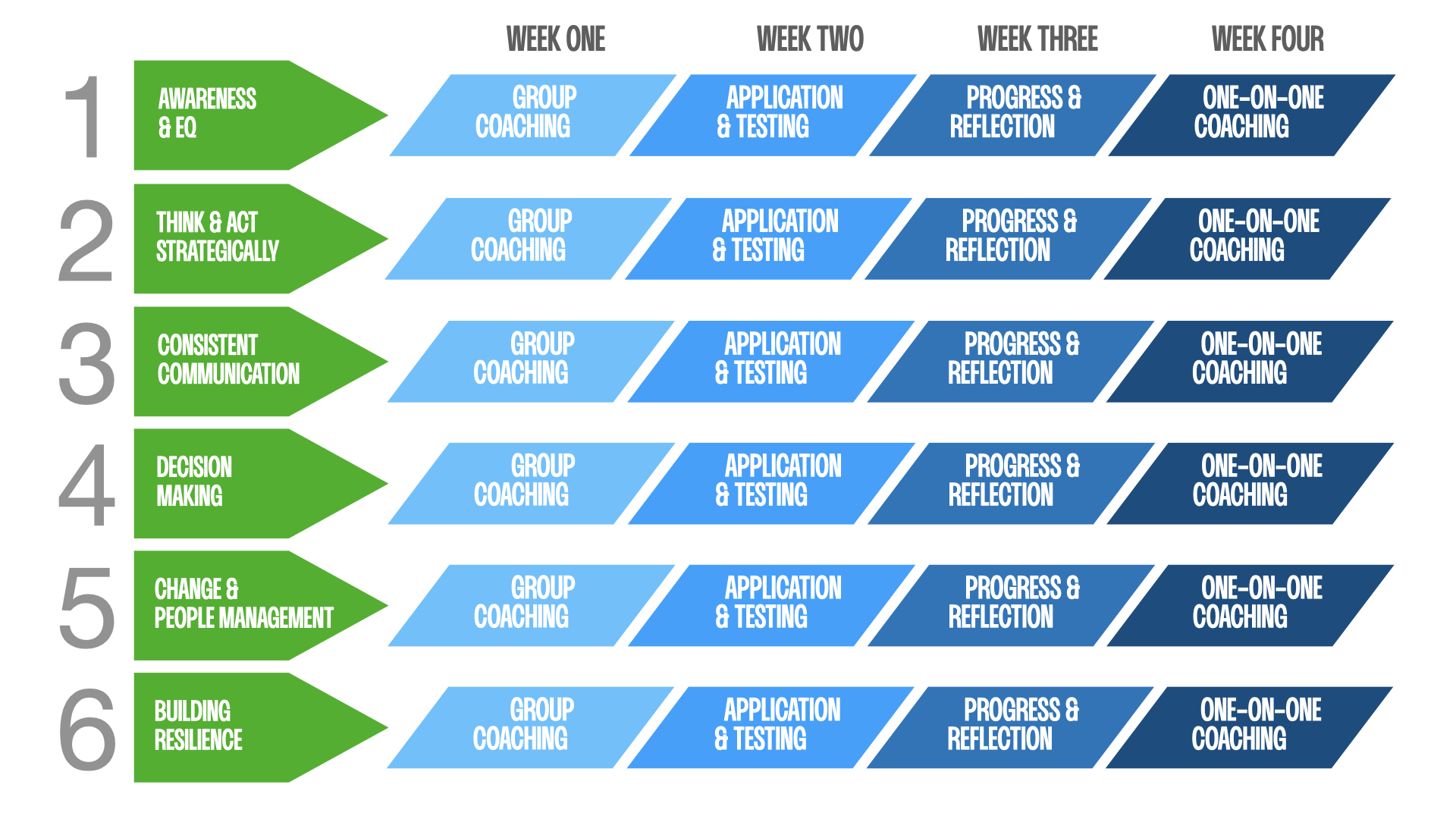
Month One: Awareness & EQ - Understanding your leadership foundation and building your mindset for success.
Month Two: Think & Act Strategically - Structure and planning to deliver results.
Month Three: Consistent Communication - The leadership linchpin so everyone works from a common blueprint.
Month Four: Decision Making - Analyze the situation and communicate your decisions without reservation or procrastination.
Month Five: Change & People Management - Reward your performers, grow your middle, and assess your problem children.
Month Six: Building Resilience - How to react to adversity when it’s coming from all directions.
Each Month We Will Have:
Week One: Group Coaching - we kick off each month with a 60-90 minute group coaching session.
Week Two: Application & Testing - each participant takes their learning and applies it to their situation.
Week Three: Progress & Reflection - each participant receives 3 questions so they can reflect on their progress.
Week Four: One-On-One Coaching - we meet with each participant to review their success and obstacles.
If you want a top-notch program, remember it's not a one-time event but a journey. Provide continuous support, feedback, and opportunities for learning and development. Foster a culture of continuous improvement and make learning a norm, not an exception.
I hope these insights give you a good starting point. A successful middle manager program is one that is tailored to your organization and its people. Because, at the end of the day, it's all about your people, and investing in them is the best investment you can make.
The Biggest Opportunity For Business In 2023.
If you've got a team loaded with whip-smart, initiative-taking pros, particularly outcome-driven ones, it's time to cannonball into the remote work pool. No kidding.
We all see it, yet no one is acting on it.
This is the hidden secret about remote work:
If you've got a team loaded with whip-smart, initiative-taking pros, particularly outcome-driven ones, it's time to cannonball into the remote work pool. No kidding.
Think about it: thanks to their overcommitted real estate budgets, you could easily out rival mega-corporations still insisting on 2 or 3-day office returns.
Trust me; thanks to the irresistible allure of remote work, you’ll poach talent from their ranks like you never could before.
Imagine this: most folks dream about living on the coast in North Carolina, enjoying a sunny view in Florida, or enjoying a lush autumn forest in Vermont.
They don't fancy getting boxed in on I-95, battling insufferable traffic, and coughing up vast chunks of their paycheck for the privilege.
Despite plush office spaces, free lunches, gyms, and unlimited snacks, people are not swayed. Give them the freedom to work from the comfort of their home, pick up their kids from school, and watch them ditch you quicker than you can say "napping pod."
Look, this is a golden chance to turbocharge your average-Joe business with ambitious future leaders, the kind who will drive your enterprise forward for years to come. These are the folks who'll flourish remotely because, let's face it, they've never needed a helicopter boss.
Worried about training, mentorship, and those spontaneous hallway chats? Don't. In this digital age and considering the current nature of most workplaces, these concerns seem downright laughable. Besides, look at the impressive productivity outcomes of remote work in recent years.
Sure, for argument's sake, let's say there might be a minor hiccup in training or onboarding fresh faces. But that's a molehill compared to the mountain of opportunities you'd miss if you don't seize the remote work moment.
Here's the kicker, though: remote work isn't a one-size-fits-all. If you genuinely need on-site staff or have employees who aren't cut out for it, fair enough. But, otherwise, you should be bucking the trend and piling your chips on a remote workforce, pronto.
Prove To Yourself That You Can Do The Hard Things In Life.
The secret to overcoming this isn't some mystical wisdom. It is proving to yourself that you can, indeed, do the hard things in life.
In the mid-1990s, J.K. Rowling found herself in what she has described as "rock bottom." Recently divorced, living on state benefits, and with a dependent child, she was diagnosed with clinical depression. During this challenging time, she began writing 'Harry Potter and the Philosopher's Stone' in cafés around Edinburgh while her daughter Jessica slept beside her in a pram.
When she finished the manuscript, she sent it to numerous publishers, only to be met with rejection. Rowling's efforts seemed fruitless, and her situation remained the same – she was a single mother living on state benefits and now an aspiring author with a manuscript nobody seemed to want.
However, she didn't let the circumstances defeat her. She believed in her story and her ability to tell it. So she kept trying. After countless rejections, the manuscript finally landed on the desk of Barry Cunningham at Bloomsbury Publishing. He decided to give it a chance. But even then, he warned Rowling that she should get a day job because she wouldn't make much money in children's books.
J.K. Rowling, however, proved him wrong. Harry Potter became a worldwide phenomenon. Today, she's one of the wealthiest authors in the world, but more importantly, her books have touched the lives of millions of readers around the globe.
This story illuminates J.K. Rowling's journey through some of the most challenging parts of her life. It's a powerful reminder that believing in ourselves, persisting through the hard times, and continuing to work towards our dreams, even when impossible, can lead to extraordinary outcomes.
Everyone is a mélange of potent talents, remarkable abilities, and untapped potentials. Despite this fact, we often find ourselves battling with self-doubt, indecision, and fear. The immense difficulty of stepping out of our comfort zones and surmounting life's challenges is often what holds us back. The secret to overcoming this isn't some mystical wisdom. It is proving to yourself that you can, indeed, do the hard things in life.
We each have our battles to fight and mountains to climb. Life can be a relentless test of resilience, from physical challenges to mental barriers, from emotional traumas to financial predicaments. But what if we could turn this picture around? What if we could tell ourselves a different narrative in which we aren't just surviving but thriving?
Let's dive deeper and understand how to rewrite this narrative, one hard thing at a time.
Embrace The Difficulty
The first thing to acknowledge is that life is hard. It is filled with uncertainties, disappointments, and failures. It's like a roller-coaster; sometimes, you're up, and sometimes down. The trick is not to make life easier but to make yourself stronger. Embrace the difficulty. See it not as a hindrance but as an opportunity to grow. Understand that adversity is what sharpens us and pushes us beyond our limits.
Practice Persistence
It's about something other than getting it right the first time. It's about sticking with it until you get it right. Rome wasn't built in a day, and neither is resilience and tenacity. It takes time, dedication, and immense perseverance to reach the finish line. Sometimes, it might seem easier to throw in the towel, but that's when you need to remind yourself why you started in the first place.
Cultivate a Growth Mindset
This is where the magic happens. Cultivating a growth mindset means believing you can improve and grow through experience and practice. This means embracing challenges, persisting in the face of setbacks, learning from criticism, and finding lessons and inspiration in the success of others. It's the belief that you can change, adapt, and evolve. This mindset is what sets the doers apart from the dreamers.
Build a Support Network
We are social beings, and our journey becomes a lot easier when we have like-minded people around us. Build a support network of people who inspire, challenge, and believe in you. They will pick you up when you fall, motivate you when you're running out of steam, and celebrate your victories with you.
Celebrate Small Victories
No matter how small, every step you take in the right direction is a victory. It's essential to celebrate these small wins. They serve as a reminder that you are making progress and moving forward. It boosts your confidence and keeps you motivated.
Let's boil them down into actionable steps:
1. Acknowledge the Hard Things: Be honest about what you find challenging. It's not a sign of weakness but the first step towards growth.
2. Set a Goal: A clear, tangible goal gives you something to aim for. Make sure it's measurable, attainable, relevant, and time-bound.
3. Embrace the Process: Understand that it's a journey. There will be obstacles and setbacks, but they are part of the process. Don't rush it.
4. Cultivate a Growth Mindset: Approach each challenge believing you can overcome and learn from it. This is what will fuel your persistence and resilience.
5. Build Your Support Network: Seek out individuals or groups who will support and inspire you. Remember, it's okay to ask for help.
6. Celebrate Your Progress: Recognize and celebrate each small victory. This will keep you motivated and remind you how far you've come.
The journey to prove that you can do the hard things in life is not easy, but it's worth it. Remember, the more complex the battle, the sweeter the victory. You are more capable than you know. You have to believe it and then prove it.
Pick one today and try it.
Leading by Learning: Carving Out Time for Your Self-Development.
Your team looks up to you for guidance, inspiration, and mentorship. This means that your own growth, both professionally and personally, can directly impact the development and performance of your team.
Reclaiming Your Time: Strategies for Busy Managers
As a manager, it’s easy to get caught up in the hustle and bustle of the workday, from leading team meetings and managing projects to resolving conflicts and making crucial decisions.
Amid all this, finding time for personal development might seem like a luxury you can't afford. But let's be clear: growth isn't just a luxury—it's a necessity. In fact, it's a critical element that propels you forward, not just in your career but in your overall life journey. So, let's dive into how you, as a manager, can carve out time for your own development.
Why Self-Development is Critical
Your team looks up to you for guidance, inspiration, and mentorship. This means that your own growth, both professionally and personally, can directly impact the development and performance of your team. By investing time in your personal development, you enhance your skills, knowledge, and perspective, leading to improved decision-making, innovation, and leadership—translating to better team performance and morale.
Creating the Time
Let’s face it; time is a finite resource. You can't create more hours in a day, but you can optimize your time. Here's how:
1. Prioritize Your Tasks:
Start by identifying what’s really important. Employ the 'Eisenhower Box' technique, a simple decision-making tool that separates your actions based on four possibilities: urgent and important, important but not urgent, urgent but not important, and not urgent or important. This helps you focus on what truly matters, freeing up time for personal growth activities.
2. Delegate Effectively:
As a manager, you have the power to delegate. Utilize it! Trust your team with responsibilities; it saves you time and fosters a sense of ownership and responsibility among your team members.
3. Time Blocking:
Dedicate specific time slots in your day for focused learning. It could be 30 minutes in the morning or an hour after lunch. What matters is that you remain consistent and treat this time as non-negotiable.
4. Use Tech Tools:
Leverage technology to streamline your work processes. From project management tools like Asana to communication platforms like Slack, technology can save you a ton of time which can be used for personal development.
5. Mind Your Health:
Never underestimate the power of a healthy mind and body. Regular exercise, a good night's sleep, and proper nutrition can significantly boost your productivity, giving you more time during the day.
Embarking on Your Growth Journey
Now that you’ve made some time, how do you fill it? The answer is simple: invest it in yourself. Here’s how you can start:
1. Continuous Learning:
Engage in lifelong learning. This could be through reading books, attending webinars, enrolling in online courses, or even listening to podcasts related to your field.
2. Seek Feedback:
Actively seek feedback from your team, peers, and superiors. Constructive criticism can offer valuable insights into areas of improvement.
3. Practice Mindfulness:
Mindfulness enhances emotional intelligence, a key trait for effective leadership. Practice mindfulness through meditation, yoga, or simply taking a quiet walk.
4. Networking:
Building connections with others in your field can expose you to new ideas, perspectives, and opportunities. Attend networking events, participate in forums, or join professional social media groups.
5. Reflect and Adjust:
Make time for self-reflection. Analyze your actions, decisions, and their outcomes. Use these insights to adjust your strategies and behaviors.
Ultimately, the journey to personal development is continuous, with no definite end. It’s about building a better version of yourself every day. As a manager, the steps you take toward your own growth will have a domino effect, inspiring your team to follow suit. So, take the leap, make the time, and watch as you propel yourself and your team toward growth and success.
The Secret of Inspiring Others : Unleashing the Power of Influence.
Inspiration is a powerful force. It can motivate people to move mountains, create masterpieces, and change the world. But how does one inspire others? The answer lies in the complex web of human connection - the power to inspire is within each of us; unlocking it is a matter of understanding and applying a few critical principles.
Inspiration is a powerful force. It can motivate people to move mountains, create masterpieces, and change the world. But how does one inspire others? The answer lies in the complex web of human connection - the power to inspire is within each of us; unlocking it is a matter of understanding and applying a few critical principles:
Authenticity Shines
The first step to inspiring others is to be authentic. Authenticity fosters trust and rapport, providing a solid foundation for inspiration to take root. People are more likely to follow and be inspired by genuine and honest people about who they are, what they believe in, and what they aim to achieve.
Action Step: Self-awareness is the key to authenticity. Engage in self-reflection to understand your values, motivations, and passions. Use this understanding to guide your actions and communications and share your experiences genuinely. (resource)
Empowerment Through Empathy
Understanding others' emotions and perspectives – empathy – is another critical factor in inspiring others. It shows that you value them and their experiences, which can build a strong connection and make them more open to your influence.
Action Step: Cultivate empathy by actively listening when others speak. Don't just hear the words – strive to understand the emotions, perspectives, and motivations behind them. Show that you care through your responses and actions. (resource)
The Power of Vision
People are inspired by those with a clear, compelling vision for the future. A compelling vision can stir emotions and create a sense of purpose that drives people to action.
Action Step: Define and articulate your vision clearly and passionately to others. Use vivid language and storytelling to help people visualize the future you want to create. Regularly reinforce your vision and how each person contributes to achieving it. (resource)
Walk the Talk
Actions speak louder than words, and inspiring others requires you to lead by example. People are inspired by those who live out their values, pursue their passions, and overcome obstacles with grace and determination.
Action Step: Align your actions with your values and vision. When faced with challenges, tackle them with tenacity and a positive mindset. Show resilience in adversity and openly share your journey and the lessons you've learned. (resource)
Encourage and Appreciate
Inspiration often grows in a positive, supportive environment. Encouraging others and appreciating their efforts nurtures their self-belief and desire to contribute. It gives them the courage to stretch their boundaries and strive for greatness.
Action Step: Regularly acknowledge and appreciate others' efforts and achievements, no matter how small. Provide constructive feedback and offer support to help them improve. Foster a culture of collaboration and mutual respect. (resource)
Continuous Learning and Growth
People are inspired by those who embody a growth mindset - continuously learning, adapting, and seeking to improve. This mindset not only fuels your own development but also motivates others to do the same.
Action Step: Seek out opportunities for personal and professional development. Embrace feedback, view failures as learning opportunities, and share your growth journey with others. Encourage and facilitate learning within your team or community. (resource)
Be A Positive Force.
A positive attitude is contagious. When you are positive, it rubs off on others and makes them feel good. You might come to work with a bad attitude from home or leave a meeting with a heavy workload. Don’t unload it onto your team — always look at the bright side and deliver a motivating viewpoint to energize your team.
Action Step: Make an effort to see the good in every situation and focus on your life’s positive aspects. Smile and energize your delivery. (resource)
The secret to inspiring others isn't an elusive magic formula. By practicing these principles and actions, you can unlock the power to inspire others and significantly impact their lives and the world around you.
Maximize Your One-on-Ones: Essential Questions for Your Boss.
One-on-one meetings with your boss can be a powerful tool to enhance your career development, improve your relationship, and clarify work expectations.
Pave the Way for a More Successful
and Productive Working Relationship
One-on-one meetings with your boss can be a powerful tool to enhance your career development, improve your relationship, and clarify work expectations. These interactions are crucial not only for catching up on your projects and receiving feedback but also for expressing your concerns, proposing new ideas, and understanding your boss's expectations and the company's vision.
A list of well-crafted questions can ensure these meetings are productive and meaningful. They allow you to delve deeper into your work, enhance your performance, and demonstrate your dedication and professional growth.
However, your questions must be thoughtful, relevant, and constructive. They should encourage open dialogue, generate valuable insights, and lead to mutual understanding and respect. The goal is to create a collaborative relationship where both parties feel heard, valued, and motivated to work towards common objectives.
In this context, I've prepared a list of 20 questions you can consider asking in your one-on-one meetings with your boss. Each question highlights your commitment, interest in growth, and dedication to the team's success while giving you valuable feedback and direction for your professional journey.
Understanding Objectives and Expectations:
What key objectives would you like me to focus on in the upcoming weeks? This question can help clarify your immediate priorities.
What are the top priorities for our team this quarter? Keeping abreast of team priorities helps you align your work effectively.
How do my current tasks align with the company's larger goals? This helps you understand the broader context of your work.
Seeking Feedback and Improvement:
What areas of my performance are strong, and where could I improve? This allows you to understand your boss's perception of your work and areas for potential growth.
Please share some feedback on my latest project/presentation/etc. Specific, direct feedback helps you grow professionally.
How do you evaluate success in my position? Understanding how your performance is assessed can help you focus your efforts.
Is there anything you'd like to see me do differently? This direct question shows your openness to constructive criticism.
Professional Development and Growth:
Is there a skill I should learn or develop further? This can uncover opportunities for professional development.
What opportunities are there for advancement within our team or the company? This shows ambition and forward-thinking.
What are some habits or practices of top-performing employees in our organization? Learning what is valued can guide your professional behavior.
How can I improve in managing my time and prioritizing tasks? Here, you're seeking guidance to increase your efficiency.
Can you recommend any resources (books, podcasts, courses) that could help my professional growth? It shows initiative and a desire to continue learning.
Contributing To Your Team's Success:
How can I contribute to the team's goals more effectively? This question highlights your interest in team success, not just individual achievement.
Are there any specific projects or initiatives you'd like me to be involved in? This question signals your willingness to take on new responsibilities.
How can I help foster better communication within our team? This showcases your commitment to a positive team environment.
How can I support my colleagues more effectively? This question emphasizes your commitment to teamwork.
Understanding Future Challenges and Vision:
How can I help alleviate some of the challenges you're facing? Showing empathy towards your boss's difficulties can strengthen your working relationship.
What are the most significant challenges our team/company will face in the upcoming months? This promotes a proactive approach to problem-solving.
Could you share your vision for our team for the next year? Understanding your boss's vision can give you a sense of direction.
What's the best way to share ideas or suggestions for the team or company? Encouraging an open dialog promotes innovation and mutual respect.
Take Action.
I want you to pick one question that applies to your situation, walk into your boss’ office, and ask. Not only will they be impressed with your question, but you will also immediately grow in their eyes and get a positive answer (hopefully!).