

ARTICLES
Written By Rich For You.
Hybrid Work — Do What's Best For You.
HR departments are starting to communicate parameters of hybrid schedules to the employee population. I have one thing to say to everyone in this situation . . .
It’s been a long 22 months . . .
The accelerated effects of the pandemic on workplace life have, in fact, delivered a much-needed surprise — working from home.
Many companies and organizations are finding it advantageous to let their employees work from home because they have stumbled into many added benefits — productivity gains, reduced facility costs, and happier employees (who don’t have that long commute and can stay closer to their families).
As 2022 is almost upon us, management and HR are devising novel plans to embrace hybrid work so it benefits their needs and keeps their best people happy, engaged, and distant from the idea of fleeing the coop for another company.
HR departments are starting to communicate parameters of hybrid schedules to the employee population. I have one thing to say to everyone in this situation:
Do What’s Best For YOU.
Because, in the end, hybrid work is for YOU — your happiness and your productivity. So ensure your hybrid schedule benefits your situation, your productivity, your home life. It will not only ensure that you can continue with this new situation, but you can also enjoy and grow with it.
We all know that we rarely worked a full and productive 8-hour day. We filled the gaps with boring meetings, longer-than-needed phone calls, chatting with cubical colleagues, taking long lunches, etc. Just read Tim Ferriss’ first book, The Four-Hour Workweek (btw, he has an incredible podcast — catch it here).
Figure out what days are best for you to commute to the office and what days are best for you to work from home — when you’re most productive, engaged, and when it’s best for your home life, interests, and growth opportunities. Then communicate your needs (requirements) to your manager ASAP.
Again, hybrid work is for YOU — so take advantage of this new normal and make it work for you.
And maybe someday, hopefully in the near future, we might see the advent of a four-day workweek (it’s starting to happen).
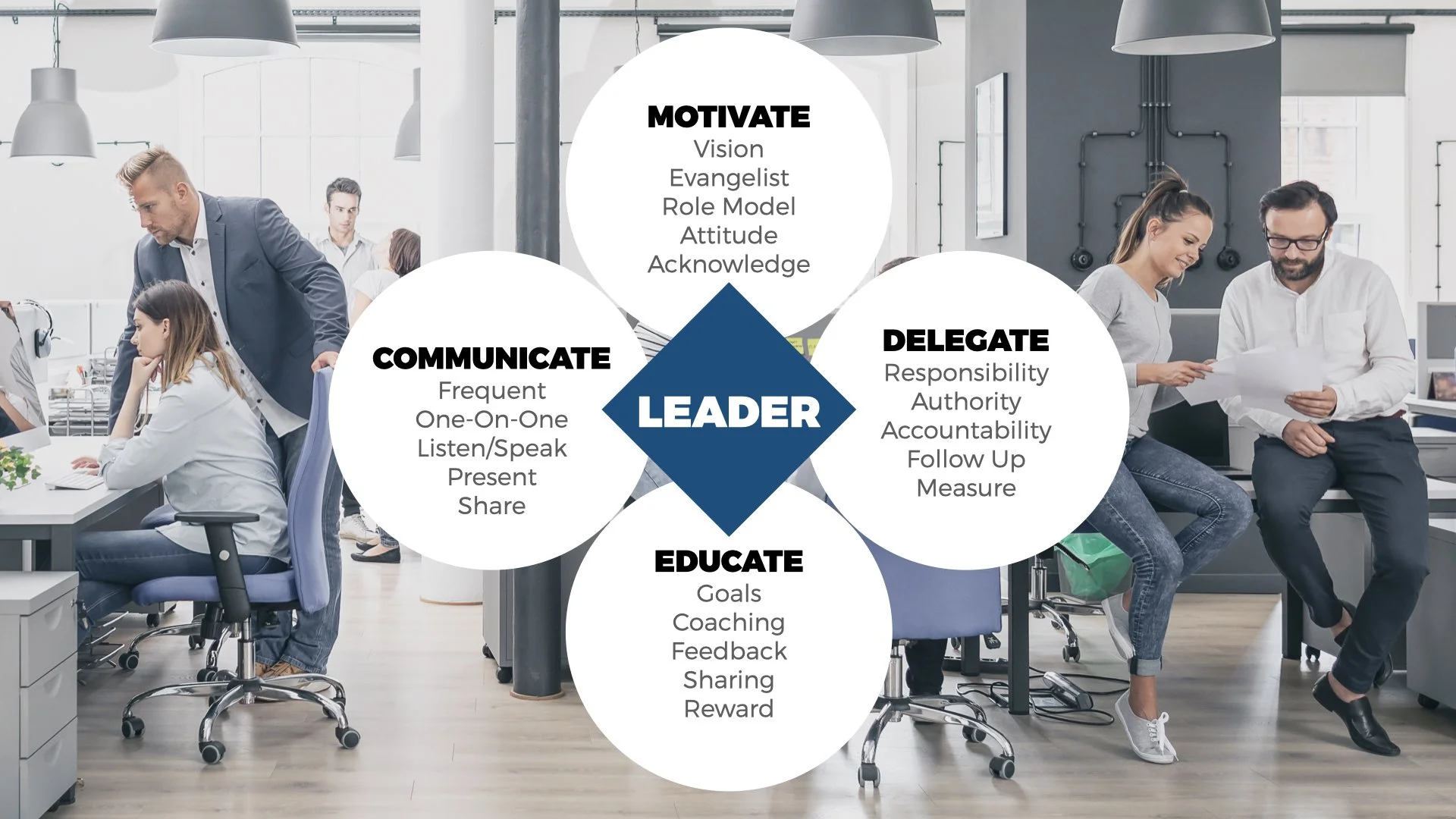
We've just launched a new program: The Four Elements of Transformational Leadership where we engage managers on how to effectively communicate, motivate, educate, and delegate their teams.
It’s a series of customized timely workshops for your team to focus on growing their leadership skills over a series of months. Why months?
People learn by doing, not just attending a single 8-hour offsite — our program ensures that each candidate learns, understands, and takes action after each 60-90 minute live session.
In addition, we include one-on-one coaching sessions for each candidate to follow up on their progress, answer any questions they might have, and reinforce the right behaviors so they apply what they've learned in their day-to-day interactions.
Motivate Your Team So They Stick Around.
Successful leaders figure out how to strategically motivate their team every day. The more they inject enthusiasm, energy, and excitement into a typical workday, the more loyal and engaged each associate will be.
"They should motivate themselves — I've got too much to do!"
And suddenly, your best people give their notice and leave.
It's a FACT: Successful leaders figure out how to strategically motivate their team every day. The more they inject enthusiasm, energy, and excitement into a typical workday, the more loyal and engaged each associate will be.
Here are 5 simple actions to motivate more like a leader:
Start with your attitude.
SMILE! You are the beacon of motivation for your team — if you aren't presenting your best self every day, nothing else will motivate your team. Set the example — make sure you start every day on a positive note and carry it through all eight hours. Don't let momentary issues drag you down — present to your team that the right attitude can conquer all problems, "We'll figure it out.". Unfortunately, you can't fake it — they will see it a mile away — be sincere and honest.
Ensure a healthy working environment.
Protect your team from malicious 'external forces' — we all know them, the over-zealous, competitive peer or over-bearing boss that brings the whole department down with their fears or insinuations. Your job as their leader is to let them know NOT to listen to these characters and get them back on track. Everyone loves to pick on success (look at Tesla, Apple) — your job is to insulate your team from their drama and re-focus them on their goals.
Find the right fuel to energize each associate.
This is the big kahuna — most managers have a 'managing script' they use to keep their people in line. Great leaders figure out what specific actions and communication patterns to use with each direct report to elevate their mindset and take action daily. Find out each 'fuel' and make sure their tank is filled up daily. Don't be that manager who drains their team's gas tank with unreasonable requests or out-of-the-blue critiques on their progress. It does the exact opposite of what you want — an engaged team that willingly supports you.
Be unpredictable with your motivation.
Mix it up — don't do the same things each week to the same people — it gets obsolete quickly. Think of new ideas and strategies to motivate your team members. I had a great manager many years ago who was an incredible motivator — right out of the blue, he grabbed us in the early afternoon and said he had 3 tickets to the tennis open, would we like to go? We all hopped in his car and had a wonderful time. The more you mix it up with your team, the more motivated they will become.
Embrace those who thrive; eject the problem children.
Get rid of the gossip, the behind-the-scenes drama — some people will bring the energy of the group down with just one well-placed juicy tidbit, "I hear they're reorganizing". You need to stamp out that type of behavior where it starts by compartmentalizing and re-directing that person or figuring out how to separate them from your team. These people are insidious and will counteract anything you try to do with their constant criticism and negative sarcasm. Fix or eject them ASAP.
Action Step:
Come into the office (physical or virtual) tomorrow and show them your energized and positive attitude. Follow the steps over the next week and see what transpires — you might be surprised how quickly your team embraces it.
We can go so much deeper into Motivation — but we wanted to give you a few quick, actionable steps to take away and use this week.
This is part four of our 4-part series on Leadership.
We've just launched a new program: The Four Elements of Transformational Leadership where we engage managers on how to effectively communicate, motivate, educate, and delegate their teams.
It’s a series of customized timely workshops for your team to focus on growing their leadership skills over a series of months. Why months?
People learn by doing, not just attending a single 8-hour offsite — our program ensures that each candidate learns, understands, and takes action after each 60-90 minute live session.
In addition, we include one-on-one coaching sessions for each candidate to follow up on their progress, answer any questions they might have, and reinforce the right behaviors so they apply what they've learned in their day-to-day interactions.
Educate Your People To Build A Solid Team.
Great leaders build a learning journey for every team member who reports to them. Success relies on the consistent growth of your team, expanding their knowledge base and experience.
"You know your job — just do it!"
Most managers forget that educating your troops is an ongoing process.
Great leaders build a learning journey for every team member who reports to them. Success relies on the consistent growth of your team, expanding their knowledge base and experience. That approach is what keeps everyone happy and engaged (and not leaving for another firm).
Here are 5 simple actions to educate more like a leader:
Use an assessment to uncover their strengths.
Before you start making assumptions — use an established assessment tool to help you target what areas need work. A great tool I use is Strengthsfinder 2.0 by Tom Rath - it presents hundreds of strategies for applying your team member's strengths and also change the way they look at work forever.
Expose them to new opportunities.
Work gets boring after a while — especially when you've mastered many of the areas where you are responsible. A good leader recognizes that the associate is at the end of their learning runway and they need to pull back the curtain. Expose them to something totally new — a new project, process, group, especially if it significantly takes them out of their comfort zone.
Coach them and teach them to be coaches.
Coaching is the cornerstone of professional growth — if you share your coaching skills with your team (most managers keep them tightly hidden), you'll see them grow exponentially. And it's a virus — it will spread from your team to other departments and the higher-ups will see the positive effects with increased productivity and fewer personnel issues.
Implement job rotation to mix it up.
Move your people around frequently — ensure that they're learning a broad spectrum of abilities, communication skills, and talents. If you just exercise one muscle, the others will atrophy. Make sure that you move your people into areas that test and strengthen their weaker business muscles. This also helps with those tedious tasks no one wants - share.
Give them purpose.
I've saved to best for last — don't just teach them checkers, give them the space to learn complex chess moves. For every educational growth level you present, show them the powerful purpose of it's effects and how it makes all ships rise in the organization. That will ensure a bright future for your people by exposing them to the rest of the company, frequently.
Action Step:
Over this holiday season, implement a strengths assessment. It will guide you on how to educate your team to a higher knowledge and experience base in 2022.
We can go so much deeper into Education — but we wanted to give you a few quick, actionable steps to take away and use this week.
This is part three of a 4-part series on Leadership.
We've just launched a new program: The Four Elements of Transformational Leadership where we engage managers on how to effectively communicate, motivate, educate, and delegate their teams.
It’s a series of customized timely workshops for your team to focus on growing their leadership skills over a series of months. Why months?
People learn by doing, not just attending a single 8-hour offsite — our program ensures that each candidate learns, understands, and takes action after each 60-90 minute live session.
In addition, we include one-on-one coaching sessions for each candidate to follow up on their progress, answer any questions they might have, and reinforce the right behaviors so they apply what they've learned in their day-to-day interactions.
Do You Need To Delegate More To Be Successful?
Leaders build a delegation strategy in everything they do. The more they delegate lower-level tasks, the more time they have to spend planning, leading, communicating, and growing their team.
"I hate to delegate — it's easier if I just do it myself."
That's a recipe for a management disaster.
Leaders build a delegation strategy in everything they do. The more they delegate lower-level tasks, the more time they have to spend planning, leading, communicating, and growing their team.
Here are 5 simple actions to delegate more like a leader:
What will you delegate?
Effective delegation begins with defining your critical/difficult and non-critical/easy responsibilities. Make a quick list and then target the less critical and easier to accomplish items for your team members. We usually do the easier ones because we like them or they distract us from the more difficult ones. Be honest with yourself: what can you give away?
Who will you delegate to?
Andrew Carnegie once said, “The secret to success lies not in doing your own work, but in recognizing the right person to do it.” The key to finding the right person to delegate an assignment to is to match their skills and attitude to the task at hand. Sometimes you might have to stretch someone's abilities to fit the responsibility - go for it.
Clarify the result.
Show them what to do, how to do it, who to interact with, and most importantly, the deadline. The more clear you are with your team member, the more effective they will be in solving your problem. In addition, they might come up with an innovative way of solving it!
Make them accountable.
They own the activity. Make sure they understand the ramifications of dropping the ball or doing an incomplete delivery (this is one of the enemies of delegation). They can enlist others to be responsible for discrete areas of the activity, but in the end, they are accountable.
Follow up.
Monitor their progress during the span of the project — schedule touch-base meetings to review what they've accomplished and if they are floundering. Pick them up, reorient them, and ensure they are back on track. Always have them deliver first thing in the morning, so if they miss something, they have the rest of the day to fix it.
Action Step:
Take a lower-level task and delegate it this morning. Follow the steps and see what transpires — you might be surprised how easy it is.
We can go so much deeper into Delegation — but we wanted to give you a few quick, actionable steps to take away and use this week.
This is part two of a 4-part series on Leadership.
We've just launched a new program: The Four Elements of Transformational Leadership where we engage managers on how to effectively communicate, motivate, educate, and delegate their teams.
It’s a series of customized timely workshops for your team to focus on growing their leadership skills over a series of months. Why months?
People learn by doing, not just attending a single 8-hour offsite — our program ensures that each candidate learns, understands, and takes action after each 60-90 minute live session.
In addition, we include one-on-one coaching sessions for each candidate to follow up on their progress, answer any questions they might have, and reinforce the right behaviors so they apply what they've learned in their day-to-day interactions.
Do You Need To Communicate More To Be Successful?
You have to communicate strategically to your team, peers, and key people above you to be a great leader.
"Yeah, yeah . . . I have to communicate more."
NO, not 'more'.
You have to communicate strategically to your team, peers, and key people above you to be a great leader. It's not MORE communication, it's how, when, what, and why you're communicating.
Too many managers blather on, micromanage, pick on weaknesses, and worst of all, give faint praise at the worst time.
You do not want to be this person. You want to say the right things, at the right time, to the right people.
Here are 3 simple actions to communicate more like a leader:
PLAN AHEAD
Take time to see the big picture — who are your key connections — team members, peers, and superiors. Develop a plan on why you will communicate with them and how you will deliver that communication.
Every morning, take a few minutes and architect who you will interact with that day, what message you will use, and what it will accomplish. This should only take 3-5 minutes if you do it daily.
BE AUTHENTIC
Weak managers hurry their communication (bad status meetings, faint praise, etc.). You have to be visible and approachable.
Powerful leaders exude messages from the heart, target their statements with precision and ensure the recipient not only understands the meaning but reacts in an expected fashion. And they add a bit of fun too.
COMMUNICATE IN THE MOMENT
You can’t plan for everything — sometimes leaders are called upon to make a snap decision, ask for resources from their boss, or help a peer with a problem.
This only comes with experience and practice. Bad managers shy away from these opportunities, leaders dive right in and practice their craft.
At first, you will not be perfect, but as you hone your ability, you will find authentic, spot-on communication will flow right off your tongue.
We can go so much deeper into Communication — but we wanted to give you a few quick, actionable steps to take away and use this week.
This is part one of a 4-part series on Leadership.
We've just launched a new program: The Four Elements of Transformational Leadership where we engage managers on how to effectively communicate, motivate, educate, and delegate their teams.
It’s a series of customized timely workshops for your team to focus on growing their leadership skills over a series of months. Why months?
People learn by doing, not just attending a single 8-hour offsite — our program ensures that each candidate learns, understands, and takes action after each 60-90 minute live session.
In addition, we include one-on-one coaching sessions for each candidate to follow up on their progress, answer any questions they might have, and reinforce the right behaviors so they apply what they've learned in their day-to-day interactions.