The Performance Ceiling.
Hey there,
I see business owners lie to themselves all the time. They hit a wall, growth stalls, and they immediately blame the market, the economy, or their team's inability to execute. But let’s not sugarcoat it. The stagnation that traps your business between $1M and $10M is not a market problem or a demand problem. It is a leadership architecture problem.
The harsh reality is that the exact skills, habits, and operating model that took your business from $0 to $1M are the exact same things that will trap you between $1M and $10M. What got you here will not get you there. Those early skills were essential, but they have a structural expiration date.
I call this invisible constraint The Performance Ceiling. It traps businesses in a cycle of stagnation that effort alone cannot solve. You cannot outwork a structural problem. Yet, most founders just keep treating the symptoms by hiring more people, adding more tools, or building more processes, completely blind to the real constraint. Left unaddressed, this ceiling doesn't just stall your growth—it reverses it and erodes your margins.
If your strategy is to work harder, throw it out. You need to recognize the symptoms for what they actually are.
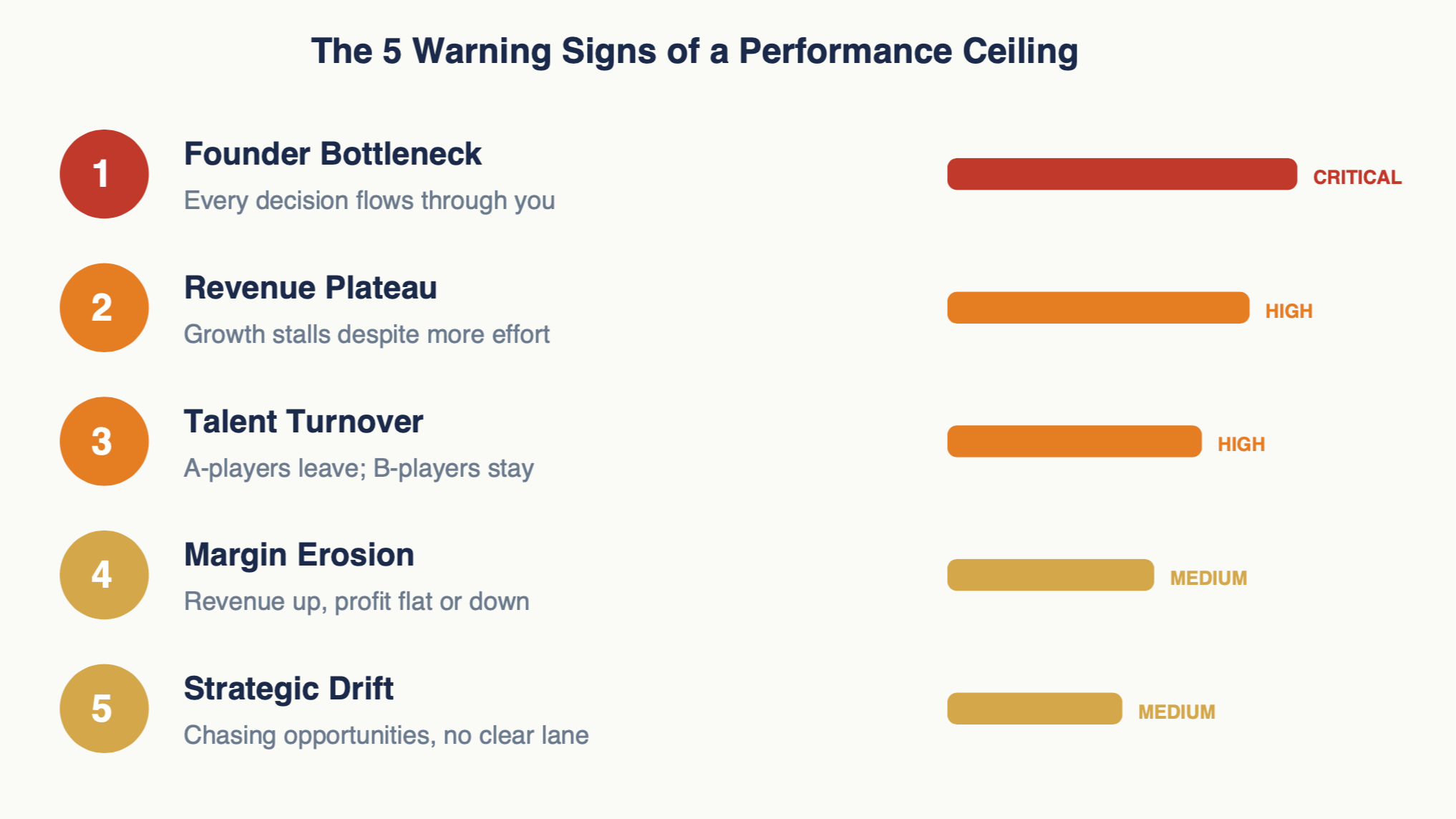
1. The Founder Bottleneck: Every meaningful decision routes through you. Your team waits for your input, your approval, your sign-off. You tell yourself this is quality control, but it is actually the single biggest growth constraint in your business. When you are the bottleneck, your company can only grow as fast as your calendar allows. The math is brutal: one person, even a great one, cannot scale.
2. The Revenue Plateau: Revenue growth decelerates despite increasing effort and investment. You are adding sales reps, increasing marketing spend, and launching new offerings, but the top line barely moves. This is not a sales problem. It is a signal that your current operating model has reached its structural maximum output.
3. Talent Turnover: Your best people leave, and the ones who stay are the ones who are comfortable with the status quo. This is not a compensation problem. A-players leave when they cannot grow, when they have no real authority, or when they see that the founder will never truly let go. You end up with a team that can follow instructions but cannot lead.
4. Margin Erosion: Revenue inches up but profit stays flat or drops. You are spending more to earn the same. This happens when you add complexity, like people, services, or tools, without adding strategic leverage. More inputs, same output. It is the financial signature of a business hitting its ceiling.
5. Strategic Drift: You chase every opportunity that looks promising, whether that's new verticals, new partnerships, or new product ideas. None of them get the sustained focus required to actually work. This is not ambition—it is anxiety. When the core business stalls, founders instinctively diversify, which results in a company that does six things at 60% instead of two things at 100%.
The Hard Truth
If three or more of these describe your business right now, you are not looking at isolated problems. You are looking at your own ‘Performance Ceiling’.
Stop responding to a structural failure with brute force. You need to rebuild your business's leadership and operational architecture so that growth is structural, not heroic. The goal is a company that scales without depending on any single person.
I’ve broken down exactly how to do this in my new Business Insight Report: The Performance Ceiling: Why Your Business Stalls Between $1M and $10M - And the Proven Framework to Break Through.
Read the report, stop making excuses, and start fixing the foundation.
Reach out (richgee@richgee.com) and tell me which of the 5 warning signs is bleeding your business the most right now.