

ARTICLES
Written By Rich For You.

Who’s Got the Monkey? Mastering Delegation for High-Performance Teams
A few months ago, I found myself in the middle of a workshop with 72 eager executives, all facing the same challenge: managing their growing responsibilities without getting buried under an avalanche of tasks.
A few months ago, I found myself in the middle of a workshop with 72 eager executives, all facing the same challenge: managing their growing responsibilities without getting buried under an avalanche of tasks. This wasn’t just another leadership session—it was a high-stakes opportunity to help these leaders reclaim their time and empower their teams. As we delved into various management techniques, one particular concept resonated deeply with the group: the idea of “Who’s Got the Monkey?” from a seminal Harvard Business Review article.
The company that organized this workshop was at a critical juncture, rapidly expanding and requiring its leaders to operate at peak efficiency. They were eager to refine their management practices and avoid the pitfalls of rapid growth. The stakes were high, and the pressure was on.
This article shares the key points from that workshop, specifically how the principles from “Who’s Got the Monkey?” can transform your approach to delegation and team management.
The Concept of Customer Experience
One of the core discussions during the workshop was around the customer experience, a concept that goes beyond mere satisfaction. It’s about creating an emotional and transactional connection that fosters loyalty and advocacy. But how does this tie into “Who’s Got the Monkey?” The link is subtle yet powerful: managing customer experience requires attention to detail and clear ownership, as does managing your team’s responsibilities.
We explored how leaders often take on tasks—monkeys—that should remain with their team members. This not only overwhelms the leader but also disempowers the team. The lesson here was clear: for a leader to enhance the customer experience, they must first ensure their team is fully equipped and responsible for their own “monkeys.” This means setting clear expectations, providing the necessary tools, and allowing team members to manage their challenges.
Take Action: Evaluate how you’re managing your team’s responsibilities. Are you unknowingly taking on tasks (monkeys) that should belong to your team? Start delegating these tasks back to their rightful owners and watch your team’s efficiency—and customer experience—improve.
Shifting Focus from Value Proposition to Value Aspirations
The second point we discussed involved a common pitfall in business thinking: an overemphasis on the company’s value proposition at the expense of understanding the customer’s aspirations. In the context of “Who’s Got the Monkey?” this misalignment often manifests when leaders focus too much on their to-do list rather than enabling their team to achieve their goals.
In the workshop, I illustrated this by showing how leaders who focus only on their value proposition often end up with more monkeys on their backs. This happens because they’re more concerned with pushing their agenda than helping their team members fulfill their potential.
Take Action: Shift your focus to what your team aspires to achieve. Doing so empowers them and reduces the number of monkeys on your desk. This shift in focus not only changes the dynamic within the team but also broadens the understanding of value within the organization, leading us to the final point.
Implications for Business Leaders
Your role as a business leader is to drive value and cultivate it within your team. This means recognizing when you’ve taken on too many monkeys and consciously choosing to delegate them back. Doing so creates a more capable and motivated team, ultimately benefiting your customers and your business.
Final Thoughts
The key ideas from the workshop centered on the importance of customer experience, the shift from focusing solely on value propositions to understanding value aspirations, and the expanded view of value as it relates to effective delegation. The concept of “Who’s Got the Monkey?” was a powerful tool in helping these leaders understand the necessity of proper task delegation and team empowerment.
I encourage you to apply these strategies to your leadership practices. Start by identifying the monkeys you’ve been carrying that should belong to your team and begin the delegation process. By doing so, you’ll not only lighten your load but also build a stronger, more effective team.
Remember, outstanding leadership is not about doing everything yourself but empowering others to take ownership and thrive. As you grow as a leader, keep these principles in mind, and don’t be afraid to hand those monkeys back to their rightful owners. Your team—and your business—will thank you.

Overcoming Imposter Syndrome: A Strategic Blueprint for Professional Success.
Imposter syndrome—a psychological phenomenon in which individuals doubt their accomplishments and harbor a persistent fear of being exposed to fraud—is a formidable obstacle that many professionals face, especially those from underrepresented backgrounds.
"Stop renting space in your head to imposter syndrome; it's time to evict doubt and let Moxie sign the lease to your success!"
Imposter syndrome—a psychological phenomenon in which individuals doubt their accomplishments and harbor a persistent fear of being exposed to fraud—is a formidable obstacle that many professionals face, especially those from underrepresented backgrounds.
This deep-seated self-doubt can severely undermine one's confidence and stunt career progression, causing even the most qualified individuals to question their worthiness in their roles and achievements. However, overcoming this isn't merely a matter of willpower; it requires cultivating deep-seated resilience and determination, qualities embodied by the concept of Moxie.
Moxie is more than raw strength or boldness—a dynamic amalgamation of self-discipline, perseverance, and courage. It’s about the spirited resolve that drives individuals to confront internal and external doubts about their capabilities.
Moxie involves harnessing one's inner strengths—often developed through overcoming personal and systemic adversities—to persist through challenges that might otherwise seem daunting.
For professionals wrestling with imposter syndrome, Moxie can be genuinely transformative. It counterbalances doubt, empowering individuals to confidently own their achievements and push beyond self-imposed and external boundaries.
Moxie is incredibly potent in environments like corporate boardrooms, where diversity is still advancing. It enables those who might feel like outsiders due to their background or identity not just to fill spaces where they are underrepresented but to thrive and lead within them.
Professionals can arm themselves with a powerful toolkit for ‘Moxie-ating’ their careers by understanding the interplay between imposter syndrome and Moxie. This toolkit isn't about denying the feelings associated with imposter syndrome but confronting and overcoming them through developing Moxie, a quality that, once harnessed, transforms barriers into stepping stones for success.
The journey to embracing Moxie involves several strategic actions that professionals can adopt to not only combat imposter syndrome but to excel in their careers:
1. Harness Cultural Strengths:
Draw on the resilience and attitudes shaped by overcoming cultural and systemic hardships. Reflect on your past adversities and the strategies you employed to navigate these challenges to develop a strong will and self-discipline. These insights are powerful tools that can enhance your professional approach and presence.
Go Deep - WHY do you feel like an imposter? Was it your upbringing? Was it one or a number of instances where you or someone else made you feel like an imposter? Our families usually play a large part in our imposter syndrome synthesis and continuity.
2. Engage in Identity Play
Experiment with new professional roles and behaviors. This means allowing yourself the space to grow into new challenges without the immediate pressure to perform perfectly. Identity play helps build confidence and adaptability, critical traits for thriving in unfamiliar or demanding situations.
I tell clients to act like Daniel Craig or Taylor Swift — act confident in uncertain situations and deftly place yourself into their persona — it works.
3. Ignore the Naysayers
It's crucial to actively disregard or challenge detractors who fail to recognize your value or contribute constructively to your growth. When faced with criticism, reframe it as a hypothesis to be tested, not a fact. This approach can transform potential negativity into a constructive learning opportunity.
Stay away from these energy vampires. Their role in your life and success is to bring you down, develop doubt in your abilities, and ultimately fail. Sometimes, the people closest to us exhibit this behavior to promulgate their lives by bringing us down in the process.
4. Make Strategic Decisions
Know when to persist and when to walk away. Assess the demands of overcoming specific challenges and decide if they merit your time and energy. This ensures that your efforts are invested in realistic and rewarding goals, aligning your resources with your career aspirations.
Be vicious with your decisions. If they aren’t growing your Moxie and confidence, stop doing them and re-target your focus to easier or higher-performing actions.
5. Learn Through Discomfort
Embrace a mindset that sees challenges and discomfort as opportunities for growth. Commit to ongoing personal and professional development by taking risks and testing new behaviors. Understanding that transformative learning occurs outside comfort zones is essential for true growth and success.
This will hurt — any subtle or major change in our behavior puts us out of our comfort zone. We need to prepare for that uncomfortableness and build up our Moxie to overcome each challenge as it appears.
Final Thoughts
By adopting these strategies, individuals, particularly those from underrepresented backgrounds, can overcome imposter syndrome and systemic barriers and achieve their career aspirations with confidence and determination.
Remember, Moxie isn't just a trait but a journey that involves continuous learning, adaptation, and the courage to stand firm in the face of challenges. Make Moxie your superpower, and watch as it turns every barrier into a new opportunity for success.

Navigating New Horizons: Transitioning Successfully After Decades with One Company.
In an era where the average tenure at a job is diminishing, dedicating 20 to 30 years to one company is not just commendable—it's a rarity. It's a testament to loyalty, resilience, and the ability to adapt to changes within a single organization.
"Deciding to leave a company after decades is like finally deciding to change your favorite 20-year-old sneakers. It’s uncomfortable at first, but you'll sprint faster than ever once you realize the new ones have far better support, and you're not dragging years of accumulated gum under your soles."
In an era where the average tenure at a job is diminishing, dedicating 20 to 30 years to one company is not just commendable—it's a rarity. It's a testament to loyalty, resilience, and the ability to adapt to changes within a single organization.
However, there comes a time when moving on appears not just as an option but as a necessary step for personal growth, fresh challenges, or a change in scenery. You might also see major changes on the horizon that might impact your future — it’s time to make that move.
If you're contemplating or embarking on this significant transition, know that you're not just closing a chapter but also turning the page to an exciting new beginning. Here are essential action items to navigate this journey with confidence and success.
Embrace the Emotional Journey
Leaving a company after decades is not merely a professional change; it's an emotional journey. Acknowledge the mix of feelings—nostalgia, fear, excitement, and maybe even guilt. It's essential to process these emotions rather than suppress them. Talk to friends, mentors, or a coach who can help you navigate this emotional landscape. Remember, it's okay to grieve the end of an era as you prepare for the new adventures ahead.
Rediscover and Reinvent Yourself
After years at one company, you might find your identity deeply intertwined with your job and organization. This transition is your golden opportunity to rediscover who you are beyond your previous role. Ask yourself:
What are my core strengths and skills?
What passions have I neglected?
What do I want from my next role?
Answering these questions can help you chart a course that aligns more closely with your true self. Consider this time as a blank canvas for reinvention. Perhaps pursue further education, certifications, or hobbies that can enrich your personal and professional life. This self-reflection will empower you and enhance your appeal to future employers.
Network with Purpose and Authenticity
Networking is crucial in your transition arsenal, especially when moving industries or roles. However, the goal is to collect contacts rather than build meaningful relationships. Attend industry events, join relevant online forums, and contact acquaintances in fields of interest. Be genuine in your interactions—share your story, aspirations, and what you can offer. Networking is a two-way street; consider how you can add value to your new connections. Remember, a recommendation from a trusted contact can significantly boost your chances of landing a role that's a perfect fit.
Master the Art of Storytelling
Your resume will likely be rich with experiences and achievements from your long tenure. The challenge is presenting this wealth of experience relevant and compellingly to a new audience. This is where storytelling comes into play. Frame your experiences not just as a list of duties and achievements but as a narrative of your professional journey, highlighting:
Challenges you've overcome
Innovations you've spearheaded
Leadership experiences
Lessons learned and how they've shaped your approach
Ensure your story resonates with where you want to go, not just where you've been. Tailor your narrative for each opportunity, focusing on the experiences and skills most relevant to the prospective employer.
Final Thoughts
Transitioning to a new company after decades of service is a formidable undertaking. Still, it's also a thrilling opportunity for growth and self-discovery. Embrace the emotional aspects of this journey, take the time to rediscover and reinvent yourself, build genuine connections, and master the art of storytelling to showcase your wealth of experience. These steps and a fresh, enthusiastic mindset will pave the way for a successful transition. Remember, you're not just moving on; you're moving forward.
You're One Step From The C-Suite: How To Make The Jump.
For many ambitious professionals, the C-suite appears just one step away, yet this final step often proves the most elusive. Here's how to bridge that gap . . .
In the competitive realm of business, reaching the C-suite represents not just a pinnacle of achievement but also a testament to one's leadership, vision, and dedication. For many ambitious professionals, the C-suite appears just one step away, yet this final step often proves the most elusive. Here's how to bridge that gap:
1. Embrace a Strategic Mindset
Transitioning from senior management to the C-suite requires a shift from operational to strategic thinking. Executives are expected to foresee industry trends, set long-term goals, and ensure the company's growth aligns with its vision.
Action: Start by developing your understanding of the business as a whole. Participate in cross-departmental projects to gain insights into areas outside your expertise. This broad perspective is crucial for strategic decision-making.
2. Cultivate Leadership Excellence
Leadership at the C-suite level transcends managing teams. It involves inspiring the entire organization, driving cultural change, and embodying the company's values.
Action: Seek opportunities to lead larger projects or initiatives that require cross-functional collaboration. Focus on building a leadership brand that resonates with authenticity, vision, and the ability to galvanize others toward a common goal.
3. Enhance Your Communication Skills
Communication in the C-suite involves articulating the company's vision, negotiating with stakeholders, and representing the company externally. Clarity, persuasion, and the ability to handle tough conversations are paramount.
Action: Work on your public speaking and negotiation skills. Consider hiring a coach or attending workshops to refine your ability to communicate complex ideas succinctly and powerfully.
4. Build a Robust Network
The adage "It's not what you know, but who you know" holds significant weight in ascending to the C-suite. Networking with industry leaders, mentors, and peers can open doors and provide critical insights.
Action: Attend industry conferences, join professional associations, and actively participate in business forums. Seek out a mentor in the C-suite who can offer guidance and support, and potentially advocate on your behalf.
5. Demonstrate Your Business Impact
Ultimately, your track record of delivering results will make the strongest case for your elevation to the C-suite. Tangible achievements in driving revenue, improving efficiency, or innovating processes are critical.
Action: Document your accomplishments and their impact on the business. Prepare a portfolio of your work highlighting your strategic contributions, leadership in pivotal projects, and innovations you've spearheaded.
6. Stay Adaptable and Open to Learning
The business world is ever-evolving, and the ability to adapt and continuously learn is a hallmark of successful executives. Stay abreast of industry trends, emerging technologies, and shifts in the global business landscape.
Action: Commit to lifelong learning through courses, reading, and staying engaged with thought leaders in your industry. Consider earning certifications or attending executive education programs relevant to your field.
The Confidence Kickstart: The Swift Path to Feeling Unstoppable
Confidence is a critical part of your success. You'll need it selling, networking, connecting, negotiating, presenting, on projects, team-building, in meetings — I can go on forever. It's a major part of your business life.
Confidence is a critical part of your success. You'll need it selling, networking, connecting, negotiating, presenting, on projects, team-building, in meetings — I can go on forever. It's a major part of your business life.
And yet when I present to clients worldwide, confidence is one of the most needed attributes in business.
We read books and listen to podcasts — yet, we still have a confidence deficit. How do we fix that?
Confidence isn’t binary — it’s a gradual process of learning to move on our ‘confidence range’. And here’s the secret: We constantly shift on that RANGE.
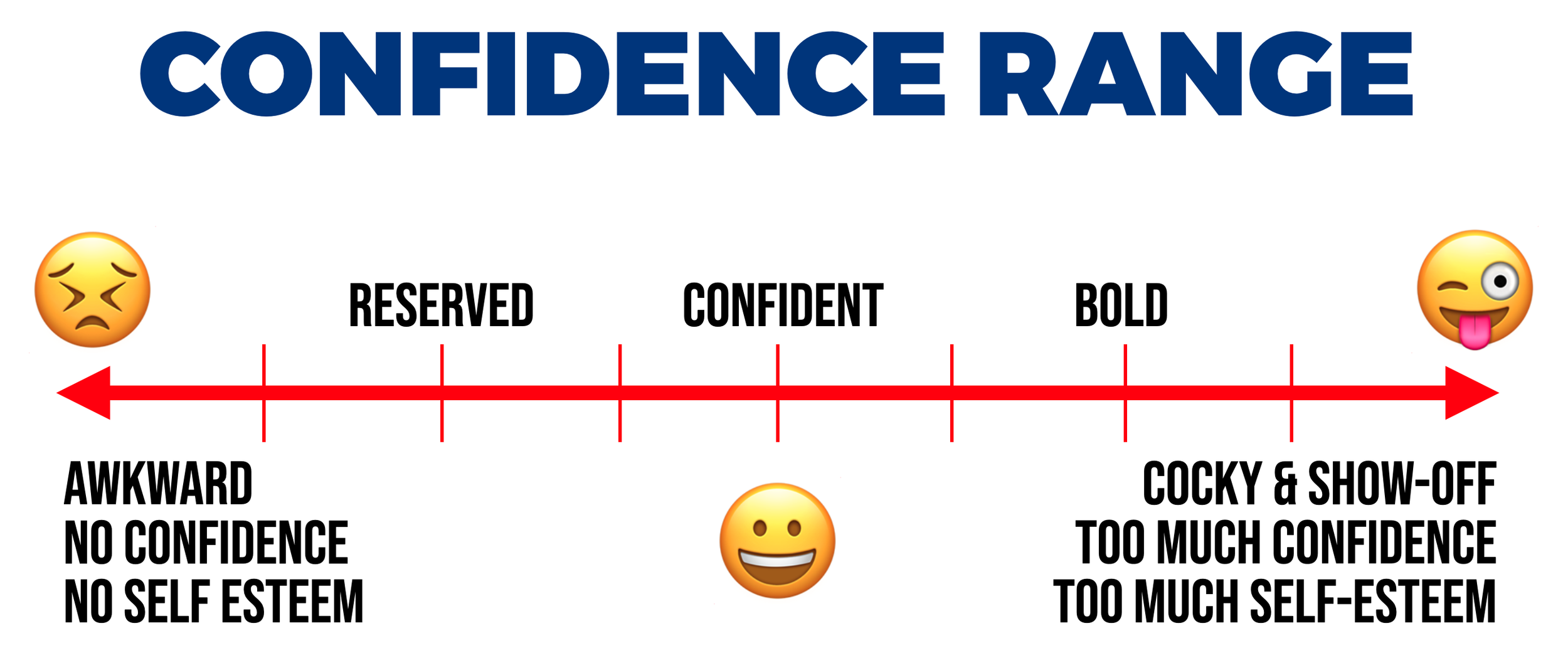
We’re afraid of both outliers of our confidence range — we are so scared of being viewed as a jerk, a show-off, or on the other end, low self-esteem, an awkward person.
We don’t realize that being confident is in the middle of the range and that we frequently need to be a bit more assertive (or bold) or a little less assertive (or reserved). All three states (reserved, confident, bold) are admired and expected in any business environment.
So how do we get MORE confident?
1. Develop a True Belief In Your Abilities
Focus on your internal mindset — validate and recognize each success you have at work frequently so they can occur repeatedly. Build an athlete’s mindset — where you believe and consistently internalize that you can do better, jump higher, and accomplish more.
2. Prove To Yourself That You Are Great
List your accomplishments over the years and where they have brought you presently (we rarely look back and admire our progress). Again, be an athlete — develop a practice schedule where you admire your accomplishments and use them to push yourself to higher heights in business.
3. Before Long, You Will Fail
Failure is a significant part of confidence-building — think of a baseball player with a .333 average — that’s an excellent average — but they only hit once out of every three times at-bat. The other two times? They strikeout. No one likes failure — but it’s part of the game. Many failures can hurt your ego and lessen your self-esteem. You might even GIVE UP — this is the tipping point of confidence — failure is a significant building block. Get up, dust yourself off, and get back into the game.
4. Passion = Confidence
Developing a passion for whatever you’re doing is one of your best confidence builders. I want you to paint yourself in a corner to force yourself to be more passionate about what you do and how you communicate with others. Remove the comfort to create the desire to be more passionate.
5. Practice Being Confident All The Time
Pain is a normal part of this journey, and so is failure. You are going to succeed in certain areas and also fail. But keep telling yourself that this is a journey to build your confidence.
And here’s my secret: Nothing feels better or makes you feel more alive than when you are confident.

The FADE Cycle
The FADE CYCLE is a quality performance model and a simple methodology for business improvement. I often use it with clients to help them grow their businesses or initiate a major career change.
The FADE Cycle
Let’s focus on a simple methodology for problem/process review and improvement - The FADE Cycle.

Summary:
The FADE CYCLE is a quality performance model and a simple methodology for business improvement. I use it often with clients to help them grow their businesses or initiate a major change in their careers. Other business applications include:
Product Development | Market Expansion | Operational Efficiency | Customer Satisfaction Improvement | Cost Reduction | Digital Transformation | Talent Management and Development | Crisis Management | Sustainability Initiatives | Mergers and Acquisitions (M&A)
Benefits:
In many instances, quick, off-the-cuff 'executive' decisions are made to solve endemic problems (upper management is notorious for doing this — they know better than you). The Fade Cycle is a powerful tool to help you stand back, analyze the issues with data, develop a solid solution, and execute with confidence.
History:
Duke University developed the FADE model, analyzing the acronym into four steps: Focus, Analyze, Develop, and Execute. The FADE cycle is part of QI (quality improvement) and Six Sigma and is used by many prominent organizations globally.
Applications:
The best way to perform the FADE Cycle is to have critical constituents in the room to assist in providing insight/data and developing the analysis. The problem might be as simple as a dysfunctional program that requires a deeper fix to create a new product line. The FADE Cycle is set in four stages:
FOCUS STAGE
Exploration starts with a belief or suspicion that there is a hidden problem or an opportunity for improvement.
1. Generate a list of problems (issues) — brainstorm with your team as many contributing areas you infer to be the dysfunction.
2. Select (vote) one problem — this is critical - building consensus and agreement at this point will guide you forward.
3. Verify and define the problem — check that this is the real issue, then confirm and clearly define what the issue is.
ANALYZE STAGE
Gather and analyze information, recognize the root cause, and establish solutions.
1. Decide what you need to know — go through the team and collect as many questions you’ll need to answer with data and info.
2. Collect data/baselines/patterns. This will help you when assembling organizational commitment. Use facts and data to convince them.
3. Determine influential patterns — a critical step - this is where things start coming together.
DEVELOP STAGE
From the gathered data, develop techniques for advancement, including enactment, communication, and observation.
1. Generate promising solutions — Bring everyone together and brainstorm possible solutions based on the Analyze stage.
2. Select the solution — Multi-vote with the team and decide on one plan of attack.
3. Develop an implementation plan — Don’t let the team out of the room before you assign roles, responsibilities, and deadlines.
EXECUTE STAGE
Implement the developed plans on a pilot basis and install a process control program that is in use for success.
1. Gain commitment—Ensure you have organizational commitment, signoff, budget, and backing (this is critical for success).
2. Execute plan—Now, run with the ball, keep an eye on all resources and deliverables, and follow a tight Gantt chart plan.
3. Monitor and measure impact — Once launched, measure the effect and make subtle adjustments along the way.
CASE STUDY
Here’s a fictional Case Study where the FADE Cycle was valuable:
Background: TechGadget Inc., a leading electronics manufacturer, observed a stagnation in sales of their flagship product, the X-200 SmartWatch. Market research indicated a shift in consumer preferences towards health-focused features. To regain market share and address consumer demands, TechGadget decided to leverage the FADE Cycle to develop an enhanced version of its smartwatch.
Focus: The initial phase involved assembling a cross-functional team to identify the key area for product innovation: integrating advanced health-monitoring features into the X-200 SmartWatch. This decision was driven by consumer feedback and a gap in the current market offerings.
Analyze: In the analysis phase, TechGadget conducted extensive research, including customer surveys, focus groups, and competitive analysis. The data revealed a strong market demand for features such as blood pressure monitoring, sleep tracking, and stress management. Additionally, the team analyzed technical feasibility and cost implications to ensure the new features could be implemented without significantly increasing the retail price.
Develop: The development phase kicked off with a clear understanding of consumer needs and technical possibilities. Engineers and designers collaborated to integrate the new health-monitoring features into the smartwatch while maintaining its sleek design and user-friendly interface. Simultaneously, the marketing team developed a strategy to highlight these new features, focusing on the benefits of comprehensive health monitoring.
Execute: The execution phase saw the launch of the X-300, featuring the newly developed health-monitoring capabilities. The launch was supported by a targeted marketing campaign emphasizing the smartwatch's ability to provide users with valuable health insights and wellness tracking. The product was made available through TechGadget's online store and retail partners, accompanied by promotional events and influencer partnerships to generate buzz.
Results: The introduction of the X-300 was met with positive consumer response, leading to a significant increase in sales and market share. Customer reviews praised the innovative health features, and TechGadget saw a notable improvement in brand perception as a leader in health-oriented technology. The successful application of the FADE Cycle in this product development project not only rejuvenated a flagship product but also positioned TechGadget as a forward-thinking company responsive to consumer needs.
Conclusion: TechGadget Inc.'s strategic use of the FADE Cycle in product development demonstrated how a structured approach to innovation could lead to significant business outcomes. By focusing on consumer needs, analyzing the market thoroughly, developing a compelling product, and executing a targeted launch, TechGadget successfully navigated the competitive landscape and achieved a winning product innovation.

When Your Boss Is A Jerk.
Imagine working under a leader whose low EQ manifests in poor empathy, inadequate communication, and a lack of understanding of team dynamics. It's a situation many find themselves in, yet few know how to navigate effectively.
Emotional intelligence (EQ) is a cornerstone of effective leadership. Unfortunately, not all leaders possess it, creating a hostile work environment for you.
Imagine working under a leader whose low EQ manifests in poor empathy, inadequate communication, and a lack of understanding of team dynamics. It's a situation many find themselves in, yet few know how to navigate effectively.
Want to thrive under such leadership? Here are five actions to unlock your potential and catalyze positive change, even in the most trying circumstances:
Empathetic Communication: Start by understanding your manager's perspective. Communicate your needs and observations empathetically, focusing on common goals. It's about creating a dialogue that fosters mutual understanding without placing blame.
Seek Feedback and Act: Constructively seek feedback on your work and how you can contribute to a positive change. Use this as a learning opportunity to adapt and grow, showing resilience and the ability to thrive under any leadership style.
Build Emotional Resilience: Develop your emotional resilience. This means not taking low-EQ behaviors personally and focusing on what you can control—your reactions, growth, and the positive influence you can have on your team.
Foster a Supportive Network: Cultivate a supportive network within the organization. This network can offer advice, provide emotional support, and help navigate the challenges posed by low-EQ leadership.
Advocate for Professional Development: Encourage and advocate for leadership development programs that focus on emotional intelligence within your organization. This can be a delicate process, but framing it as a benefit for the entire team and organization can facilitate openness to the idea.
How To Get Noticed (and Promoted) at Work.
Standing out and moving up the ladder requires more than just showing up and doing your job. It's about making an indelible mark, demonstrating your unique value, and strategically positioning yourself for promotions. Here's a comprehensive guide to getting noticed—and promoted—at work, complete with action steps and book recommendations to propel your career forward.
Standing out and moving up the ladder requires more than just showing up and doing your job. It's about making an indelible mark, demonstrating your unique value, and strategically positioning yourself for promotions. Here's a comprehensive guide to getting noticed—and promoted—at work, complete with action steps and book recommendations to propel your career forward.
1. Master Your Current Role
Excellence in your current position is the foundation of getting noticed. It's essential to meet and exceed expectations. Understand the metrics by which your performance is judged and aim to surpass them consistently.
Action Steps:
Identify key performance indicators for your role.
Seek feedback from your supervisor on areas for improvement.
Set personal milestones that go beyond your job description.
2. Become a Problem Solver
Every organization has its challenges and inefficiencies. Stand out by identifying issues and proposing solutions. This proactive approach shows leadership potential and a vested interest in the company's success.
Action Steps:
Regularly brainstorm potential improvements to your team’s processes.
Present well-thought-out solutions to your manager.
Volunteer for projects that address these challenges.
3. Build Your Brand
Your brand is how you present yourself and your professional capabilities. It’s what you’re known for and how people perceive your value. Cultivating a strong personal brand within your workplace can make you a go-to person in your area of expertise.
Action Steps:
Consistently deliver quality work to become synonymous with excellence.
Share your successes and learning experiences with your team to build credibility.
Participate in workplace events and professional development opportunities.
4. Network Strategically
Building relationships within your organization can significantly impact your visibility and opportunities for advancement. Networking isn’t about superficial interactions; it’s about forming genuine connections that are mutually beneficial.
Action Steps:
Identify key influencers within your organization and find ways to connect with them.
Offer your help to colleagues and other departments.
Attend company events and participate in cross-departmental projects.
5. Seek Out Mentorship
Mentors can provide invaluable guidance, support, and exposure within the company. They can also champion your work and open doors to opportunities you might need access.
Action Steps:
Identify potential mentors who embody where you aspire to be in your career.
Reach out for an informational interview or casual coffee chat.
Be clear about what you hope to learn or achieve through the mentorship.
6. Continuously Learn and Grow
The business world is constantly changing, and so should you. Continuous learning demonstrates your commitment to personal and professional development, making you a valuable asset to your team and company.
Action Steps:
Stay abreast of industry trends and new technologies.
Invest in learning new skills relevant to your career goals.
Share what you learn with your team to demonstrate thought leadership.
7. Document Your Achievements
When it’s time for performance reviews or discussions about promotions, having a record of your achievements can be a game-changer. Documenting your successes and their impact on the team or company ensures you’re prepared to make your case.
Action Steps:
Keep an ongoing file or journal of your accomplishments and the positive feedback you receive.
Quantify your achievements in terms of revenue generated, time saved, or efficiency improved.
Prepare a succinct presentation or report highlighting your contributions.
Recommended Books
To further guide you on your journey, consider delving into these insightful books:
"Lean In: Women, Work, and the Will to Lead" by Sheryl Sandberg. This book is a call to action for women to pursue their ambitions and offers practical advice on navigating the workplace.
"Drive: The Surprising Truth About What Motivates Us" by Daniel H. Pink. Understanding what motivates you and others can significantly impact how you approach your work and leadership.
"How to Win Friends and Influence People" by Dale Carnegie. A classic in personal development and professional networking, this book offers timeless advice on building relationships that can propel your career forward.
Final Thoughts . . .
Getting noticed and promoted at work is a multifaceted endeavor - by following these steps and embracing the mindset of a leader, you position yourself as an indispensable asset to your organization.
Remember, the journey to the top is not a sprint but a marathon. With persistence, resilience, and the right strategies, you'll get noticed and pave your way to a rewarding career.
Can You Really Change? A Deep Dive into Personal Transformation.
In a constantly moving world, the idea of change is both comforting and challenging. We often hear about the importance of change: changing habits, attitudes, and lives. But beneath the surface of these conversations lies a more profound question that touches the core of our being: Can people really change?
In a constantly moving world, the idea of change is both comforting and challenging. We often hear about the importance of change: changing habits, attitudes, and lives. But beneath the surface of these conversations lies a more profound question that touches the core of our being: Can people really change?
Last year, I stumbled upon a quote that has since reshaped my perspective on self-belief and personal growth. It eloquently questions and then affirms the possibility of change, encapsulating a profound truth about human nature and potential:
"Can people really change? What does it take to change?"
"You used to be a risk-averse entrepreneur. Looking at you now, there isn't anyone who would think you were once hesitant to embrace new opportunities. People do change. You've evolved into a visionary coach, bold and innovative. You're on your way to becoming a better person right now."
This simple yet powerful dialogue challenges the often cynical view of change. It suggests that transformation is possible and happening within us as we journey through life. But how do we navigate this journey? Let's explore the essence of change and how embracing it can redefine our lives.
Understanding Change: The Internal Battle
Change is an internal battle before it becomes an external transformation. It begins with confronting our impulses, those automatic, sometimes irrational responses that dictate much of our behavior. The quote reminds us that we are not merely the sum of these impulses. By consciously choosing our actions, we can significantly alter the outcomes of our lives.
This choice does not eliminate our impulses but redirects our energy towards more positive outcomes. Over time, this deliberate action can reshape our impulses, aligning them more closely with our ideals and aspirations. This process is slow, often imperceptible, but incredibly potent.
The Residual Self: Living in the Echoes of the Past
Our present self constantly lives in the residue of our past thoughts and actions. This realization can be daunting, as it confronts us with the weight of our history. However, it also offers a beacon of hope. Once we recognize that our past does not define our future, we can take control of our thoughts, steering them toward the future we desire.
The key realization here is that thoughts are the seeds of change. We set the foundation for meaningful change by nurturing positive, forward-looking thoughts. It reminds us that while we cannot escape our past, we are not bound by it. Our future is shaped by the thoughts we choose to cultivate today.
Embracing Change: The Only Constant
Acknowledging that change is the only constant in life is a transformative insight. It frees us from the fear of the unknown and the comfort of the familiar. With all its unpredictability, change becomes a source of hope rather than anxiety. It is a reminder that no matter where we are in our journey, there is always the potential for growth and improvement.
This perspective on change is liberating. It encourages us to embrace the slow and incremental nature of personal transformation. Change does not happen overnight. It requires patience, persistence, and, most importantly, belief in oneself.
The Power of Belief
Reflecting on the quote that sparked this exploration, I am reminded of the power of belief. Belief in change, belief in oneself, and belief in the journey ahead. It reminds us that we are all works in progress, constantly evolving and growing. The path to becoming a better person is not linear. It is filled with setbacks and breakthroughs, doubts and discoveries.
As we navigate this path, let us remember that the only limit to our growth is the one we set for ourselves. Change is not just possible; it is inevitable. Our task is not to resist but to guide it, shaping our lives with intention and purpose.
Final Thoughts
The question of whether people can really change is not just a philosophical musing; it is a call to action. It challenges us to reflect on our lives, to confront our impulses, and to take control of our thoughts. Change is slow and incremental, but it is also constant and inevitable.
As we embrace this transformational journey, let us hold onto the belief that we are always on our way to becoming better versions of ourselves. Remember, dear friend, to keep moving forward and believe in yourself, for you are already well on your way.
Book Recommendations
Mindset: The New Psychology of Success by Carol S. Dweck
Dweck introduces the concept of "fixed" vs. "growth" mindsets:
A fixed mindset assumes our character, intelligence, and creative ability are static givens, which we can't change meaningfully. A growth mindset thrives on challenge and sees failure not as evidence of unintelligence but as a heartening springboard for growth and for stretching our existing abilities. The book is filled with real-life examples ranging from education to business to relationships, illustrating how a simple change in mindset can make a significant difference in achieving our goals.
Atomic Habits: An Easy & Proven Way to Build Good Habits & Break Bad Ones by James Clear
A comprehensive guide to understanding how tiny changes can lead to remarkable results. Clear argues that the compound effect of small habits, which he terms "atomic habits," is the real secret to making significant personal and professional transformations. Focusing on the systems and processes that lead to outcomes rather than the goals themselves, Clear outlines practical strategies for habit formation, including making good and bad habits inevitable. The book is a masterclass in making the science of habits accessible and actionable, providing readers with the tools they need to make meaningful changes in their lives, embodying the principle that small, incremental changes can indeed lead to profound transformations.
The Transformation Playbook: Mastering the Message That Moves Organizations Forward
Corporate transformations have become an inevitable reality in today's rapidly evolving business landscape.
Corporate transformations have become inevitable in today's rapidly evolving business landscape. Organizations must adapt to remain competitive and relevant, whether driven by technological advancements, market shifts, or strategic realignments. However, communicating these transformative changes effectively is a critical challenge that, if not appropriately addressed, can undermine the entire endeavor.
A well-crafted corporate transformation message fosters employee engagement, builds stakeholder trust, and ensures a smooth transition. It catalyzes change, aligning minds and hearts toward a shared vision. This article explores four tactical approaches that can empower organizations to craft compelling transformation messages.
Embrace Authenticity and Transparency

Authenticity and transparency should be the cornerstones of any corporate transformation message. Employees and stakeholders crave honesty and openness, especially during significant change. Attempting to sugarcoat or conceal the true nature of the transformation can breed distrust and skepticism, ultimately hindering the process.
To cultivate authenticity, leaders must be willing to have candid conversations about the challenges and opportunities that lie ahead.
Acknowledge the complexities and potential disruptions, but balance them with clearly articulating the strategic rationale behind the transformation. Transparency fosters trust, essential for securing buy-in and fostering a collaborative spirit.
Furthermore, authenticity extends beyond the message itself; it must permeate the actions and behaviors of the organization's leadership. Leaders who embody their values and principles will inspire confidence and credibility, enabling the transformation message to resonate more deeply.
Take Action:
Hold a leadership training session on delivering authentic, transparent communications during the transformation.
Establish clear guidelines for addressing complex questions and potential concerns openly and honestly.
Model authentic behavior at the highest leadership levels through consistent actions that reinforce the transformation message.
Craft a Compelling Narrative

Humans are innately drawn to stories, and a well-crafted narrative can be a powerful tool for communicating complex ideas and igniting emotions. In corporate transformation, a compelling narrative can help employees and stakeholders visualize the future state, understand the rationale behind the changes, and connect with the broader purpose and vision.
Compelling narratives often begin by vividly describing the current reality, acknowledging the challenges and limitations that necessitate transformation. From there, the narrative should weave together a captivating vision of the desired future state, highlighting the benefits and opportunities that will arise due to the transformation.
Storytelling techniques, such as using relatable analogies, incorporating real-life examples, and leveraging emotional language, can make the narrative more engaging and memorable. Additionally, incorporating the voices and perspectives of various stakeholders can add depth and authenticity to the narrative, fostering a sense of shared ownership.
Take Action:
Assemble a cross-functional team to gather diverse perspectives and craft an overarching transformation narrative.
Conduct research or focus groups to uncover real employee experiences that can be incorporated into the narrative.
Develop a suite of storytelling tools (videos, presentations, brochures) to share the transformation narrative consistently.
Tailor the Message to Diverse Audiences

Corporate transformations impact a diverse range of stakeholders, each with their own unique perspectives, concerns, and information needs. A one-size-fits-all approach to communicating the transformation message is unlikely to resonate effectively with all audiences.
Organizations must tailor their messages to address different stakeholder groups' specific needs and priorities to ensure maximum impact.
For employees, the focus might be on job security, new roles and responsibilities, and professional growth opportunities. For customers, the emphasis could be on improved products or services, enhanced customer experiences, and continuity of support. Investors and analysts, on the other hand, may prioritize information about financial implications, competitive advantages, and long-term strategic positioning.
Customizing the message for each audience requires a deep understanding of their motivations, concerns, and communication preferences.
Organizations can leverage data-driven insights, stakeholder feedback, and targeted communication channels to deliver tailored messages that resonate with their intended recipients.
Take Action:
Conduct a detailed stakeholder analysis to identify key audiences and their priorities/concerns.
Create audience-specific messaging frameworks that highlight the most relevant aspects of the transformation.
Establish processes for continuously gathering audience feedback to refine tailored messaging over time.
Establish Consistent/Sustained Communication

Effective communication during corporate transformations is not a one-time event but an ongoing process requiring consistency and sustained effort. A well-defined communication strategy ensures that the transformation message remains top-of-mind, reinforcing its importance and relevance throughout the transition period.
The communication strategy should encompass various channels and tactics, including town hall meetings, internal newsletters, social media platforms, and one-on-one interactions. Each channel serves a unique purpose, catering to different communication preferences and allowing for varying levels of engagement and feedback.
Consistency in messaging is paramount, as mixed signals or contradictory information can sow confusion and undermine trust. All communication channels should reinforce the core transformation message while adapting the delivery and emphasis to suit the specific audience and context.
Furthermore, the communication strategy should include opportunities for two-way dialogue, enabling stakeholders to ask questions, voice concerns, and provide feedback. This interactive approach fosters inclusivity and allows the organization to proactively address emerging issues and refine the transformation message.
Take Action:
Develop a multi-channel corporate communication plan with a schedule of activities over the transformation timeline.
Implement tools or platforms to enable two-way dialogue and continuous feedback from stakeholders.
Conduct regular audits to ensure message consistency across all communication channels and spokespeople.
Final Thoughts
Remember, a well-crafted transformation message is not merely a tool for disseminating information; it is a catalyst for change, a rallying cry that aligns minds and hearts toward a shared vision of a better future. Invest in this critical aspect of your transformation journey, and you'll be better equipped to navigate the challenges and seize the opportunities.

Turn Your Dreams into Reality.
We often find ourselves at the crossroads between what we dream of and the tangible outcomes we seek.
We often find ourselves at the crossroads between what we dream of and the tangible outcomes we seek.
It's a terrain filled with aspirations, objectives, and the relentless pursuit of success. But beyond the conventional markers of success lies the ultimate destination: fulfillment.
This isn't just about achieving goals; it's about embarking on a journey that is deeply meaningful and uniquely personal. Let's unfold this roadmap, shall we?
1. Goal (No Deadline) = Wish/Dream
At the very inception of any journey is the dream. These are the seeds of potential that reside within us, the visions of what we yearn for in our quieter moments. However, a dream without a deadline remains just that—a wish. It's akin to gazing at the stars and longing to touch them without the means to launch into space. Dreams are essential, for they are the genesis of all great endeavors. But to bring them into reality, we must take the next step.
2. Goal + Deadline = Objective
Introducing a deadline to a goal transforms it from a nebulous dream into a tangible objective. This is where the nebulous begins to crystallize into the concrete. A deadline acts as a catalyst, compelling us to move from idle wishing to active planning. It sets the stage for commitment, signaling to ourselves and the universe that we are serious about our aspirations. Yet, an objective alone, while a significant leap forward, lacks the scaffolding necessary for realization.
3. Goal + Deadline + Plan = Intention
When we add a plan to our objective, we infuse our journey with intention. This is the blueprint, the strategy that guides our steps. A plan is our roadmap, outlining the when, the how, and the what. It anticipates challenges and devises routes around them. Intention imbues our actions with purpose, ensuring that each step taken is a deliberate move toward our ultimate goal. But even the most meticulous plan requires the vital ingredient of action to bring it to life.
4. Goal + Deadline + Plan + Consistent Action = Success
Consistent action is the bridge between the world of ideas and the reality of achievement. It is the daily commitment to our plan, the resilience in the face of setbacks, and the persistence through the highs and lows of the journey. Success is not a moment but a series of actions, repeated day in and day out, in service of our objectives. It's the sweat on the brow of the marathoner, the stroke of the painter's brush, the late nights of the entrepreneur. Success is action crystallized.
5. Personally Meaningful Goal + Deadline + Plan + Consistent Action = Fulfillment
Yet, success, in its traditional guise, can often feel hollow if the goals we pursue lack personal significance. Fulfillment emerges when our goals resonate with the core of our being—when they are not just markers of societal achievement but extensions of our deepest values and passions. This is the zenith of the journey, where success is not just achieved but felt. Fulfillment is the harmonious convergence of our actions and our essence, the point at which we not only touch the stars but become one with them.
Take Action
Concluding this exploration, it's clear that the journey from dreaming to achieving is both complex and rewarding. It's a path that requires clarity, commitment, and a deep understanding of what truly matters to us. To navigate this journey effectively, consider these action steps:
Define Your Dreams: Start by articulating your dreams. Write them down, no matter how lofty they may seem. This is your vision board, your north star guiding you towards what you aspire to achieve.
Set Deadlines: Transform your dreams into objectives by setting realistic deadlines. These timeframes should challenge you but remain achievable. Deadlines are your commitment to moving forward, a tangible sign that you're ready to turn your dreams into reality.
Develop a Plan: With your objectives set, it's time to craft a detailed plan. Break down your goals into actionable steps, identify resources needed, and anticipate potential obstacles. Your plan is your roadmap; the clearer it is, the smoother your journey will be.
Take Consistent Action: Action is the fuel for your journey. Commit to daily or weekly actions that propel you toward your goal. Consistency is key; even small steps add up to significant progress over time.
Seek Fulfillment: Always align your goals with your personal values and passions. Success is not just about achieving what you've set out to do; it's about finding joy and fulfillment in the process. Pursue goals that make you feel alive, that challenge and excite you.
Reflect and Adjust: Regularly reflect on your progress and the joy your journey brings. Be open to adjusting your goals, plans, and actions as you grow and learn. Flexibility is a strength that allows you to navigate the ever-changing landscape of life with resilience.
By following these steps, you're not just chasing success; you're crafting a life of meaning and fulfillment. Remember, the journey itself is as important as the destination. Embrace each step, celebrate your progress, and continue to dream big. Your roadmap to fulfillment is uniquely yours; cherish it, and let it guide you to the heights you aspire to reach.

Why Top Leaders Will Never Be Replaced by AI
Can AI replace human leaders? The short answer is no. The nuanced explanation, however, reveals why the best leaders — those characterized by their compassion, wisdom, and innate ability to inspire — are irreplaceable, even as AI-enabled leadership evolves.
In an age where artificial intelligence (AI) is not just a buzzword but a tangible reality shaping every facet of our lives, there's a looming question that echoes through the corridors of corporations and startups alike: Can AI replace human leaders? The short answer is no. The nuanced explanation, however, reveals why the best leaders — those characterized by their compassion, wisdom, and innate ability to inspire — are irreplaceable, even as AI-enabled leadership evolves.
The Unparalleled Human Touch
At the heart of great leadership are qualities that transcend mere decision-making or strategic prowess. Compassion and wisdom stand out as beacons of human leadership, guiding teams through turbulent times and fostering environments where creativity and innovation flourish. These are not attributes that can be coded into algorithms; they are born from life's experiences, emotional intelligence, and a profound understanding of human nature.
Compassion: The Foundation of Trust
It’s about understanding the challenges and aspirations of those you lead, demonstrating genuine care, and taking actionable steps to support their well-being and growth. This empathetic approach builds trust — a fundamental element in any successful team. AI, for all its analytical capabilities, lacks the depth of empathy required to connect on a human level and nurture this trust.
Wisdom: The Art of Seeing Beyond
Wisdom is the culmination of experience, knowledge, and insight. It's about making decisions that not only address immediate concerns but also anticipate future challenges and opportunities. While AI can process vast amounts of information and predict trends based on data, it cannot replicate the intuitive grasp of context and human dynamics that comes from years of hands-on leadership.
AI: A Tool, Not a Replacement
It's crucial to view it AI as a tool that enhances, rather than replaces, human leadership. AI can provide valuable insights, automate routine tasks, and even help make data-driven decisions. However, the final judgment — especially in matters that affect people's lives and careers — should always rest with a human leader.
Action Items for Human Leaders in an AI-Enhanced World
1. Leverage AI for Data-Driven Insights
Use AI tools to gather and analyze data for better decision-making. Let AI handle the heavy lifting of data processing, allowing you more time to focus on strategy and people.
2. Cultivate Emotional Intelligence
As AI takes over more cognitive tasks, the distinctly human emotional intelligence skill becomes more crucial. Focus on developing empathy, self-awareness, and social skills to lead effectively in an AI-enhanced environment.
3. Promote a Culture of Lifelong Learning
Encourage your team to embrace both AI tools and the pursuit of personal growth. As AI evolves, so too should your team's skills and capabilities, ensuring they remain relevant and empowered.
4. Balance AI Insights with Human Judgment
While AI can provide valuable insights, always apply human judgment to any decision. Consider the broader implications of your choices, especially on team morale and individual well-being.
5. Champion Ethical AI Use
As a leader, advocate for ethical AI practices within your organization. Ensure that AI tools are used responsibly, with consideration for privacy, bias, and the potential impact on employment.
The Irreplaceable Value of Human Leadership
As we navigate the complexities of a world increasingly influenced by AI, the value of human leadership — with its depth of compassion, wisdom, and the ability to inspire — has never been more evident. These qualities ensure that the best leaders always have a place at the helm, guiding their teams with a vision that algorithms cannot replicate.
The future of leadership is not about choosing between humans or AI, but rather understanding how to blend the strengths to create more resilient, innovative, and compassionate organizations. The best leaders of tomorrow will be those who embrace AI as a powerful tool while remaining steadfast in their commitment to the timeless principles of great leadership.
Final Thoughts
As AI-enabled leadership evolves, it's clear that the essence of what makes a leader truly effective — their humanity — cannot be replicated by algorithms. The best leaders understand this and inspire teams to achieve greatness. In the face of technological advancement, compassion, wisdom, and the human touch remain the cornerstones of leadership that no AI can replace.
How to Develop a Better Work/Life Balance: A High-Performance Coach's Perspective
As a high-performance coach specializing in helping executives and business owners reach their fullest potential, I've often observed that the issue of work/life balance is a recurring challenge.
My clients frequently grapple with the tension between career advancement and personal well-being. The juggling act is challenging; however, there are actionable strategies you can employ to harmonize your work and life spheres effectively.
Below are four action items that I've found invaluable in my coaching practice:
Action 1: Time Block Your Day
In my experience, time management is at the crux of a balanced life. As we often discuss in our coaching sessions, your calendar should be your best friend. I recommend implementing time-blocking techniques to designate specific hours of the day for work tasks and personal activities.
How to Implement: Digital calendars or planner apps are excellent tools. Your workday should be a mosaic of time blocks, including work tasks, meetings, and, crucially—periods for self-care and family. Doing this prevents work from encroaching upon personal time, improving balance and reducing stress.
Action 2: Establish Unambiguous Boundaries
The next step in attaining work/life balance is setting clear boundaries. Many of my clients have initially struggled with this, but the benefits are enormous once you practice it. Be explicit about your 'office hours' and adhere to them.
How to Implement: Use out-of-office auto-responders during your off-hours. This signals your colleagues and clients that you're unavailable outside those times. Likewise, openly communicate your schedule to your family so they are on the same page about your availability.
Action 3: Prioritize Self-Care
Self-care is an aspect that professionals often overlook, resulting in burnout and reduced productivity. In our coaching sessions, I emphasize that self-care is not an indulgence but an essential part of your performance strategy.
How to Implement: Prioritize exercise, sleep, and activities that rejuvenate you. Mark these as non-negotiables in your calendar, treating them with the same respect you would a work meeting.
Action 4: Limit Technological Interruptions
Smartphones are double-edged swords. While they connect us to a world of information, they are also significant sources of distraction and stress. I suggest designated 'tech-free' times during your personal hours.
How to Implement: Turn off work email and messaging app notifications during your personal time. This uninterrupted time helps you recharge and allows for quality interactions with your loved ones.
Case Study: Achieving Work/Life Balance in the Executive Suite
Meet Sarah, a C-level executive in a tech firm, who reached out to me with concerns about her plummeting work/life balance. Working 70-hour weeks, she was stressed, fatigued, and disconnected from her family. Here's how she leveraged the above-mentioned action to transform her life.
Time Blocking and Boundaries
In our first session, Sarah and I immediately implemented time-blocking techniques. Sarah assigned explicit 'office hours' and informed her team and family about them. Using out-of-office auto-responders, she managed to decrease after-hours work communication substantially.
Prioritizing Self-Care
Sarah's schedule had no room for self-care initially. She incorporated well-being into her life by blocking time for gym workouts and family dinners. Over a few weeks, she reported feeling more energized and focused.
Limiting Tech Interruptions
Sarah used to keep her work emails and messaging apps active round-the-clock. After our discussion, she turned off notifications during personal hours. This simple act brought immense peace and allowed her to engage more deeply with her family.
Outcome
Within two months, Sarah's stress levels significantly decreased, and her team reported better interaction and leadership from her end. Not only did her work performance improve, but her personal life also flourished, rekindling relationships that had been strained due to her previous work schedule.
Through the application of these action items, Sarah epitomizes the transformative power of a balanced work/life approach. It's not just about working smarter but also living better. By following these strategies, you can also realize the work/life balance that seems elusive yet is crucial for lasting success and happiness.
Optimal Peak Performance for Small Business Owners.
The 'Optimal State' concept is crucial for small business owners, who often juggle numerous roles and face unique challenges. This state represents a blend of behaviors, habits, and practices that enable small business owners to thrive in a competitive environment.
The 'Optimal State' concept is crucial for small business owners, who often juggle numerous roles and face unique challenges. This state represents a blend of behaviors, habits, and practices that enable small business owners to thrive in a competitive environment.
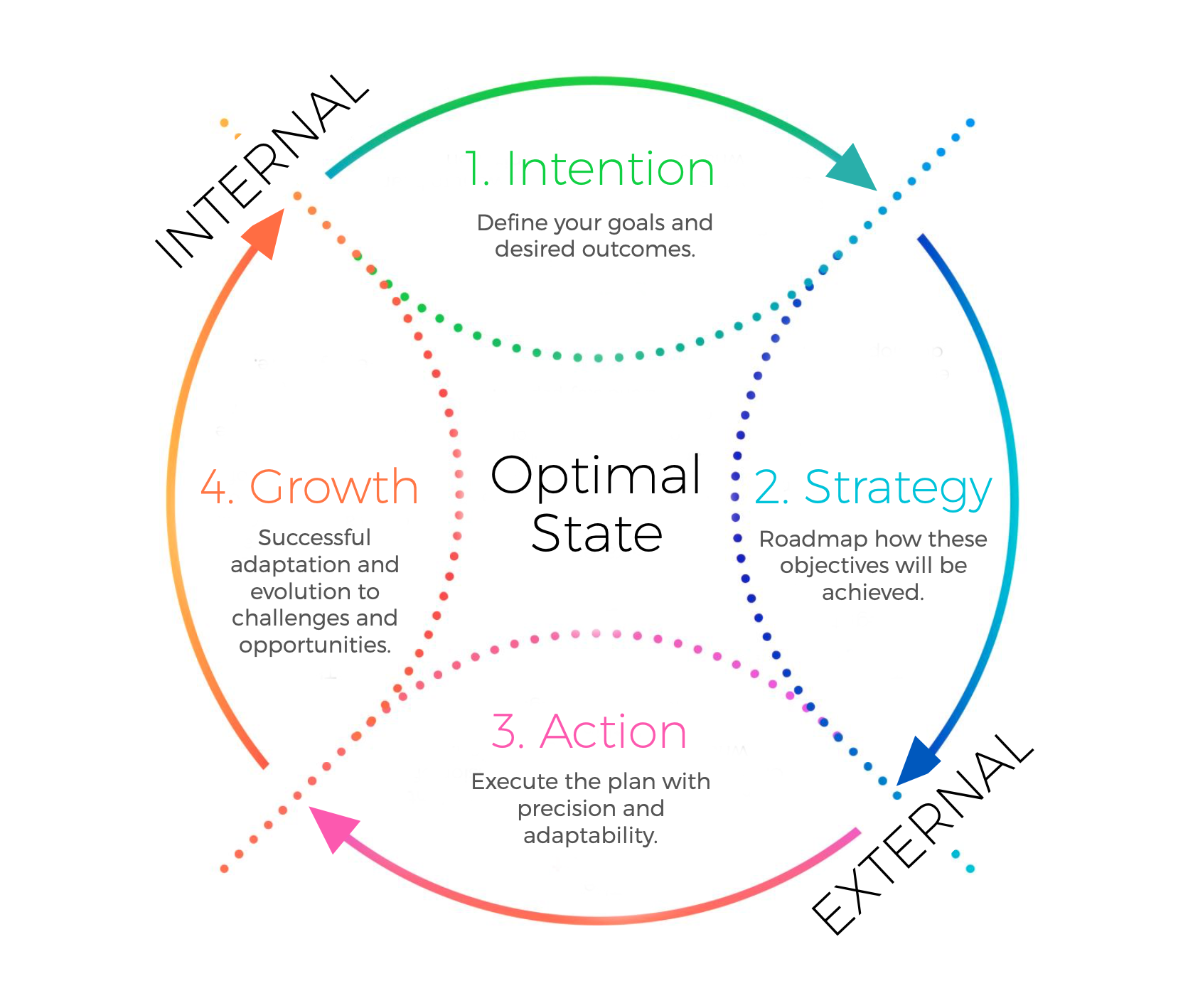
Understanding Optimal State
The journey to achieving the 'Optimal State' for a small business owner is intricate and rewarding, encompassing a process best described as Intention > Strategy > Action > Growth = Optimal State. This formula represents a comprehensive approach, guiding small business owners through the stages necessary for substantial growth and sustained success.
It begins with 'Intention,’’ the initial step where goals and aspirations are clearly defined, setting the tone for the journey ahead. Following Intention is the development of a 'Strategy,' a detailed plan outlining how these goals will be achieved. The next phase, 'Action,' involves the practical implementation of the strategy, turning plans into reality through focused efforts. The culmination of this process is 'Growth,’ both in the business and personally for the owner, indicating a successful adaptation and evolution in response to challenges and opportunities. This growth is crucial in reaching the Optimal State, a pinnacle where the business thrives and provides a platform for future expansion and success. In this discussion, we'll explore each of these stages in depth, highlighting how they collectively contribute to achieving the Optimal State for a small business owner.
1. Key Behaviors of a Successful Small Business Owner
Adaptability and Flexibility: Small businesses must be nimble. Owners who exhibit adaptability can quickly respond to market changes, customer needs, and unexpected challenges.
Customer-Centric Approach: Successful small business owners understand that their business's heart is its customers. They prioritize customer satisfaction, which often translates into customer loyalty and referrals.
Financial Acumen: An intimate understanding of the business's financial health is crucial. This means managing the daily cash flow and planning for long-term financial stability.
2. Habits That Foster Optimal State
Consistent Learning and Growth: The business landscape is constantly evolving. Small business owners need to stay informed about industry trends, new technologies, and market shifts.
Building Strong Networks: Networking isn't just about acquiring new customers; it's also about creating relationships with other business owners, mentors, and industry experts.
Risk Management: While taking risks is part of business, successful owners know how to assess and manage these risks carefully to minimize potential negative impacts.
3. Practices That Support Optimal State
Strategic Planning: Regularly setting goals and developing strategies to achieve them helps keep the business focused and on track.
Effective Delegation: Understanding that they can't do everything alone, successful small business owners delegate tasks to trusted employees or outsource to professionals.
Work-Life Balance: Maintaining a healthy balance between work and personal life is crucial to avoid burnout and maintain long-term passion for the business.
Benefits of Optimal State
Increased Business Growth and Success: Small business owners are better equipped to grow their business effectively, recognizing opportunities and seizing them wisely by being in an Optimal State.
Enhanced Decision-Making Skills: The combination of financial acumen, customer understanding, and adaptability leads to better decision-making, crucial for business success.
Resilience in the Face of Challenges: Adaptability and risk management contribute to a resilient mindset, enabling owners to navigate through tough times more effectively.
Improved Customer Relationships: A customer-centric approach results in stronger customer relationships, leading to repeat business and referrals.
Personal Satisfaction and Fulfillment: Successfully managing a business while maintaining a healthy work-life balance contributes to a sense of personal achievement and fulfillment.
Final Thoughts
The Optimal State for a small business owner is a dynamic balance of professional acumen and personal well-being. By cultivating these behaviors, habits, and practices, small business owners can navigate their way to success and enjoy the journey as much as the destination. This state leads to business growth, resilience, personal satisfaction, and a rewarding life.

Stay Sharp: Mastering Interpersonal Dynamics as a Remote Worker
In the modern professional landscape, where remote work is increasingly common, mastering interpersonal skills is more critical than ever.
In the modern professional landscape, where remote work is increasingly common, mastering interpersonal skills is more critical than ever.
The absence of daily, face-to-face interactions in remote settings can make understanding and navigating team dynamics challenging. Let’s explore practical ways to enhance these essential interpersonal abilities, ensuring remote workers like you can maintain robust, effective, and collaborative relationships with your teams from afar.
The Critical Role of Interpersonal Skills in Remote Work
Interpersonal skills, encompassing communication, teamwork, adaptability, and emotional intelligence, are vital in any work environment.
Their importance is magnified in remote work settings, where the lack of physical presence can lead to miscommunications and a weakened sense of team unity. Improving these skills is crucial for sustaining healthy professional relationships and ensuring collaborative success.
Consistently Communicate Excellence
Precision in Digital Conversations: Without body language and facial expressions, it's essential to communicate clearly in emails, messages, and video calls. Aim for precision and simplicity in your language to avoid misunderstandings.
Engaged Listening focuses entirely on understanding, responding to, and remembering what others communicate. Show engagement in video calls with nods and verbal acknowledgments and by asking follow-up questions in written communications.
Routine Updates: Establish a habit of regular updates with your team and superiors. These interactions, though brief, keep you connected and informed. Use Slack, Zoom, or email to keep these exchanges fresh and exciting.
Cultivate Relationships in a Digital Realm
Remote Team Bonding: Actively participate in or initiate online team-building activities. From virtual coffee chats to online games, these activities build team spirit and camaraderie.
Empathy and Understanding: Be mindful of your colleagues’ diverse backgrounds and personal contexts. Show empathy and consideration, especially when discussing challenges or disagreements.
Online Networking: Use platforms like LinkedIn to connect with colleagues and other industry professionals. Engage in meaningful conversations, share insights, and expand your professional network.
Be Adaptable with Creative Problem-Solving
Welcoming Change: The landscape of remote work is ever-changing. Demonstrate adaptability by embracing new communication tools and methods, showing your commitment to innovation and problem-solving.
Proactive Learning: Improve your interpersonal skills through online courses, webinars, and reading. Focus on areas like conflict management, time management, and cultural awareness.
Feedback for Growth: Regularly seek and welcome feedback from peers and supervisors on your communication and collaboration skills. Use this feedback to refine and improve your approach continuously.
A Productive and Balanced Remote Work Life
Balancing Work and Personal Life: Set clear boundaries between your professional and personal lives. This balance is essential for your well-being and productivity. Communicate your working hours clearly and respect others' boundaries.
Time Management Skills: Effective time management is crucial in remote settings. Use digital tools for planning and organizing your tasks to remain focused and efficient.
Prioritizing Self-Care: Engage in self-care activities like exercise, meditation, and hobbies. A healthy mind and body are fundamental to your effectiveness in professional interactions.
Try To Travel To The Office Regularly
Get Off Your Butt: Schedule monthly visits to headquarters to engage your boss, team, and peers. Ensure that your personality and demeanor are upbeat and positive at all times.
Be Seen: Schedule lunches with your boss, upper management, and other departments to spread your connections. Your job is to interact personally with everyone that matters.
Final Thoughts
Enhancing interpersonal skills as a remote worker is about improving personal competencies and contributing to a positive team environment.
The strategies discussed guide remote workers to develop these crucial skills. As work environments evolve, those who invest in interpersonal skills will be well-prepared to excel in virtual and physical workplaces. By embracing these strategies, you can ensure your effectiveness and collaborative ability, irrespective of your physical work location.
I Dare You to Do Better.
"I dare you to do better" is not just a line from a movie; it's a philosophy for career growth and personal excellence. Take this dare, and watch your career transform in ways you never imagined.
In the 2016 film "Star Trek," a pivotal scene captures a moment of transformation for the protagonist, James T. Kirk. Following a bar fight, Captain Pike challenges a young, egotistical Kirk with a powerful statement: “Your father was captain of a Starship for 12 minutes. He saved 800 lives, including your mother's and yours. I dare you to do better.” This line, laden with challenge and expectation, is not just a cinematic moment but a metaphor for the potential within each of us in our professional lives.
The Challenge: Rising Above the Ordinary
Much like Kirk, we often find ourselves in comfortable yet unfulfilling situations. The dare to "do better" is a call to step out of complacency and into a realm of higher achievement and fulfillment. This translates to transcending ordinary expectations and reaching for extraordinary success in the corporate world.
The first step in accepting this challenge is understanding your potential. Just like Kirk, who was unaware of his capabilities, many professionals underestimate their potential. Recognize the skills, experiences, and unique perspectives that you bring to the table.
Action Item: Conduct a personal SWOT analysis to identify your strengths, weaknesses, opportunities, and threats.
Setting Higher Goals
Once you recognize your potential, the next step is to set higher goals. These 'stretch' goals should be ambitious yet achievable, pushing you beyond your comfort zone.
Setting stretch goals often means stepping into unfamiliar territory. This can be intimidating, but growth and comfort do not coexist. Embrace the discomfort of new challenges as a sign of growth.
Action Item: Set a stretch goal that feels slightly out of reach and develop a step-by-step plan to achieve it.
Embracing Failure as a Stepping Stone
Captain Pike's challenge to Kirk was not without the risk of failure. In our careers, the fear of failure can be a significant barrier. However, every failure is a lesson in disguise, offering invaluable insights for future endeavors.
Instead of fearing failure, learn from it. Analyze what went wrong and how you can improve. This reflection turns failure into a powerful tool for personal and professional development.
Action Item: Reflect on a recent professional setback. Identify what you learned from it and how you can apply these lessons going forward.
Seeking Mentorship and Guidance
Kirk’s transformation began with Pike's guidance. In the same way, seeking mentors can be instrumental in our professional growth. Mentors provide insight and advice and can often see potential in us that we may not see in ourselves.
Apart from mentors, build a network of colleagues and professionals who can offer support, advice, and different perspectives. This network becomes a valuable resource for guidance and feedback.
Action Item: Identify a mentor in your field and schedule regular meetings to discuss your career goals and challenges.
Final Thoughts
Remember, the path to doing better is not linear. It involves setbacks, learning, and continuous self-improvement. Embrace this journey with determination and an open mind, and you will find yourself achieving things you once thought impossible.
"I dare you to do better" is not just a line from a movie; it's a philosophy for career growth and personal excellence. Take this dare, and watch your career transform in ways you never imagined.

Bridging the Gap: Transforming Dysfunctional Manager-Team Dynamics
"Getting a manager and their team to communicate effectively is like trying to teach cats to swim in formation. It's all fun and games until someone ends up on a motivational poster."
"Getting a manager and their team to communicate effectively is like trying to teach cats to swim in formation. It's all fun and games until someone ends up on a motivational poster."
A harmonious relationship between a manager and their team is paramount in the intricate dance of corporate dynamics. However, what happens when communication breakdowns and a palpable air of distrust and contempt mar this relationship?
Such scenarios dampen morale and can derail the team's performance, putting business outcomes at risk. The crux of the matter often lies in emotional intelligence (EQ) deficits on the manager's part, coupled with a team's growing skepticism and disdain towards leadership.
Fear not; even the most strained relationships can be mended with intentional effort and strategic actions. Let's explore five actionable steps to transform your manager-team dynamics, fostering a culture of trust, respect, and effective communication.
1. Initiate Open and Honest Dialogues
The first step towards healing is acknowledging the elephant in the room. Organize a series of open forums or meetings where both the manager and team members can express their grievances, concerns, and expectations openly.
The key here is not to point fingers but to foster a safe space for honest dialogue. Managers should lead by example, displaying vulnerability and willingness to understand the team's perspective. This practice lays the groundwork for mutual respect and erodes the walls of distrust.
2. Invest in EQ Development for the Manager
Emotional intelligence is not just a buzzword but a critical leadership skill. A manager with high EQ is adept at recognizing their emotions and those of others, using this awareness to manage interactions positively.
Investing in EQ development through workshops, coaching, or self-help resources can equip managers with the tools to improve their communication style, empathy, and conflict-resolution skills. As managers become more attuned to their team's needs and emotions, the likelihood of misunderstandings and contempt diminishes.
3. Establish Clear Communication Channels and Norms
Miscommunication often breeds distrust. To counteract this, establish clear and consistent communication channels and norms. Whether regular team meetings, one-on-one check-ins, or an open-door policy, define how and when communication occurs.
Could you emphasize the importance of transparency and timely feedback? Additionally, setting norms around respectful communication and constructive feedback helps create a positive environment where team members feel valued and heard.
4. Foster Team Building and Engagement Activities
Team building is about more than just off-site retreats or casual Fridays. It's about creating shared experiences that can bridge gaps and build camaraderie.
Consider activities that allow for relaxation and fun and encourage collaboration and mutual understanding. From problem-solving exercises to volunteer work, these experiences can help break down barriers and build a sense of team unity. When team members feel connected, their trust in leadership also increases.
5. Set Shared Goals and Celebrate Achievements
Lastly, aligning the team and manager towards common goals can be a powerful unifier. Work together to set achievable objectives that contribute to the larger business vision. Ensure these goals are communicated clearly and that every team member understands their role in achieving them.
Celebrating milestones and recognizing contributions is crucial in building a positive team culture. It reinforces the idea that everyone is on the same team, working towards shared success.
Final Thoughts
Transforming the dynamics between a manager and their team from contempt and distrust to mutual respect and effective communication is no small feat. It requires dedication, openness, and a willingness to change on both sides.
Remember, the strength of a team lies not just in the expertise of its members but in how well they can navigate the complexities of human emotions and relationships together. Here's to building bridges and achieving greatness together.
Optimal Peak Performance for Successful Executives.
In the dynamic world of business, the term 'Optimum State' often arises, especially in discussions about executive success. But what exactly is this Optimum State, and how does it pave the way to success?
In the dynamic world of business, the term 'Optimal State' often arises, especially in discussions about executive success. But what exactly is this Optimal State, and how does it pave the way to success?
Optimal State for a successful executive is a synergistic blend of behaviors, habits, and practices that cultivates peak performance and decision-making abilities. This article delves into these critical elements and explores the benefits they offer.

Understanding Optimal State
In the quest for excellence in executive leadership, understanding and achieving the 'Optimal State' is a pivotal goal. This state represents a zenith of professional effectiveness and growth, achieved through a deliberate and dynamic process: Intention > Strategy > Action > Growth = Optimal State. This framework offers a comprehensive roadmap for executives striving to maximize their organizational potential and impact.
It all starts with 'Intention,' the seed from which all great achievements grow, defining clear, purpose-driven goals. 'Strategy' follows, acting as the blueprint, laying out the pathways to realize these ambitions. 'Action' is the execution phase, where plans are put into motion through decisive and informed steps. The culmination of this process is 'Growth'‘ both personal and professional, signaling the evolution and refinement of leadership qualities. This growth is instrumental in reaching the Optimal State where an executive excels in their current role and is poised for future challenges and opportunities.
1. Key Behaviors of a Successful Executive
Strategic Thinking: Successful executives are visionary. They have the ability to anticipate market trends, understand complex business dynamics, and develop long-term strategies. This foresight is crucial in steering their companies towards sustainable growth.
Emotional Intelligence: High emotional intelligence (EQ) is essential. It enables executives to understand and manage their emotions and the emotions of others. This skill fosters better team dynamics, conflict resolution, and leadership effectiveness.
Decisiveness: The ability to make timely, well-informed decisions is a hallmark of successful executives. They gather relevant information, weigh the pros and cons, and make decisions confidently.
2. Habits That Foster Optimal State
Continuous Learning: The business world is ever-evolving. Executives who dedicate themselves to lifelong learning stay ahead of the curve. This habit involves staying updated with industry trends, pursuing professional development, and being open to new ideas.
Time Management: Effective time management is critical. Successful executives prioritize tasks, delegate appropriately, and avoid procrastination. This habit ensures that they are focusing on what truly matters.
Networking: Building and maintaining a robust professional network is a valuable habit. It provides access to new opportunities, insights, and collaborations.
3. Practices That Support Optimal State
Mindfulness and Mental Wellness: Regular practices like meditation, mindfulness, and sufficient rest contribute significantly to mental clarity and focus, vital components of Optimal State.
Physical Fitness: A healthy body supports a healthy mind. Regular exercise, a balanced diet, and adequate sleep are practices that successful executives often prioritize.
Work-Life Balance: Maintaining a balance between professional responsibilities and personal life is crucial. It prevents burnout and keeps executives grounded and connected to their personal values and relationships.
Benefits of Optimal State
Enhanced Leadership Abilities: Optimal State sharpens leadership skills. Executives become more inspirational, empathetic, and effective in guiding their teams.
Increased Productivity and Efficiency: By being in their Optimal State, executives can work smarter, not harder. This leads to higher productivity, better time management, and improved organizational efficiency.
Innovative Thinking: A clear, focused mind is a fertile ground for innovation. Executives in their Optimal State are more likely to come up with creative solutions and breakthrough ideas.
Resilience: Optimal State builds resilience. Executives become better equipped to handle stress, overcome challenges, and bounce back from setbacks.
Better Decision-Making: With a blend of emotional intelligence, strategic thinking, and mental clarity, decision-making becomes more effective and results-oriented.
Enhanced Personal Well-being: The holistic approach of Optimal State positively impacts personal health, relationships, and overall life satisfaction.
Final Thoughts
Optimal State for a successful executive is an integrated mix of behaviors, habits, and practices that leads to peak performance both professionally and personally. Optimal State is not just about being successful in the boardroom; it's about excelling in every aspect of life.

What To Say When Someone Is Condescending.
Condescension in the workplace or any professional environment can be a subtle yet profoundly unsettling experience. Whether it's a patronizing remark, a dismissive gesture, or a belittling comment, dealing with condescending behavior requires tact, assertiveness, and a clear understanding of one's own value.
"Grace under pressure is responding to condescension not with hurt, but with the strength of quiet confidence and the power of measured words."
Condescension in the workplace or any professional environment can be a subtle yet profoundly unsettling experience. Whether it's a patronizing remark, a dismissive gesture, or a belittling comment, dealing with condescending behavior requires tact, assertiveness, and a clear understanding of one's own value.
Let's explore practical and professional strategies for responding to condescension, empowering you to maintain your composure and assert your worth in any challenging interaction.
Understanding Condescension
"I'll handle the technical part; you just focus on the simple stuff. We don't want to overwhelm you."
Before diving into how to respond, it's crucial to recognize what condescension looks like. Condescension often manifests in subtle ways - a sarcastic tone, an over-explained instruction, or a comment that subtly undermines your capabilities. Recognizing these behaviors is the first step in addressing them.
The Power of Pausing
When faced with a condescending remark, your first response should be to pause. This moment of silence serves two purposes. Firstly, it gives you time to process the comment and control your initial emotional reaction. Secondly, it sends a message to the other person that you are considering their words seriously, which can often make them reevaluate what they've just said.
Respond with Questions
One effective strategy is to respond with a question. For example, if someone says, "Well, I wouldn't expect you to understand this," you might reply, "What about this do you think I wouldn't understand?" This approach puts the onus back on the speaker to clarify their statement, often revealing the baselessness of their condescension.
Assert Your Competence
"That's a cute idea, but let's leave the real decisions to those who understand the business."
In some cases, it's appropriate to assert your competence directly. If someone is speaking to you in a patronizing manner because they assume you're uninformed, a response like, "I'm familiar with the concept, thanks. Let's focus on the specific issue at hand," can effectively assert your knowledge without escalating the situation.
Seek Clarification
Sometimes, people aren't aware that their comments come off as condescending. In these instances, seeking clarification can be a helpful approach. You might say, "I'm not sure I follow what you mean. Are you suggesting that I'm not capable of handling this task?" This gives the other person a chance to clarify their intent and, often, to correct any unintended offense.
Use “I” Statements
"I'm surprised you managed to handle that project without any major mistakes."
Using “I” statements can help convey how the condescending behavior affects you without sounding accusatory. For example, "I feel undermined when my ideas are dismissed without discussion. I believe my perspective has value." This focuses the conversation on your feelings and experiences rather than placing blame.
Set Boundaries
If condescension is a recurring issue, it may be necessary to set clear boundaries. For instance, "I value constructive feedback, but I find that your tone often feels patronizing, which isn't helpful to me." Setting boundaries is about respecting yourself and the quality of your professional interactions.
Maintain Professionalism
"Let's stick to the adults talking right now; we'll get to the junior opinions later."
Regardless of how you choose to respond, it’s crucial to maintain a professional demeanor. Keep your tone calm and your language respectful. Avoid matching condescension with condescension, as this only escalates the situation and detracts from your professionalism.
Seek Support
If condescending behavior becomes a persistent issue, especially if it's coming from a superior, it might be necessary to seek support from HR or another authority figure in your organization. Document instances of condescension and approach the situation constructively, focusing on resolving the issue.
Reflect on Your Response
"You did well this time. I'm shocked you didn't need more help."
After the interaction, take some time to reflect on how you responded and how it felt. Consider what worked well and what you might do differently in the future. This reflection is crucial to growing your assertiveness and confidence in handling such situations.
Final Thoughts
Dealing with condescension is undoubtedly challenging, but it's also an opportunity to assert your professional worth and strengthen your communication skills. Remember, your response to condescension says as much about your professionalism and self-respect as it does about the condescending individual.
You can navigate even the most challenging interactions with grace and poise by approaching these situations with clarity, assertiveness, and a commitment to maintaining your professional integrity.
Why You Should Pause When You Speak.
The power of a pause in speech is often underestimated. As a high-performance coach helping executives and business owners, I’ve observed how pausing can be a game-changer in communication.
“Remember, when speaking, silence is not just golden; it’s your strategic secret weapon. Use it wisely, or risk sounding like a runaway train on a never-ending track of words.”
The power of a pause in speech is often underestimated. As a high-performance coach helping executives and business owners, I’ve observed how pausing can be a game-changer in communication.
A strategic pause allows your message to resonate, gives you time to think, and makes you appear more confident. It’s not just about what you say but how you say it. Let’s explore why incorporating pauses in your speech is vital.
1. Enhances Understanding
When you pause, you give your audience time to digest your words, ensuring your message is comprehended fully. In the constant barrage of information, silence is surprisingly refreshing. It’s like punctuating your speech, allowing the audience to absorb and understand before moving on to the next point. This is crucial, especially when discussing complex or essential issues.
2. Emphasizes Key Points
A pause can serve as a spotlight, highlighting the critical parts of your conversation. When you stop, the silence emphasizes what was said last, signifying its importance. This technique is powerful in persuasion and making an impact. It’s not about the quantity of words but the weight they carry. Strategic pauses make your key messages stand out.
3. Regulates Speech Pace
Rapid speech can be overwhelming for listeners and might lead to misinterpretation. Pausing helps pace your delivery, making it easier for the audience to follow. It’s about striking a balance – not too fast to be a blur, not too slow to be a bore. A well-paced speech sounds more deliberate, intelligent, and authoritative.
4. Provides Time to Think
Even the most experienced speakers need a moment to collect their thoughts. Pausing gives you a brief moment to plan your following words, ensuring clarity and coherence in your message. It’s a breathing space for your brain, allowing you to avoid filler words like ‘um’ and ‘uh,’ which can detract from your credibility.
5. Conveys Confidence and Control
A person who is comfortable with silence exudes confidence. Pausing indicates that you control the conversation and are not rushed or flustered. It’s a sign of being thoughtful and deliberate, qualities that command respect and attention. When you pause, you appear more composed and authoritative.
6. Encourages Interaction
Pauses can invite engagement, allowing the audience to ask questions or give comments. It’s a sign that you are considerate of the audience’s thoughts and are open to interaction. This two-way communication makes the conversation more dynamic and enriching.
7. Enhances Speech Quality
A pause can improve the overall quality of your speech. It allows you to breathe correctly, reducing the monotony and maintaining vocal strength throughout your speech. A well-rested voice is more pleasant and effective in communication. It also helps maintain a good rhythm and cadence in your speech.
8. Reflects Thoughtfulness and Respect
Taking pauses reflects that you are thoughtful about what you say and respect the audience’s ability to understand and interpret your words. It shows that you are not just speaking for the sake of it but are mindful of the impact of your words. This can significantly enhance the relationship and trust between you and your audience.
9. Increases Persuasiveness
A well-timed pause can make your speech more persuasive. It emphasizes your arguments and makes your call to action more compelling. When you pause before a significant point, you create a sense of anticipation, making the audience more receptive to your message.
10. Demonstrates Emotional Intelligence
Knowing when and how to pause demonstrates emotional intelligence. It shows that you are aware of the nuances of communication and the impact of your words on the audience. A pause at the right moment can convey empathy, seriousness, or humor, enhancing the emotional connection with the audience.
Final Thoughts
Incorporating pauses into your speech is an art that can significantly improve your communication skills. It’s a simple yet effective tool that reflects confidence, thoughtfulness, and respect.
As you practice this skill, you’ll notice a positive change in how people perceive and respond to your message. Remember, in the symphony of communication, the silence between the notes is just as important as the notes themselves. So, the next time you speak, don’t forget the power of a pause!